
We read your photo as:
Calculate the enthalpy change for the reaction C2H4 + H2 -> C2H6 using the provided bond energies.
ScanSolve AI Answer
Answer
Step-by-step solution
3 stepsHere are the solutions for the remaining parts of the question:
Part ii· 3 steps
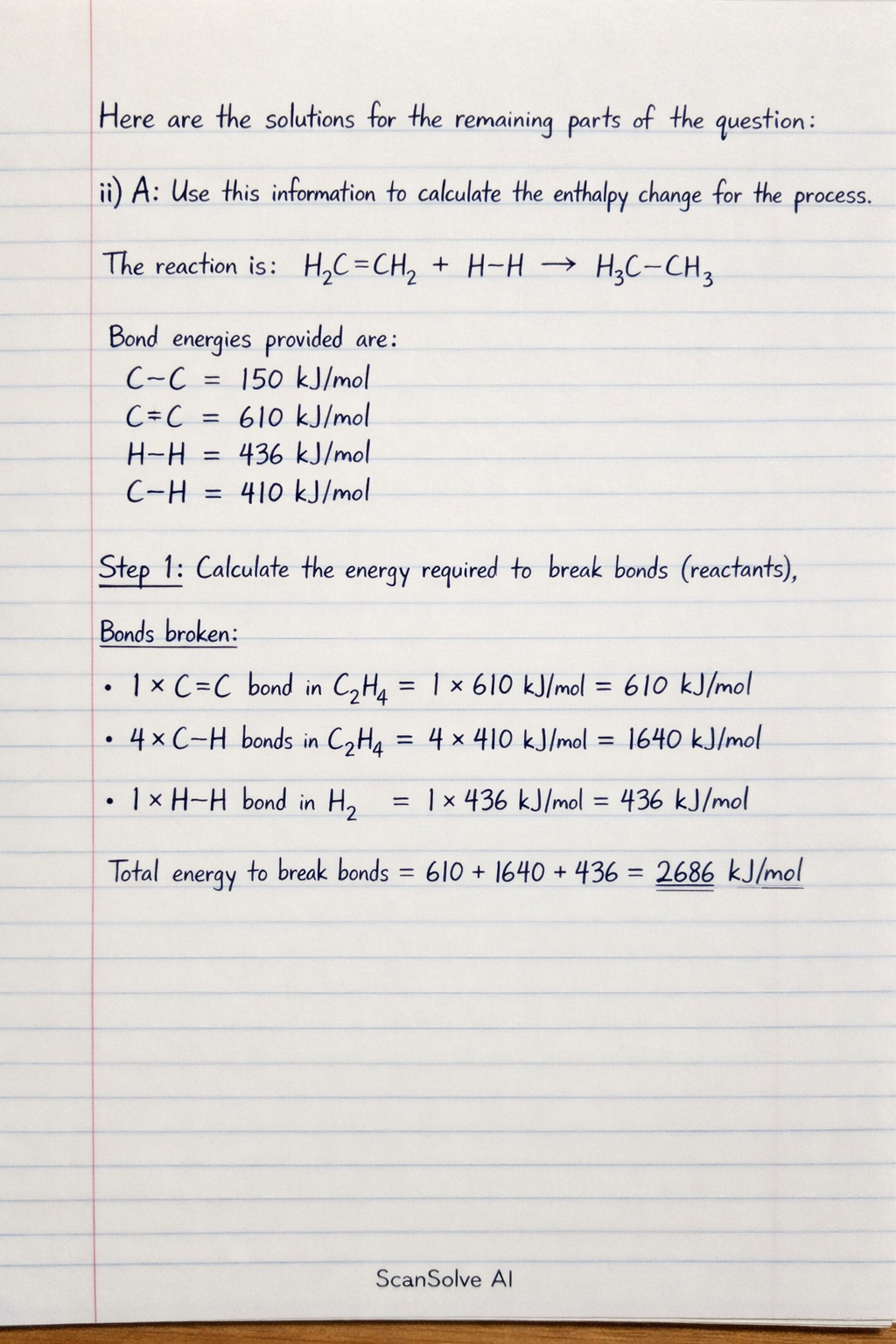
A: Use this information to calculate the enthalpy change for the process
The reaction is .
The bond energies provided are:
Calculate the energy required to break bonds (reactants).
Bonds broken:
- bond in
- bonds in
- bond in Total energy to break bonds =
Calculate the energy released when bonds are formed (products).
Bonds formed:
- bond in
- bonds in Total energy released when bonds form =
Calculate the enthalpy change ().
B: The enthalpy change of this reaction was found by experiment to be . Explain why this value is different from that calculated above.
The calculated enthalpy change uses average bond energies, which are values averaged over many different compounds. The actual bond energies in specific molecules like ethene and ethane can differ from these average values. Additionally, bond energies are typically defined for substances in the gaseous state, and the experimental conditions might not perfectly match this.
Part d
Complete the table below by filling in either the crystal type or example.
| Crystal type | Example |
|---|---|
| Body-centred cubic | Iron (Fe) |
| Hexagonal close packed | Magnesium (Mg) |
| Giant covalent structure | Diamond |
Part e(ii)
Consider the reaction
i) State Le Chatelier's Principle.
Le Chatelier's Principle states that if a change of condition (such as temperature, pressure, or concentration) is applied to a system in equilibrium, the system will shift in a direction that counteracts or relieves the stress, re-establishing a new equilibrium.
How does an increase in temperature affect:
A. The equilibrium constant?
The reaction is endothermic (). An increase in temperature favors the endothermic direction (forward reaction) to absorb the added heat. This leads to a higher concentration of products and a lower concentration of reactants at equilibrium. Therefore, the equilibrium constant will increase.
B. The equilibrium position?
An increase in temperature will shift the equilibrium position to the right, favoring the formation of .
Try one yourself
A new problem that tests the same skill.
Still stuck on this one?
Ask a follow-up, and the answer starts from this question.
More Chemistry Questions
Handwritten Step-by-Step Solution
Get this as a handwritten image on WhatsApp — like a tutor wrote it for you.
Try on WhatsApp