
Equilibrium constant formula give
Chemistry
ScanSolve AI Answer
Answer
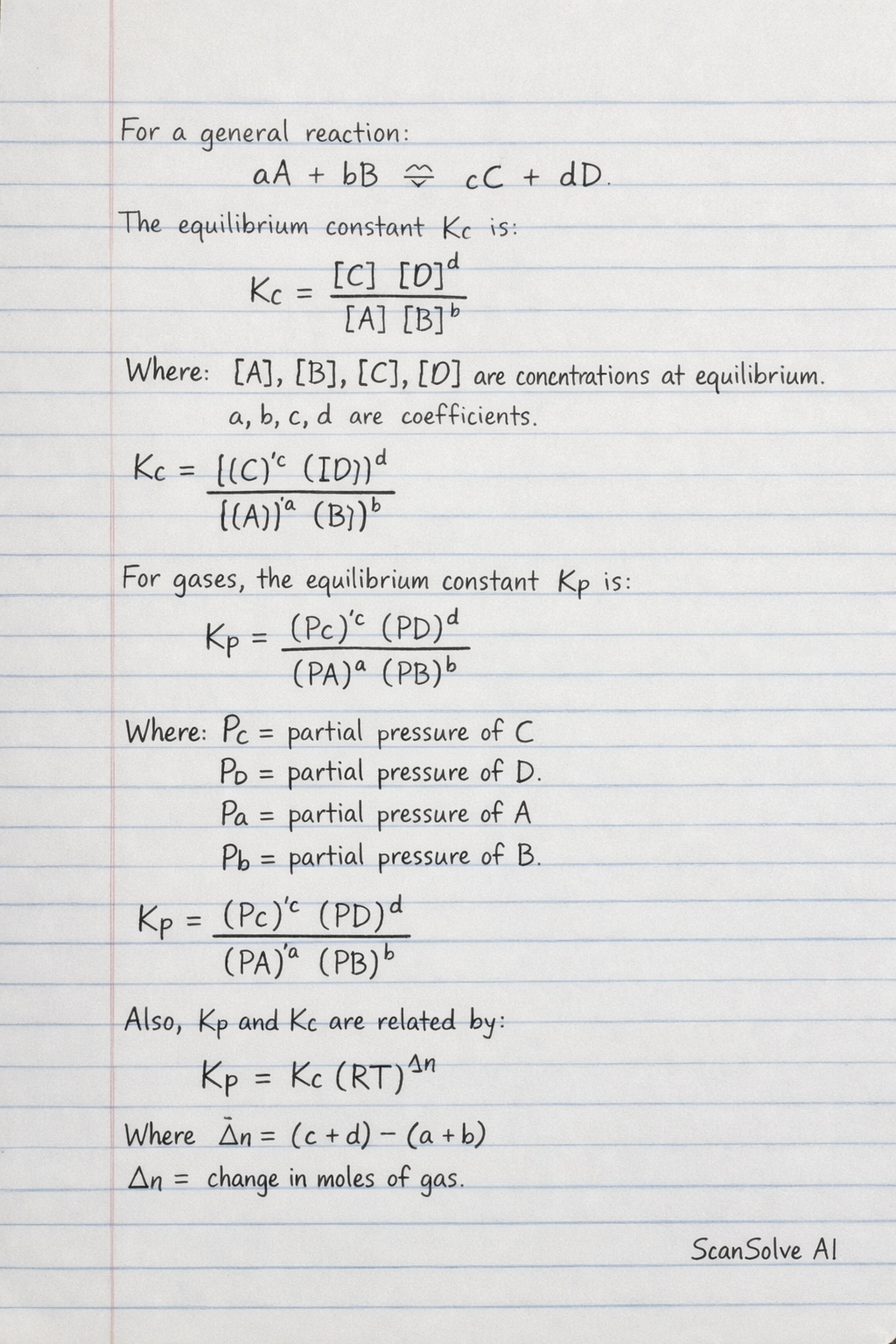
The general formula for the equilibrium constant () for a reversible reaction is derived from the law of mass action.
For a general reversible reaction:
where A, B, C, and D are chemical species, and are their respective stoichiometric coefficients.
The equilibrium constant in terms of molar concentrations () is given by:
where:
- , , , and represent the molar concentrations of the reactants and products at equilibrium.
- The exponents are the stoichiometric coefficients from the balanced chemical equation.
For reactions involving gases, the equilibrium constant can also be expressed in terms of partial pressures ():
where represents the partial pressure of gas X at equilibrium.
Was this helpful?
Still stuck on this one?
Ask a follow-up, and the answer starts from this question.
Got a different question?Ask your own question
More Chemistry Questions
QWrite the equilibrium constant expression (K_c) for the reaction.QWrite the equilibrium constant expression for the following reactions:QWrite the equilibrium constant expressions for the following reactions:QWrite the expression for the equilibrium constant Kp for the given reaction.QThe given equilibrium reaction is:
Handwritten Step-by-Step Solution
Get this as a handwritten image on WhatsApp — like a tutor wrote it for you.
Try on WhatsApp