
We read your photo as:
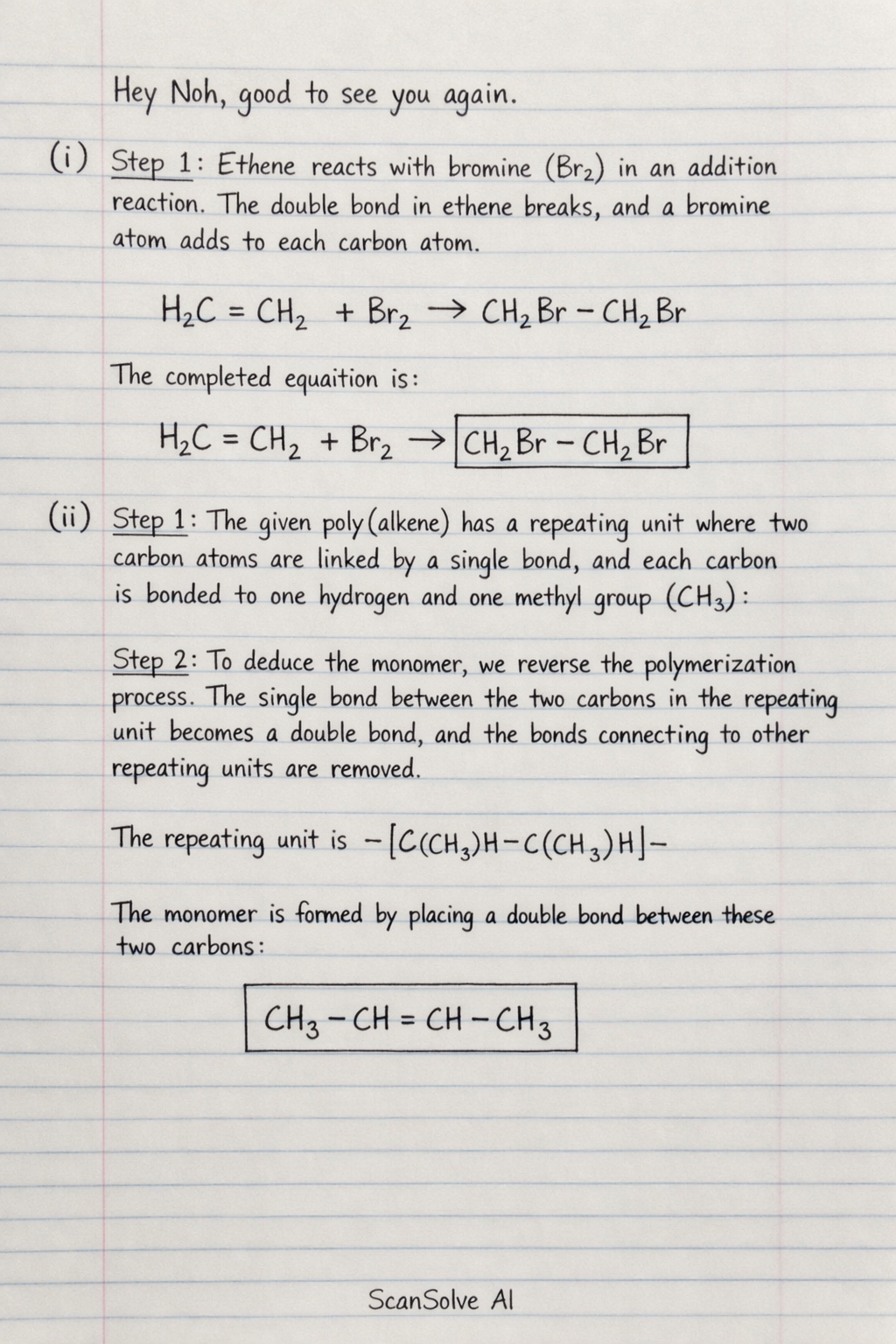
Ethene reacts with bromine (B2) in an addition reaction. The double bond in ethene breaks, and a bromine atom adds to each carbon atom.
ScanSolve AI Answer
Answers
4 partsStep-by-step solution
7 stepsPart i· 1 step
Ethene reacts with bromine () in an addition reaction.
The double bond in ethene breaks, and a bromine atom adds to each carbon atom.
The completed equation is:
Part ii
The given poly(alkene) has a repeating unit where two carbon atoms are linked by a single bond, and each carbon is bonded to one hydrogen and one methyl group ().
To deduce the monomer, we reverse the polymerization process.
The single bond between the two carbons in the repeating unit becomes a double bond, and the bonds connecting to other repeating units are removed.
The repeating unit is .
The monomer is formed by placing a double bond between these two carbons:
Part iii
Butanol (an alcohol) can be made from butene (an alkene) through a hydration reaction, which is the addition of water across the double bond.
This reaction typically requires a catalyst such as concentrated sulfuric acid or phosphoric acid and heat.
For but-1-ene (), the addition of water () will primarily form butan-2-ol.
Part iv
An alkene can be converted into an alkane through a hydrogenation reaction.
This involves the addition of hydrogen gas () across the carbon-carbon double bond.
This reaction requires a catalyst, typically nickel (Ni), platinum (Pt), or palladium (Pd), and heat.
The double bond breaks, and a hydrogen atom adds to each carbon atom, forming a single bond.
Using ethene as an example:
Try one yourself
A new problem that tests the same skill.
Still stuck on this one?
Ask a follow-up, and the answer starts from this question.
More Chemistry Questions
Handwritten Step-by-Step Solution
Get this as a handwritten image on WhatsApp — like a tutor wrote it for you.
Try on WhatsApp