
We read your photo as:
Explain evaporation vs. boiling, the effect of impurities on boiling point, and the effect of altitude on boiling point.
ScanSolve AI Answer
-
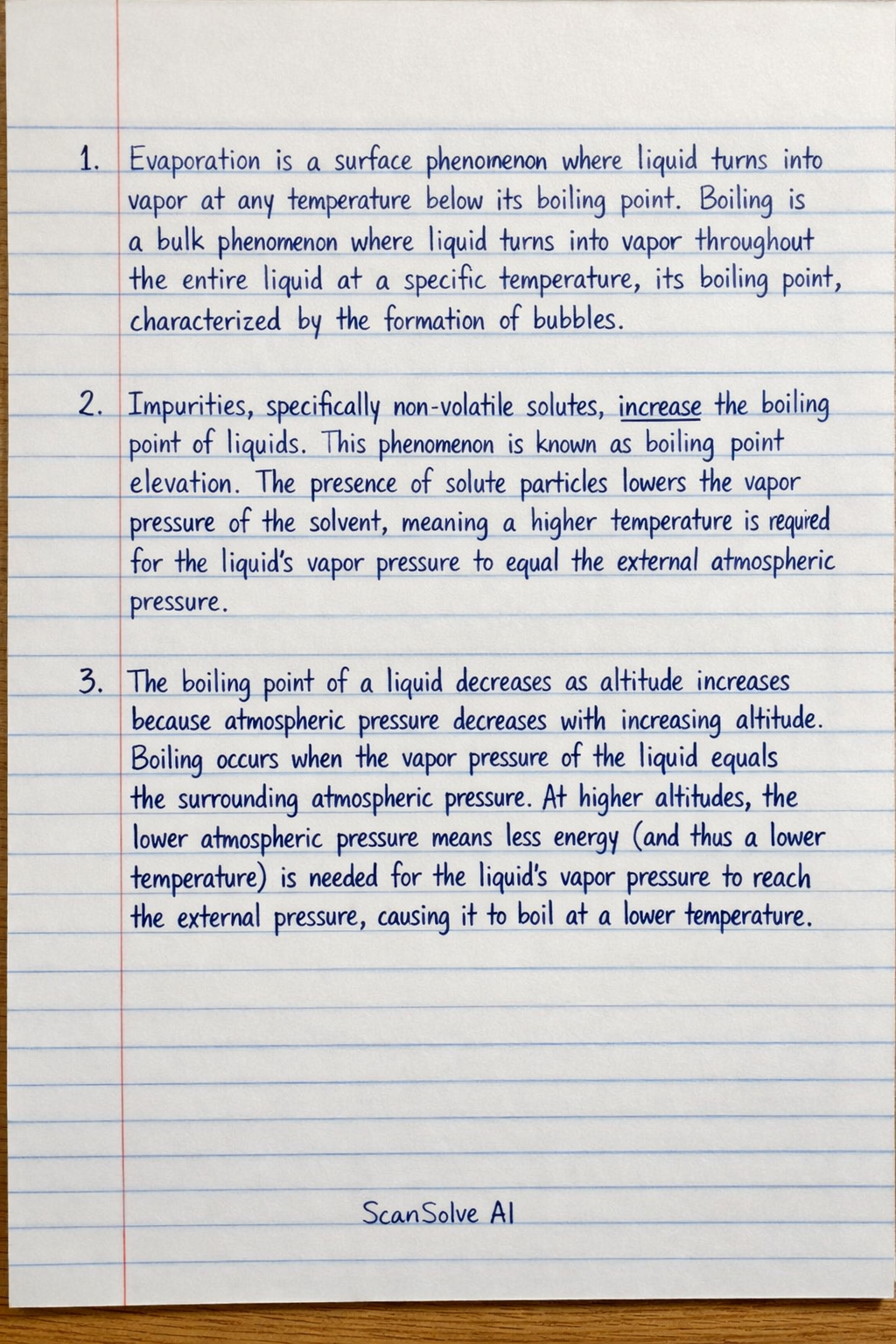
Evaporation is a surface phenomenon where liquid turns into vapor at any temperature below its boiling point. Boiling is a bulk phenomenon where liquid turns into vapor throughout the entire liquid at a specific temperature, its boiling point, characterized by the formation of bubbles.
-
Impurities, specifically non-volatile solutes, increase the boiling point of liquids. This phenomenon is known as boiling point elevation. The presence of solute particles lowers the vapor pressure of the solvent, meaning a higher temperature is required for the liquid's vapor pressure to equal the external atmospheric pressure.
-
The boiling point of a liquid decreases as altitude increases because atmospheric pressure decreases with increasing altitude. Boiling occurs when the vapor pressure of the liquid equals the surrounding atmospheric pressure. At higher altitudes, the lower atmospheric pressure means less energy (and thus a lower temperature) is needed for the liquid's vapor pressure to reach the external pressure, causing it to boil at a lower temperature.
Still stuck on this one?
Ask a follow-up, and the answer starts from this question.
More Chemistry Questions
Handwritten Step-by-Step Solution
Get this as a handwritten image on WhatsApp — like a tutor wrote it for you.
Try on WhatsApp