
We read your photo as:
Explain the Flame Test, including how it works, why chlorides are used, and how to overcome the problem of color masking.
Chemistry
ScanSolve AI Answer
Okay, عبمان, let's break down the Flame Test into an easy explanation.
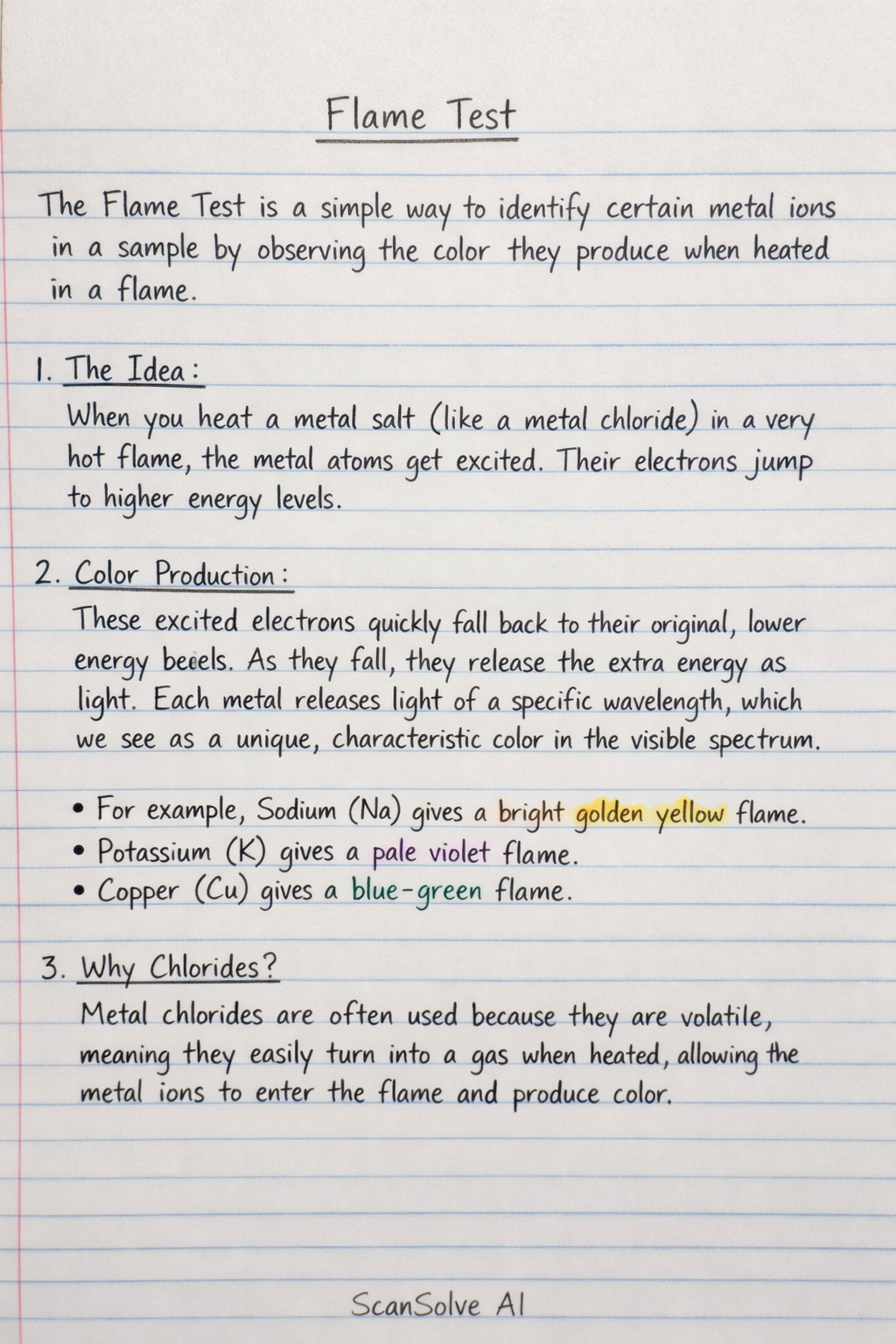
Flame Test
The Flame Test is a simple way to identify certain metal ions (also called basic radicals) in a sample by observing the color they produce when heated in a flame.
Here's how it works:
- The Idea: When you heat a metal salt (like a metal chloride) in a very hot flame, the metal atoms get excited. Their electrons jump to higher energy levels.
- Color Production: These excited electrons quickly fall back to their original, lower energy levels. As they fall, they release the extra energy as light. Each metal releases light of a specific wavelength, which we see as a unique, characteristic color in the visible spectrum.
- For example, sodium (Na) gives a bright golden yellow flame, potassium (K) gives a pale violet flame, and copper (Cu) gives a blue-green flame.
- Why Chlorides? Metal chlorides are often used because they are volatile, meaning they easily turn into a gas when heated, allowing the metal ions to enter the flame and produce color.
- The Problem (Masking): Sometimes, one strong color can hide a weaker one. For instance, the very bright yellow flame from even a tiny amount of sodium can completely hide the pale violet flame of potassium if both are present.
- The Solution (Cobalt Blue Glass): To see the potassium flame when sodium is also present, you can look through a piece of cobalt blue glass. This special glass absorbs the strong yellow light from sodium but allows the pale violet light from potassium to pass through, making it visible.
- The Tool (Platinum Wire): A platinum wire is used to hold the sample in the flame. Platinum is chosen because it's a noble metal, meaning it doesn't react with the salts or the high temperature, and it doesn't add any color to the flame itself.
Was this helpful?
Still stuck on this one?
Ask a follow-up, and the answer starts from this question.
Got a different question?Ask your own question
More Chemistry Questions
QDescribe the principle and procedure of the flame test.QEvaluate your self 🧪 Flame Test MCQs (1–10) Q1. The yellow color in flame test is characteristic…QWhat is the purpose of blue glass in a flame test and why is a platinum wire used?QExplain why borax beads produce different colors with certain basic radicals under oxidizing and…QWhile carrying out a flame test on a compound W, a bluish flame is observed and on heating W, the…
Handwritten Step-by-Step Solution
Get this as a handwritten image on WhatsApp — like a tutor wrote it for you.
Try on WhatsApp