
We read your photo as:
Explain why borax beads produce different colors with certain basic radicals under oxidizing and reducing flame conditions.
ScanSolve AI Answer
Step-by-step solution
4 stepscertain basic radicals, particularly those of transition metals, produce two different colored beads with borax because their metal ions can exist in different oxidation states, and these states are favored under different flame conditions (oxidizing vs. reducing).
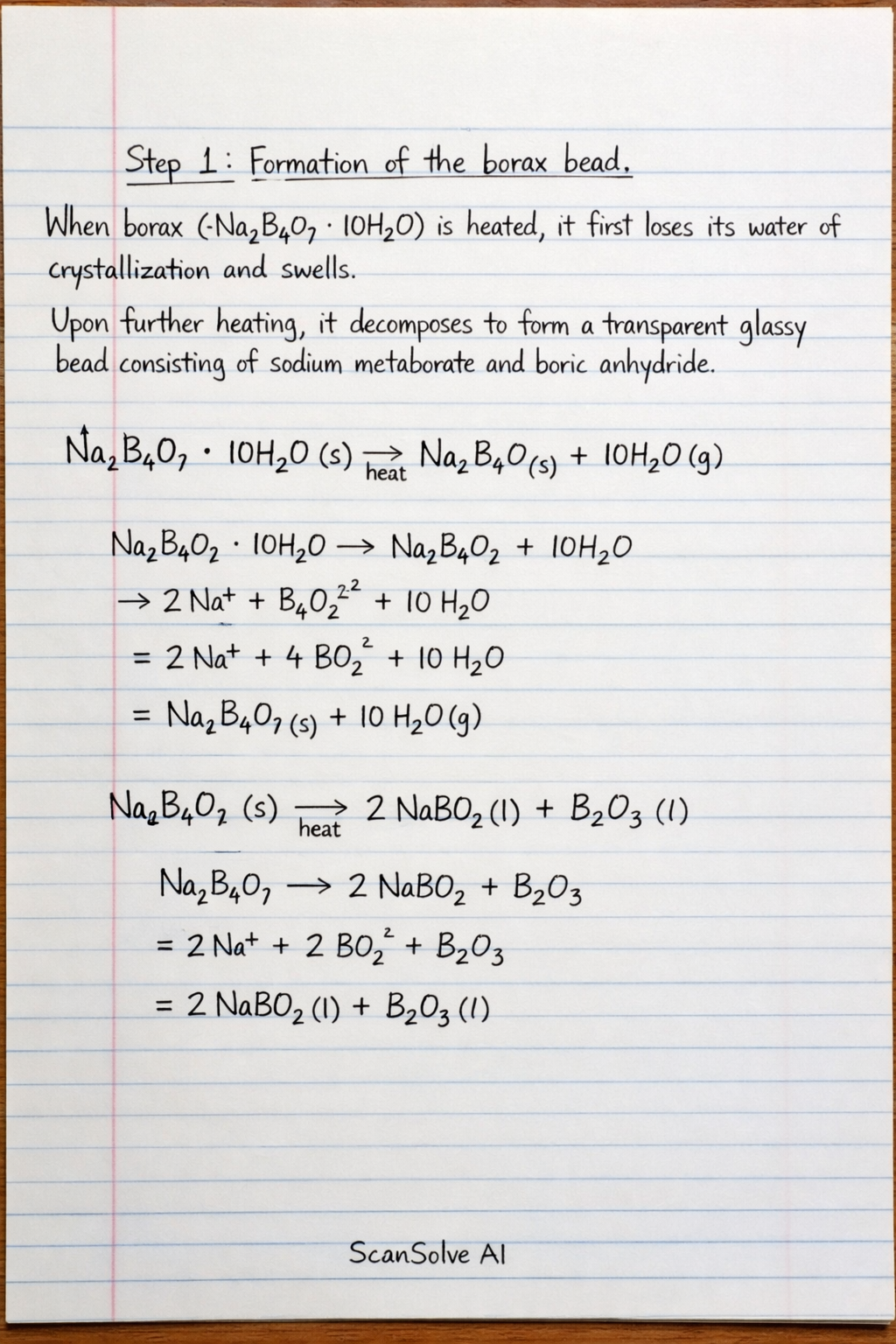
Formation of the borax bead.
When borax () is heated, it first loses its water of crystallization and swells. Upon further heating, it decomposes to form a transparent glassy bead consisting of sodium metaborate and boric anhydride.
Reaction with metal oxide.
When a metal salt is introduced into the bead and heated, the metal oxide (formed from the decomposition of the salt) reacts with the boric anhydride () to form a colored metal metaborate. For example, with copper(II) oxide:
Color in an oxidizing flame.
In the outer, oxidizing flame, the metal ion is typically in its higher oxidation state. For copper, this is , which forms copper(II) metaborate. This compound gives a characteristic blue color when hot and cold.
Color in a reducing flame.
In the inner, reducing flame (rich in carbon monoxide), the higher oxidation state metal ion is reduced to a lower oxidation state. For copper, is reduced to (copper(I)) or even to metallic copper. Copper(I) metaborate () is typically green, and elemental copper appears opaque red.
This change in oxidation state, driven by the flame conditions, results in two different colored beads for the same basic radical.
Still stuck on this one?
Ask a follow-up, and the answer starts from this question.
More Chemistry Questions
Handwritten Step-by-Step Solution
Get this as a handwritten image on WhatsApp — like a tutor wrote it for you.
Try on WhatsApp