
We read your photo as:
Explain why certain basic radicals produce two different colored beads with borax and provide examples.
ScanSolve AI Answer
This answer stops before the end.
It was cut off when it was first written. Ask ScanSolve this question again for the full working.
here are the answers to your questions:
- Certain basic radicals produce two different types of colored beads with borax due to the formation of different metal metaborates, which can have varying colors depending on the oxidation state of the metal ion and the flame conditions (oxidizing or reducing). The color can also differ when the bead is hot versus cold.
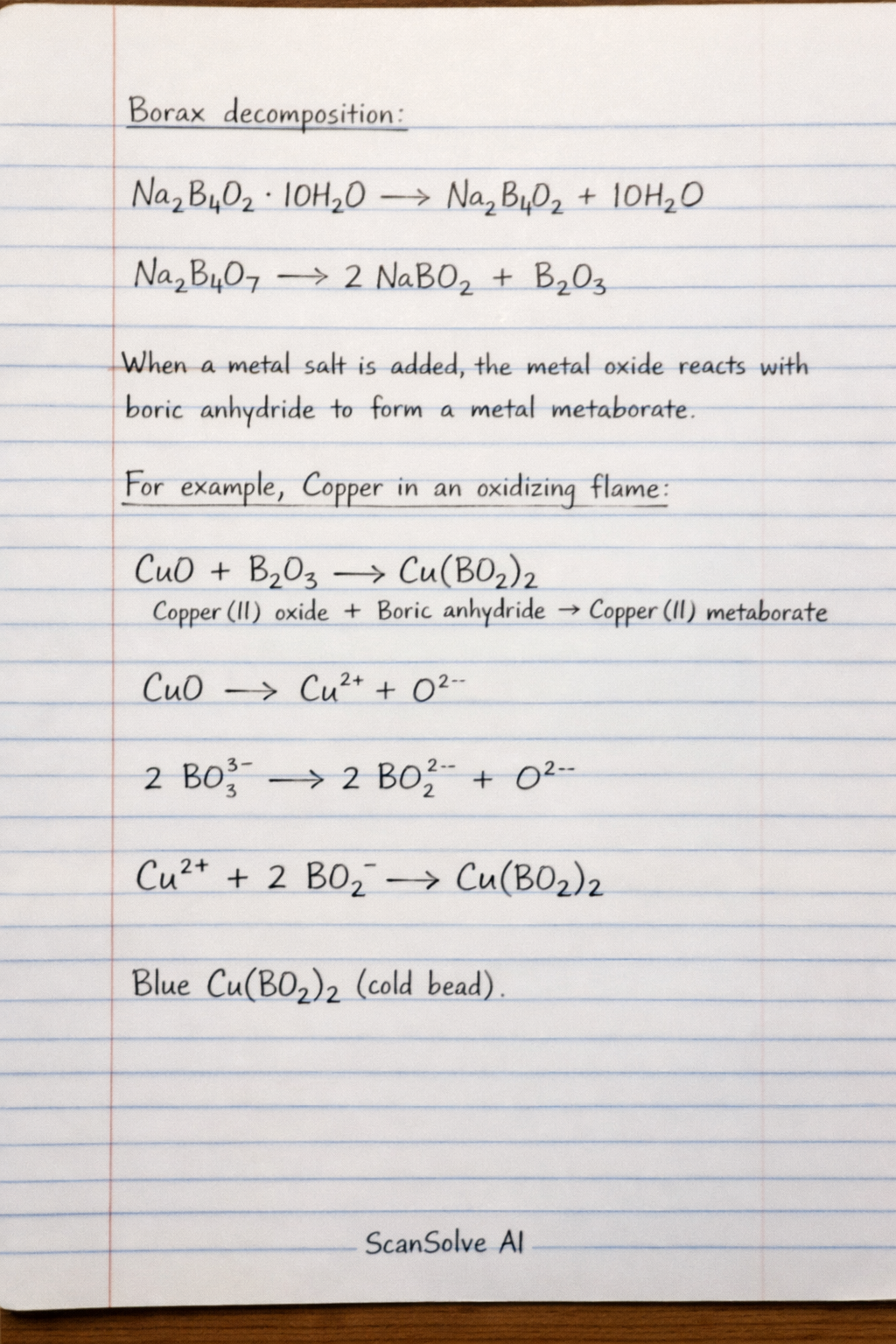
First, borax () loses water and decomposes upon heating to form sodium metaborate and boric anhydride:
When a metal salt is introduced, the metal oxide reacts with boric anhydride to form a colored metal metaborate. For example, copper:
In an oxidizing flame, copper(II) oxide forms copper(II) metaborate, which is blue when cold:
In a reducing flame, copper(II) metaborate is reduced to copper(I) metaborate, which is opaque reddish-brown when cold:
The different oxidation states ( vs. ) result in distinct colors.
a) Sodium pyroborate: (often hydrated as or )
b) Fusion mixture: (a mixture of sodium carbonate and potassium carbonate)
- Sodium pyroborate () is used in the borax bead test to analyze by forming characteristic colored beads.
Step 1: Borax loses water and decomposes upon heating to form sodium metaborate and boric anhydride.
Step 2: When is heated, it decomposes to form copper(II) oxide.
Step 3: The copper(II) oxide then reacts with the boric anhydride () to form copper(II) metaborate.
In an oxidizing flame, the bead is blue when cold:
In a reducing flame, the copper(II) metaborate is reduced to copper(I) metaborate, which is opaque reddish-brown when cold:
The distinct colors confirm the presence of copper.
- To test for the presence of in a mixture containing carbonates and sulfides salts reacting with dilute :
Step 1: The mixture of salts reacts with dilute to produce both and gases.
Step 2: Pass the evolved gas mixture through an acidified solution of potassium dichromate () or lead acetate solution. The gas will react and be removed, while will pass through.
(Orange dichromate turns green due to formation)
Alternatively:
(Lead acetate paper turns black due to formation)
Step 3: Pass the remaining gas through limewater ( solution). If is present, the limewater will turn milky.
- Chemical tests to identify the following gases:
-
Carbon dioxide (): Pass the gas through limewater (calcium hydroxide solution). It turns milky due to the formation of insoluble calcium carbonate.
-
Ammonia (): Bring a glass rod dipped in concentrated hydrochloric acid near the gas. Dense white fumes of ammonium chloride will be formed.
Alternatively, expose red litmus paper to the gas. It will turn blue as ammonia is alkaline.
-
Hydrogen sulfide (): Pass the gas through lead acetate solution or hold a piece of filter paper moistened with lead acetate solution in the gas. The paper will turn black due to the formation of lead(II) sulfide.
- The caustic soda test involves adding sodium hydroxide (, commonly known as caustic soda) solution to a solution of a metal salt to identify the metal cation. It relies on the formation of characteristic precipitates and their solubility in excess . For example, most transition metal ions form colored hydroxide precipitates that are insoluble in excess (e.g., gives a dirty green precipitate of , gives a blue precipitate of ). However, amphoteric metal hydroxides like aluminum, zinc, and lead hydroxides initially form precipitates that then redissolve in excess to form soluble complex ions.
-
Preliminary tests, even those based solely on physical appearance, are crucial in qualitative analysis because they provide initial, non-conclusive but highly informative clues about the possible presence of certain acid and basic radicals. For instance, the color of a salt can immediately suggest the presence of specific metal ions: a blue salt often indicates ions, a pale green salt might suggest or , and a yellow or brown salt could indicate ions. Similarly, a distinct smell, like the vinegar-like odor of acetates when heated with acid, or the rotten-egg smell of sulfides upon acidification, provides strong indications. While these observations are not definitive proof, they significantly narrow down the possibilities, guiding subsequent, more specific chemical tests and making the overall analysis more efficient.
-
To identify the acid radicals ( and ) in a salt mixture containing and when treated with dilute :
Step 1: Add dilute to the salt mixture. Both carbonates and sulfites will react to produce gases.
Still stuck on this one?
Ask a follow-up, and the answer starts from this question.
More Chemistry Questions
Handwritten Step-by-Step Solution
Get this as a handwritten image on WhatsApp — like a tutor wrote it for you.
Try on WhatsApp