
We read your photo as:
Identify the strongest oxidizing and reducing agents from the given standard electrode potentials and explain the deviation of benzene-ethanol mixtures from Raoult's Law.
ScanSolve AI Answer
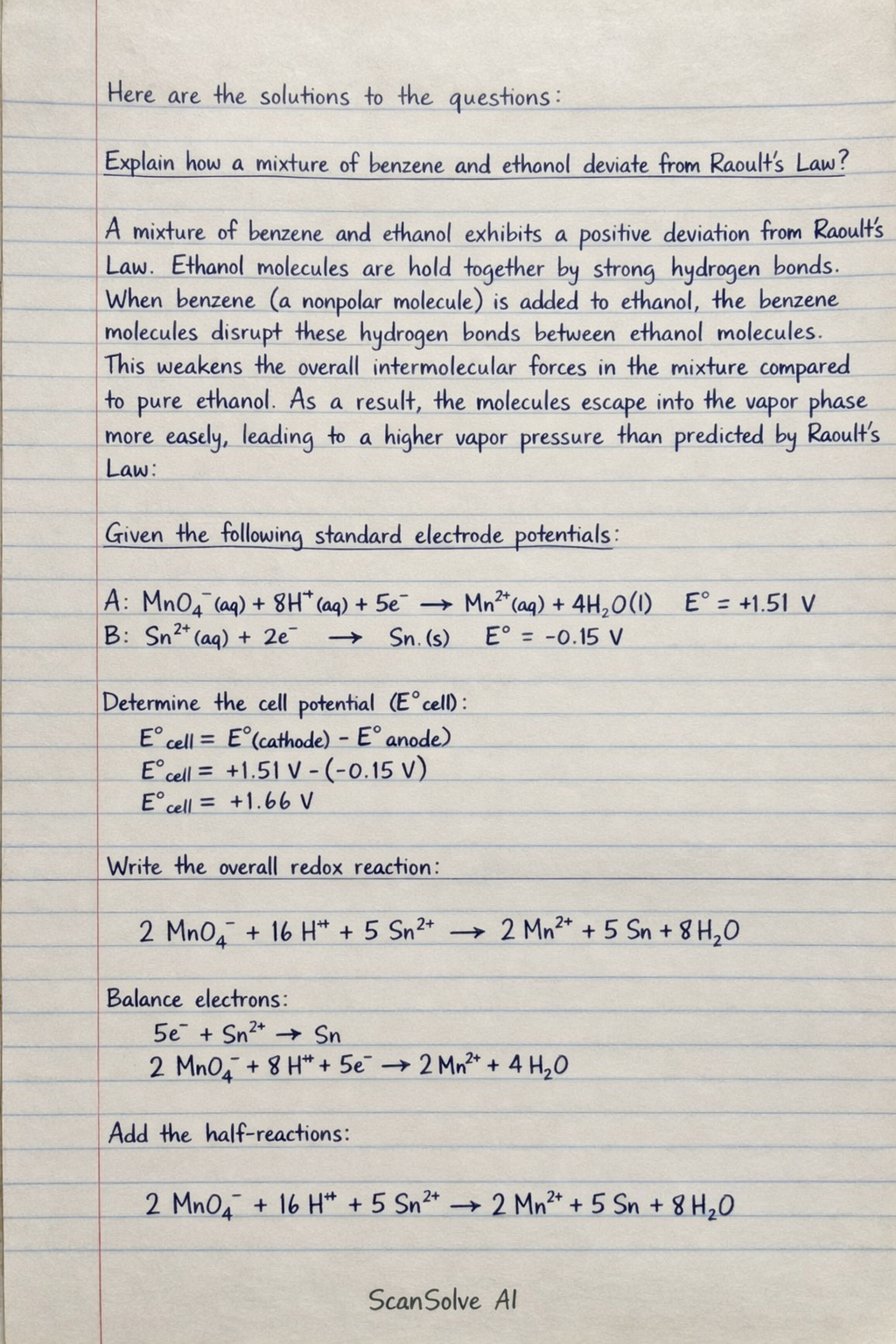
Here are the solutions to the questions:
Explain how a mixture of benzene and ethanol deviate from Raoult's Law?
A mixture of benzene and ethanol exhibits a positive deviation from Raoult's Law. Ethanol molecules are held together by strong hydrogen bonds. When benzene (a nonpolar molecule) is added to ethanol, the benzene molecules disrupt these hydrogen bonds between ethanol molecules. This weakens the overall intermolecular forces in the mixture compared to pure ethanol. As a result, the molecules escape into the vapor phase more easily, leading to a higher vapor pressure than predicted by Raoult's Law.
Given the following standard electrode potentials:
A: ;
B: ;
-
(i) Identify the species which is the strongest
- A: oxidising agent: The strongest oxidising agent is the species that is most easily reduced (has the most positive standard reduction potential).
- Strongest oxidising agent:
- B: reducing agent: The strongest reducing agent is the species that is most easily oxidised (is the reduced form of the half-reaction with the most negative standard reduction potential).
- Strongest reducing agent:
- A: oxidising agent: The strongest oxidising agent is the species that is most easily reduced (has the most positive standard reduction potential).
-
(ii) A cell is constructed by coupling the electrode systems A and B. Write down the cell diagram and calculate the e.m.f. of the cell.
- Identify Anode and Cathode:
- System A has a more positive (), so it will be reduced (cathode).
- System B has a more negative (), so it will be oxidised (anode).
- Cell e.m.f. ():
- Cell Diagram: The anode reaction is $\text{Sn(s)} \to Sn^{2+}(aq) + 2e^-
- Identify Anode and Cathode:
Still stuck on this one?
Ask a follow-up, and the answer starts from this question.
More Chemistry Questions
Handwritten Step-by-Step Solution
Get this as a handwritten image on WhatsApp — like a tutor wrote it for you.
Try on WhatsApp