
We read your photo as:
Explain why noble gases are so called and their general characteristics. Outline the steps to produce Boron.
ScanSolve AI Answer
Step-by-step solution
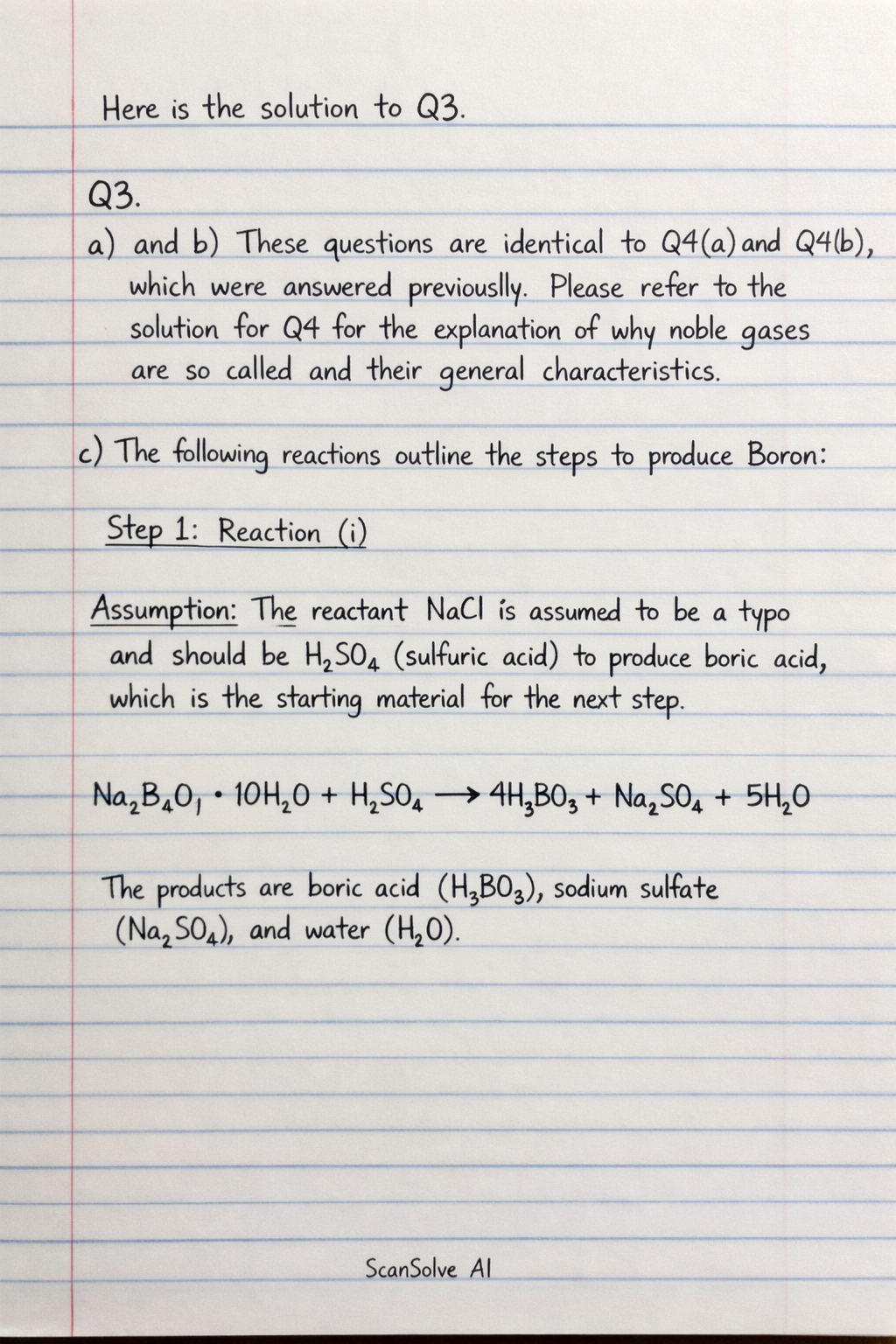
3 stepsHere is the solution to Q3.
Q3.
a) and b) These questions are identical to Q4(a) and Q4(b), which were answered previously. Please refer to the solution for Q4 for the explanation of why noble gases are so called and their general characteristics.
c) The following reactions outline the steps to produce Boron:
Reaction (i)
Assumption: The reactant is assumed to be a typo and should be (sulfuric acid) to produce boric acid, which is the starting material for the next step.
The products are boric acid (), sodium sulfate (), and water ().
Reaction (ii)
Boric acid dehydrates upon strong heating to form boron trioxide.
The products are boron trioxide () and water ().
Reaction (iii)
Boron trioxide is reduced by magnesium to produce elemental boron.
The products are elemental boron () and magnesium oxide ().
Still stuck on this one?
Ask a follow-up, and the answer starts from this question.
More Chemistry Questions
Handwritten Step-by-Step Solution
Get this as a handwritten image on WhatsApp — like a tutor wrote it for you.
Try on WhatsApp