

This chemistry question involves key chemical concepts and calculations. The detailed solution below walks through each step, from identifying the reaction type to computing the final answer.
ScanSolve AI Answer
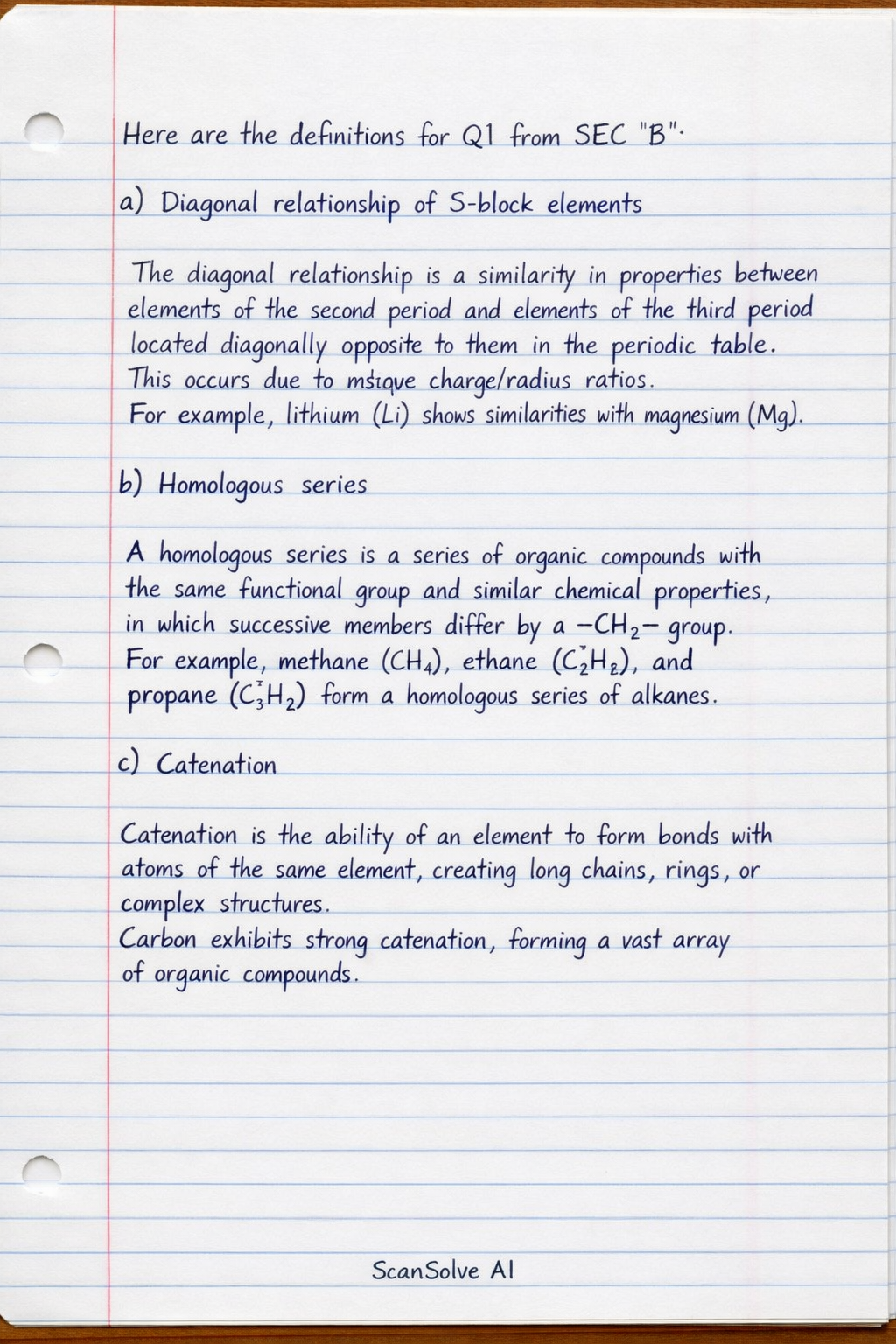
Here are the definitions for Q1 from SEC "B": a) Diagonal relationship of S-block elements The diagonal relationship is a similarity in properties between elements of the second period and elements of the third period located diagonally opposite to them in the periodic table. This occurs due to similar charge/radius ratios. For example, lithium (Li) shows similarities with magnesium (Mg). b) Homologous series A homologous series is a series of organic compounds with the same functional group and similar chemical properties, in which successive members differ by a -CH_2- group. For example, methane (CH_4), ethane (C_2H_6), and propane (C_3H_8) form a homologous series of alkanes. c) Catenation Catenation is the ability of an element to form bonds with atoms of the same element, creating long chains, rings, or complex structures. Carbon exhibits strong catenation, forming a vast array of organic compounds. d) Functional group A functional group is a specific group of atoms within a molecule that is responsible for the characteristic chemical reactions of that molecule. Examples include the hydroxyl group (-OH) in alcohols and the carboxyl group (-COOH) in carboxylic acids. e) Reforming of petrochemical Reforming in petrochemicals is a catalytic process used to convert low-octane straight-chain hydrocarbons (naphtha) into high-octane branched-chain and aromatic hydrocarbons. This process improves the quality of gasoline. f) Saponification Saponification is the hydrolysis of an ester (typically a triglyceride, which is a fat or oil) with a strong base (like NaOH or KOH) to produce a carboxylic acid salt (soap) and an alcohol (glycerol). Ester + Base Soap + Alcohol g) Flame test A flame test is an analytical procedure used in chemistry to detect the presence of certain metal ions based on the characteristic color they emit when heated in a hot flame. Different metal ions produce distinct colors due to the excitation and subsequent de-excitation of their electrons. Send me the next one 📸