

This chemistry question involves key chemical concepts and calculations. The detailed solution below walks through each step, from identifying the reaction type to computing the final answer.
ScanSolve AI Answer
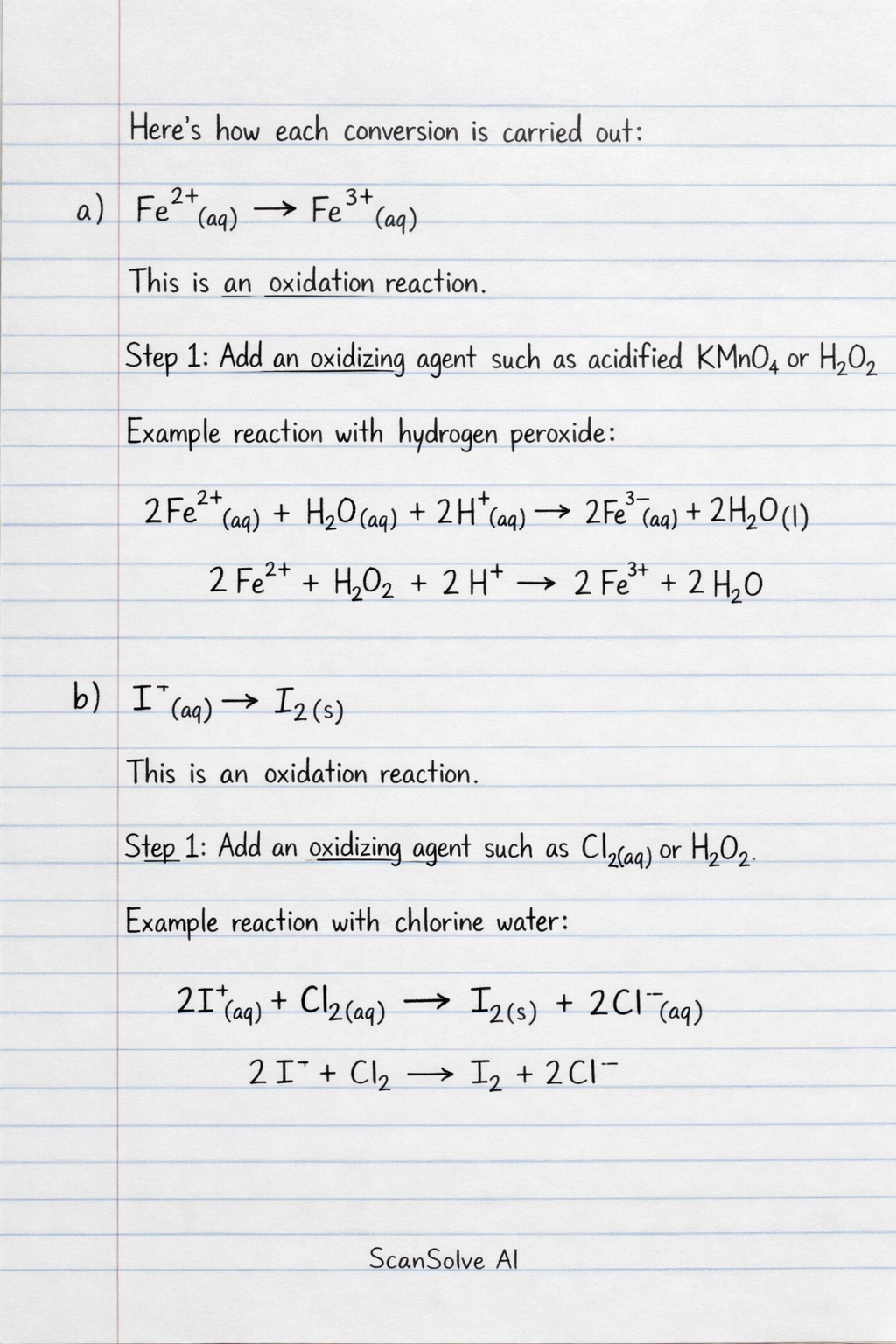
Here's how each conversion is carried out: a) Fe^2+_(aq) Fe^3+_(aq) This is an oxidation reaction. Step 1: Add an oxidizing agent such as acidified potassium permanganate (KMnO_4) or hydrogen peroxide (H_2O_2). Example reaction with hydrogen peroxide: 2Fe^2+(aq) + H_2O_2(aq) + 2H^+(aq) 2Fe^3+(aq) + 2H_2O(l) b) I^-_(aq) I_2(s) This is an oxidation reaction. Step 1: Add an oxidizing agent such as chlorine water (Cl_2(aq)) or hydrogen peroxide (H_2O_2). Example reaction with chlorine water: 2I^-(aq) + Cl_2(aq) I_2(s) + 2Cl^-(aq) c) C_2H_4 C_2H_6 This is a hydrogenation (addition) reaction. Step 1: React ethene (C_2H_4) with hydrogen gas (H_2). Step 2: Heat the mixture in the presence of a nickel catalyst (e.g., at 150-200°C). C_2H_4(g) + H_2(g) Ni catalyst, heat C_2H_6(g) d) C_2H_5OH C_2H_6 This conversion involves two steps: Step 1: Dehydration of ethanol to ethene. • Heat ethanol (C_2H_5OH) with concentrated sulfuric acid (H_2SO_4) at 170°C. C_2H_5OH(l) conc. H_2SO_4, 170^ C_2H_4(g) + H_2O(l) Step 2: Hydrogenation of ethene to ethane. • React the ethene (C_2H_4) produced with hydrogen gas (H_2). • Heat the mixture in the presence of a nickel catalyst (e.g., at 150-200°C). C_2H_4(g) + H_2(g) Ni catalyst, heat C_2H_6(g)