

This chemistry question involves key chemical concepts and calculations. The detailed solution below walks through each step, from identifying the reaction type to computing the final answer.
ScanSolve AI Answer
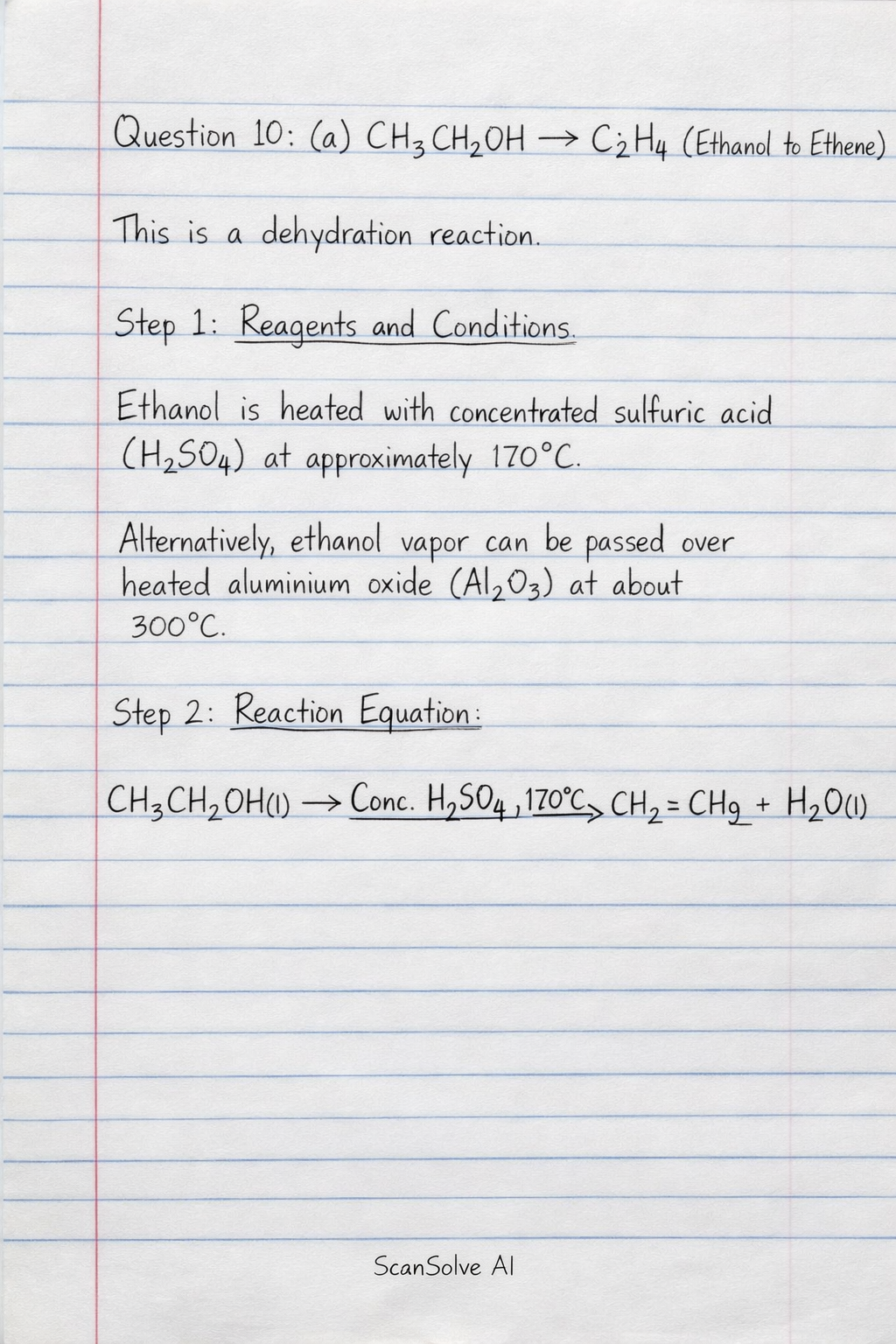
Right webasolange, let's go. Here are the descriptions for each conversion: Question 10: a) CH_3CH_2OH → C_2H_4 (Ethanol to Ethene) This is a dehydration reaction. Step 1: Reagents and Conditions Ethanol is heated with concentrated sulfuric acid (H_2SO_4) at approximately 170^. Alternatively, ethanol vapor can be passed over heated aluminium oxide (Al_2O_3) at about 300^. Step 2: Reaction Equation CH_3CH_2OH(l) Conc. H_2SO_4, 170^ CH_2=CH_2(g) + H_2O(l) b) CH_3Cl → CH_3CH_2OH (Chloromethane to Ethanol) There appears to be a typo in the question, as converting chloromethane (CH_3Cl) directly to ethanol (CH_3CH_2OH) involves chain lengthening, which is a more complex multi-step synthesis. Assuming the intention was a simple nucleophilic substitution to form an alcohol, there are two common interpretations: 1. If the starting material is strictly chloromethane (CH_3Cl), the product would be methanol (CH_3OH). 2. If the product is ethanol (CH_3CH_2OH), the starting material should be chloroethane (CH_3CH_2Cl). We will proceed with the more common conversion of a chloroalkane to an alcohol via nucleophilic substitution, assuming the question intended to show chloroethane converting to ethanol. Step 1: Reagents and Conditions Chloroethane is heated under reflux with an aqueous solution of a strong base, such as potassium hydroxide (KOH(aq)) or sodium hydroxide (NaOH(aq)). Step 2: Reaction Equation CH_3CH_2Cl(l) + KOH(aq) reflux CH_3CH_2OH(l) + KCl(aq) Ionic equation: CH_3CH_2Cl(l) + OH^-(aq) reflux CH_3CH_2OH(l) + Cl^-(aq) c) Fe → Fe^2+ + H_2O with dilute acid (Iron to Iron(II) ions) The question states H_2O as a product, but when iron reacts with dilute acid, hydrogen gas (H_2) is produced, not water. Water is typically the solvent. We will describe the reaction of iron with dilute acid to form iron(II) ions and hydrogen gas. Step 1: Reagents and Conditions Iron metal is reacted with a dilute acid, such as dilute hydrochloric acid (HCl(aq)) or dilute sulfuric acid (H_2SO_4(aq)), at room temperature. Step 2: Reaction Equation Fe(s) + 2HCl(aq) → FeCl_2(aq) + H_2(g) Ionic equation: Fe(s) + 2H^+(aq) → Fe^2+(aq) + H_2(g) d) Br^- → Br_2 (Bromide ion to Bromine) This is an oxidation reaction. Step 1: Reagents and Conditions Bromide ions are oxidized by a stronger oxidizing agent. A common reagent is chlorine water (Cl_2(aq)), which is a stronger oxidizing agent than bromine. The reaction occurs at room temperature. Step 2: Reaction Equation 2Br^-(aq) + Cl_2(aq) → Br_2(aq) + 2Cl^-(aq) What's next? Send 'em over!