
We read your photo as:
Describe the reactions of chloroethane shown in the image.
ScanSolve AI Answer
Step-by-step solution
11 stepsHere is a detailed breakdown of the synthetic route shown in the image:
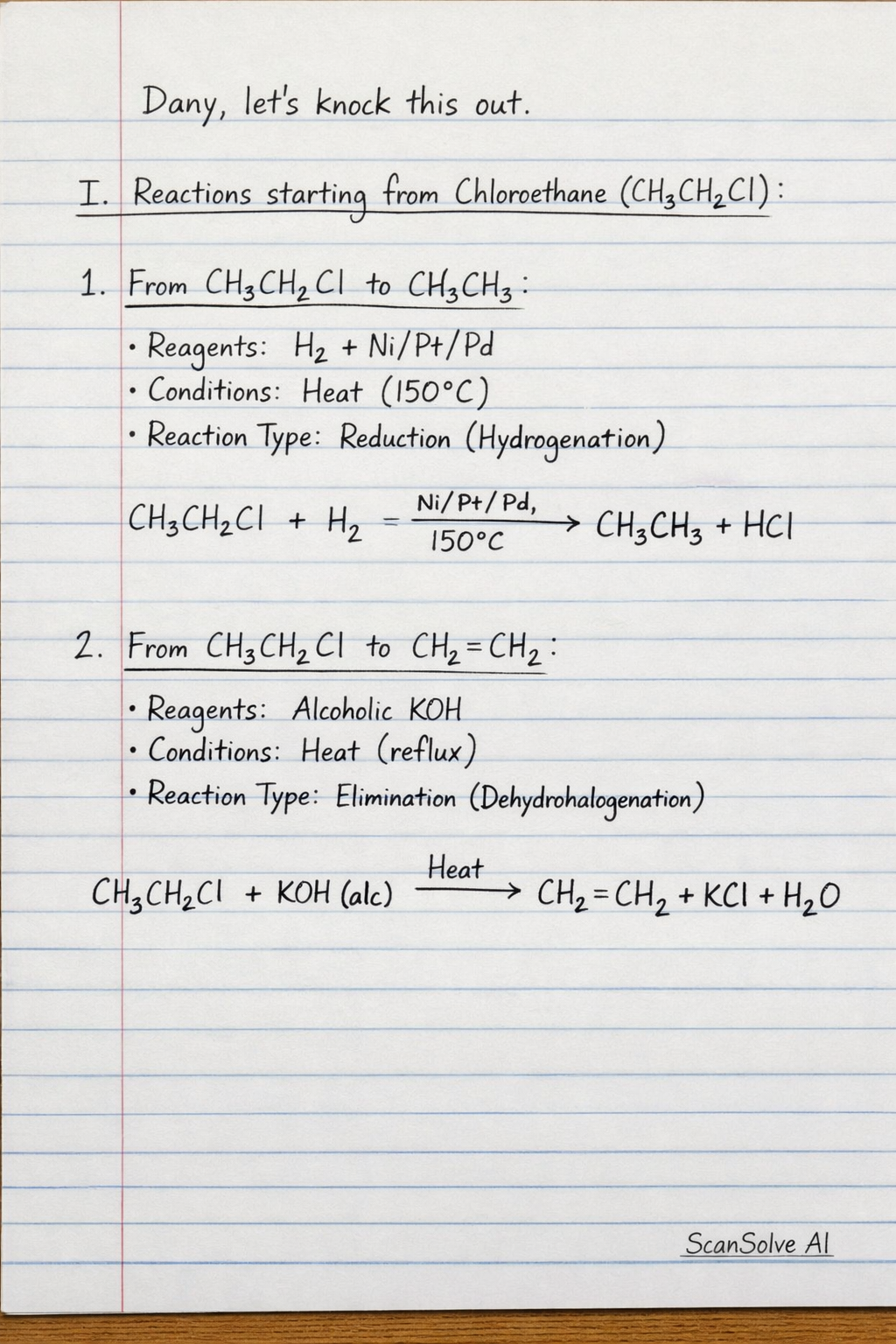
I. Reactions starting from Chloroethane ():
From Chloroethane () to Ethane ()
- Reagents: with a catalyst (e.g., , , or )
- Conditions: Heat (e.g., 150°C)
- Reaction Type: Reduction (Hydrogenation/Hydrogenolysis)
- Equation:
From Chloroethane () to Ethene ()
- Reagents: Alcoholic KOH
- Conditions: Heat (reflux)
- Reaction Type: Elimination (Dehydrohalogenation)
- Equation:
From Chloroethane () to Ethanol ()
- Reagents: Aqueous KOH
- Conditions: Heat (reflux)
- Reaction Type: Nucleophilic Substitution
- Equation:
II. Reactions starting from Ethanol ():
From Ethanol () to Ethene ()
- Reagents: Concentrated or
- Conditions: Heat (170°C for , 350°C for )
- Reaction Type: Dehydration (Elimination)
- Equation (using ):
From Ethanol () to Ethanoic Acid ()
- Reagents: Acidified potassium permanganate () or acidified potassium dichromate ()
- Conditions: Heat (reflux)
- Reaction Type: Oxidation
- Equation (using ):
From Ethanol () to Chloroethane ()
- Reagents: HCl (often with anhydrous as a catalyst, Lucas reagent) or or
- Conditions: Heat (if using HCl)
- Reaction Type: Nucleophilic Substitution
- Equation (using HCl):
III. Reactions starting from Ethene ():
From Ethene () to Chloroethane ()
- Reagents: HCl
- Conditions: Room temperature
- Reaction Type: Electrophilic Addition (Hydrohalogenation)
- Equation:
From Ethene () to Ethanol ()
- Reagents: Steam () with an acid catalyst (e.g., )
- Conditions: High temperature, high pressure
- Reaction Type: Electrophilic Addition (Hydration)
- Equation:
From Ethene () to 1,2-Dichloroethane ()
- Reagents:
- Conditions: Room temperature, dark
- Reaction Type: Electrophilic Addition (Halogenation)
- Equation:
From Ethene () to Ethane-1,2-diol ()
- Reagents: Cold, dilute, alkaline (Baeyer's reagent)
- Conditions: Cold, dilute, alkaline
- Reaction Type: Oxidation (Dihydroxylation)
- Equation:
IV. Additional Reactions/Sequences shown at the bottom:
Sequence: Chloroethane () to Ethanol () to Ethene ()
- Step 1:
- Reagents: Aqueous NaOH
- Conditions: Heat (reflux)
- Reaction Type: Nucleophilic Substitution
- Equation:
- Step 2:
- Note: The reagent is typically for hydration of alkenes. For dehydration of alcohol to alkene, concentrated acid (e.g., ) and heat are used. Assuming this refers to acid-catalyzed dehydration:
- Reagents: Concentrated (or )
- Conditions: Heat (e.g., 170°C)
- Reaction Type: Dehydration (Elim
- Step 1:
Still stuck on this one?
Ask a follow-up, and the answer starts from this question.
More Chemistry Questions
Handwritten Step-by-Step Solution
Get this as a handwritten image on WhatsApp — like a tutor wrote it for you.
Try on WhatsApp