
We read your photo as:
Which of the following is the strongest reducing agent? (a) Fe^(3+) (b) Cr2O7^(2-) (c) Cl2
ScanSolve AI Answer
Step-by-step solution
7 stepsPart i· 4 steps
Understand what a reducing agent is.
A reducing agent is a species that causes another species to be reduced, and in doing so, it itself gets oxidized (loses electrons).
Relate reducing strength to standard reduction potentials.
The standard electrode potentials () provided are for reduction reactions. A stronger reducing agent is the reduced form of a redox couple that has a lower (more negative or less positive) standard reduction potential. This means it has a greater tendency to be oxidized.
Compare the given standard reduction potentials.
- For A: ,
- For B: ,
- For C: ,
Identify the strongest reducing agent.
The lowest standard reduction potential among the given options is for the couple. The reduced species in this couple is . Therefore, is the strongest reducing agent.
The strongest reducing agent is .
Part ii· 3 steps
Determine the anode and cathode.
When coupling two half-cells, the half-reaction with the higher standard reduction potential will act as the cathode (reduction), and the half-reaction with the lower standard reduction potential will act as the anode (oxidation).
Comparing A () and B ():
Since , half-reaction B will be the cathode, and half-reaction A will be the anode.Write the half-reactions for the anode and cathode.
Anode (oxidation, reverse of A):
Cathode (reduction, B):
Construct the cell diagram.
The cell diagram notation is: Anode | Anode solution || Cathode solution | Cathode.
Since all species involved are aqueous ions, inert platinum (Pt) electrodes are used.Anode compartment:
Cathode compartment:The cell diagram is:
Still stuck on this one?
Ask a follow-up, and the answer starts from this question.
More Chemistry Questions
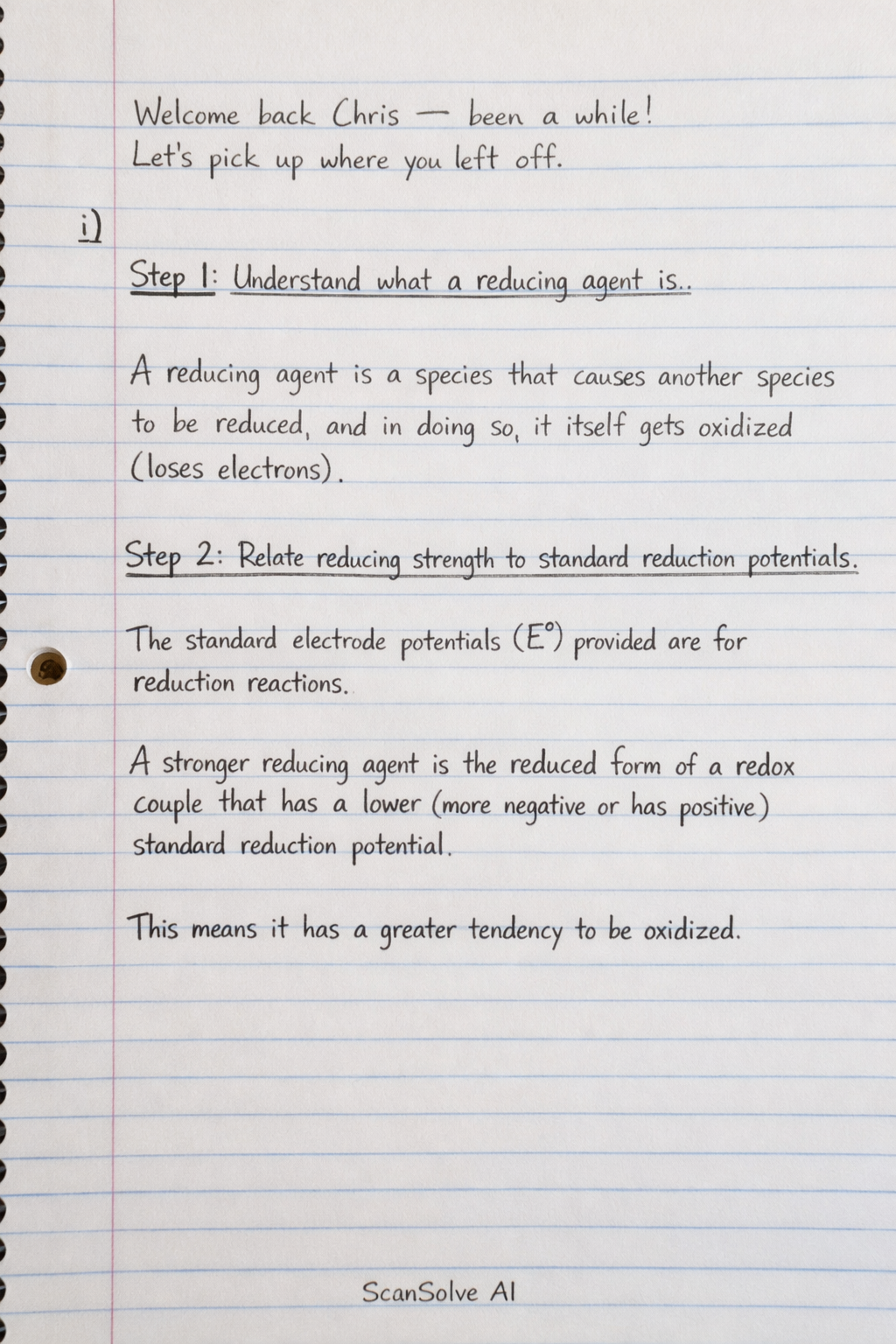
Handwritten Step-by-Step Solution
Get this as a handwritten image on WhatsApp — like a tutor wrote it for you.
Try on WhatsApp