
We read your photo as:
Describe the formation of ionic and simple covalent bonds, providing an example for ionic bonding.
ScanSolve AI Answer
Step-by-step solution
3 stepsHere are the answers to the questions from SECTION C.
Question 1:
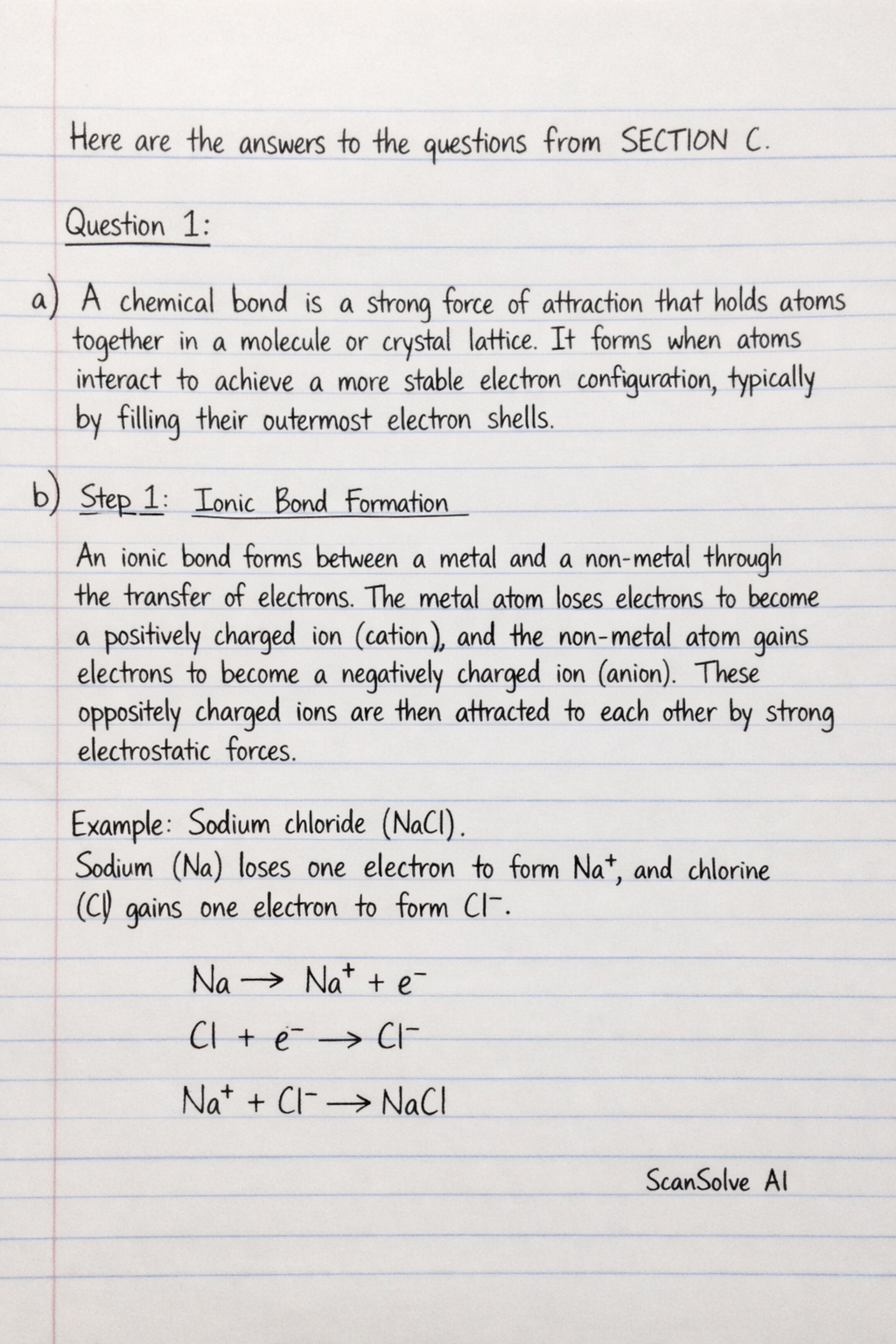
a) A chemical bond is a strong force of attraction that holds atoms together in a molecule or crystal lattice. It forms when atoms interact to achieve a more stable electron configuration, typically by filling their outermost electron shells.
b)
Ionic Bond Formation
An ionic bond forms between a metal and a non-metal through the transfer of electrons. The metal atom loses electrons to become a positively charged ion (cation), and the non-metal atom gains electrons to become a negatively charged ion (anion). These oppositely charged ions are then attracted to each other by strong electrostatic forces.
Example: Sodium chloride (). Sodium (Na) loses one electron to form , and chlorine (Cl) gains one electron to form .Diagram: (Imagine a diagram showing a sodium atom transferring its single valence electron to a chlorine atom, resulting in a ion and a ion.)
Simple Covalent Bond Formation
A simple covalent bond forms between two non-metal atoms through the sharing of electrons. Each atom contributes one or more electrons to form shared pairs, allowing both atoms to achieve a stable electron configuration.
Example: Water (). Two hydrogen atoms each share an electron with an oxygen atom.
Diagram: (Imagine a diagram showing an oxygen atom sharing electrons with two hydrogen atoms, forming two single covalent bonds.)Metallic Bond Formation
A metallic bond forms between metal atoms in a metallic lattice. The valence electrons of the metal atoms are delocalized and form a "sea" of electrons that are shared among all the positively charged metal ions (cations). This electrostatic attraction between the positive metal ions and the delocalized electrons holds the structure together.
Example: Copper (Cu). Copper atoms lose their valence electrons to form ions, which are surrounded by a mobile sea of electrons.
Diagram: (Imagine a diagram showing a lattice of positive metal ions surrounded by a cloud of delocalized electrons.)c)
- Ionic substance (e.g., NaCl): Has a high melting point. This is because the strong electrostatic forces of attraction between the oppositely charged ions require a large amount of energy to overcome.
- Simple covalent substance (e.g., ): Has a low boiling point. This is due to the weak intermolecular forces of attraction between individual molecules, which require little energy to overcome.
- Metallic substance (e.g., Copper): Is a good electrical conductor. This property arises from the presence of delocalized electrons that are free to move throughout the metallic lattice, carrying electrical charge.
Question 2:
a)
i) The gas that turns acidified potassium dichromate from orange to green is Sulfur dioxide ().
To collect a pure dry sample of sulfur dioxide, it can be collected by downward delivery (or upward displacement of air) because it is denser than air. It can be dried by passing it through concentrated sulfuric acid.ii) The gas that is odourless and rekindles a glowing splint is Oxygen ().
To collect a pure dry sample of oxygen, it can be collected by downward delivery (or upward displacement of air) as it is slightly denser than air. It can also be collected over water, but for a dry sample, downward delivery is preferred after drying with a desiccant like concentrated sulfuric acid.iii) The gas that burns with a 'pop' sound is Hydrogen ().
To collect a pure dry sample of hydrogen, it can be collected by upward delivery (or downward displacement of air) because it is much less dense than air. It can be dried by passing it through concentrated sulfuric acid.b) An instrument that can be used to measure the volume of a gas in the laboratory is a gas syringe.
Still stuck on this one?
Ask a follow-up, and the answer starts from this question.
More Chemistry Questions
Handwritten Step-by-Step Solution
Get this as a handwritten image on WhatsApp — like a tutor wrote it for you.
Try on WhatsApp