

This chemistry question involves key chemical concepts and calculations. The detailed solution below walks through each step, from identifying the reaction type to computing the final answer.
ScanSolve AI Answer
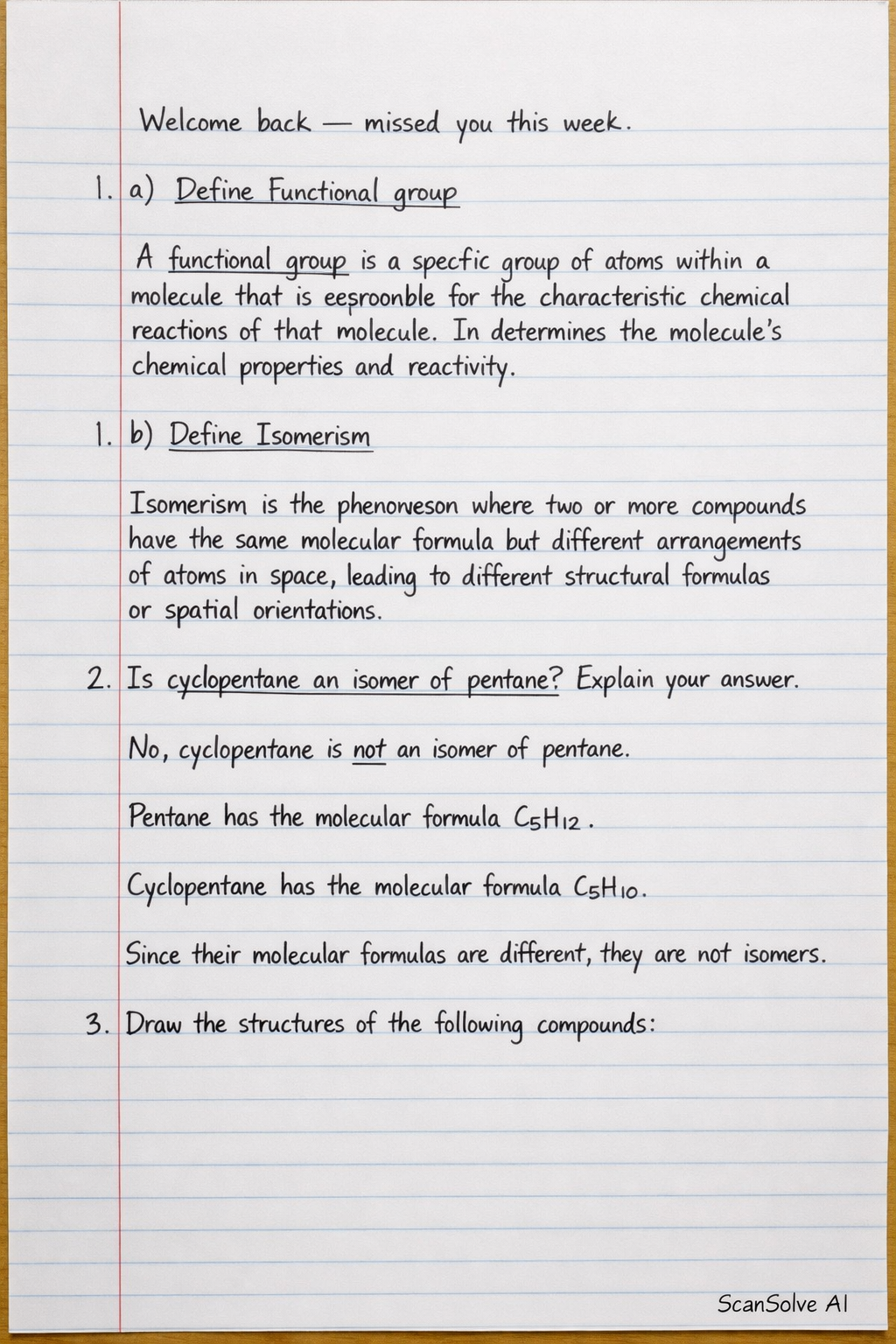
Welcome back — missed you this week. 1. a) Define Functional group A functional group is a specific group of atoms within a molecule that is responsible for the characteristic chemical reactions of that molecule. It determines the molecule's chemical properties and reactivity. 1. b) Define Isomerism Isomerism is the phenomenon where two or more compounds have the same molecular formula but different arrangements of atoms in space, leading to different structural formulas or spatial orientations. 2. Is cyclopentane an isomer of pentane? Explain your answer. No, cyclopentane is not an isomer of pentane. Pentane has the molecular formula C_5H_12. Cyclopentane has the molecular formula C_5H_10. Since their molecular formulas are different, they are not isomers. 3. Draw the structures of the following compounds a) 4-ethyl-6-isopropyldecane The parent chain is decane, which has 10 carbon atoms. There is an ethyl group at position 4 and an isopropyl group at position 6. CH_3CH_2CH_2CH(CH_2CH_3)CH_2CH(CH(CH_3)_2)CH_2CH_2CH_2CH_3 b) 6,6-diethyl-3,5,5-trimethylnonane The parent chain is nonane, which has 9 carbon atoms. There are two ethyl groups at position 6, and three methyl groups at positions 3, 5, and 5. CH_3CH_2CH(CH_3)CH_2C(CH_3)_2C(CH_2CH_3)_2CH_2CH_2CH_3 4. Give the IUPAC name to the following compound Step 1: Identify the parent ring. The parent ring is a cyclohexane. Step 2: Identify the substituents. There are two ethyl groups and one methyl group. Step 3: Number the ring to give the lowest possible numbers to the substituents. Starting from the carbon with the methyl group and numbering clockwise gives 1-methyl, 3-ethyl, 5-ethyl. This simplifies to 1-methyl-3,5-diethyl. Starting from one of the ethyl groups and numbering clockwise gives 1-ethyl, 3-methyl, 5-ethyl. This simplifies to 1,5-diethyl-3-methyl. Starting from one of the ethyl groups and numbering counter-clockwise gives 1-ethyl, 3-ethyl, 5-methyl. This simplifies to 1,3-diethyl-5-methyl. According to IUPAC rules, when there are different substituents, they are listed alphabetically. The numbering should give the lowest possible set of locants. If we number to give the lowest set of locants, we get (1,3,5). If we number such that the first substituent encountered gets the lowest number, and then proceed to give the next substituents the lowest numbers, and then prioritize alphabetical order for naming: Option 1: 1-ethyl, 3-ethyl, 5-methyl → 1,3-diethyl-5-methylcyclohexane Option 2: 1-methyl, 3-ethyl, 5-ethyl → 3,5-diethyl-1-methylcyclohexane Both options give the locant set (1,3,5). When the locant sets are identical, alphabetical order of substituents determines the numbering. "Diethyl" comes before "methyl". So, the numbering should prioritize the ethyl groups. Therefore, the correct numbering starts at one ethyl group as 1, the other ethyl group as 3, and the methyl group as 5. The IUPAC name is 1,3-diethyl-5-methylcyclohexane. Send me the next one 📸