
We read your photo as:
Explain Gay-Lussac's Law and Avogadro's Law, and demonstrate how the reaction of hydrogen and oxygen to form water vapor supports Gay-Lussac's Law.
ScanSolve AI Answer
Answer
Step-by-step solution
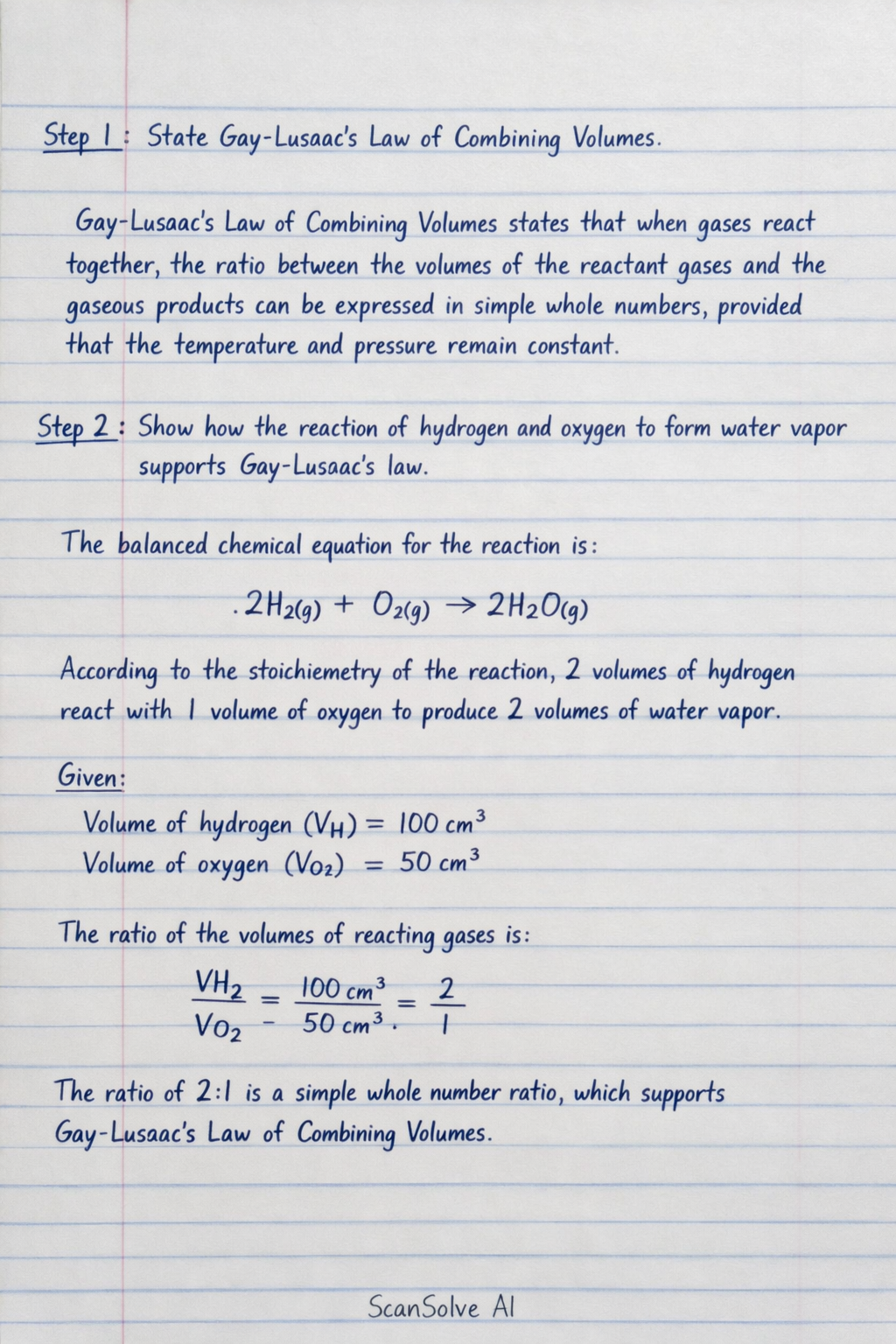
8 stepsState Gay-Lussac's Law of Combining Volumes.
Gay-Lussac's Law of Combining Volumes states that when gases react together, the ratio between the volumes of the reactant gases and the gaseous products can be expressed in simple whole numbers, provided that the temperature and pressure remain constant.
Show how the reaction of hydrogen and oxygen to form water vapor supports Gay-Lussac's law.
The balanced chemical equation for the reaction is:
According to the stoichiometry of the reaction, 2 volumes of hydrogen react with 1 volume of oxygen to produce 2 volumes of water vapor.
Given:
Volume of hydrogen () = 100 cm
Volume of oxygen () = 50 cmThe ratio of the volumes of reacting gases is:
The ratio of 2:1 is a simple whole number ratio, which supports Gay-Lussac's Law of Combining Volumes.
State Avogadro's Law.
Avogadro's Law states that equal volumes of all gases, at the same temperature and pressure, contain the same number of molecules.
Define molar volume of a gas.
Molar volume of a gas is the volume occupied by one mole of any gas at a specific temperature and pressure. At Standard Temperature and Pressure (STP), the molar volume of any ideal gas is approximately 22.4 dm.
Calculate the volume occupied by 2 moles of a gas at standard temperature and pressure (STP).
At STP, 1 mole of any gas occupies 22.4 dm.
Volume for 2 moles = Number of moles Molar volume at STPThe volume occupied by 2 moles of a gas at STP is .
Verify Avogadro's law if 5.6 dm of a gas contains 0.25 moles at STP.
To verify Avogadro's law, we calculate the molar volume from the given data:
Molar volume =Since the calculated molar volume (22.4 dm/mol) matches the standard molar volume of a gas at STP, this data verifies Avogadro's law.
State Dalton's law of partial pressure.
Dalton's Law of Partial Pressures states that the total pressure exerted by a mixture of non-reacting gases is equal to the sum of the partial pressures of the individual gases.
Calculate the total pressure of the mixture.
According to Dalton's Law of Partial Pressures:
Total Pressure () = Partial Pressure of O () + Partial Pressure of N () + Partial Pressure of CO ()
Given:
= 200 mmHg
= 500 mmHg
= 100 mmHgThe total pressure of the mixture is .
Try one yourself
A new problem that tests the same skill.
Still stuck on this one?
Ask a follow-up, and the answer starts from this question.
More Chemistry Questions
Handwritten Step-by-Step Solution
Get this as a handwritten image on WhatsApp — like a tutor wrote it for you.
Try on WhatsApp