
We read your photo as:
Write the general rate expression for the reaction.
ScanSolve AI Answer
Step-by-step solution
7 stepsa) For the reaction , the rate of reaction can be expressed in terms of the change in concentration of reactants and products over time.
Write the general rate expression for the reaction.
The rate of reaction is related to the rate of change of concentration of each species divided by its stoichiometric coefficient. For reactants, a negative sign is used as their concentration decreases.
To express the rate in terms of the formation of ammonia, we use the term involving .
b) For the reaction , the rate of disappearance of reactant A is given as .
The general rate expression for this reaction is:We are given .
xiii) What is the rate of disappearance of the reactant B?
Relate the rate of disappearance of B to the rate of disappearance of A using the stoichiometric coefficients.
Solve for the rate of disappearance of B, .
Substitute the given value for .
Rounding to two significant figures:
xiv) What is the rate of appearance for the product D?
Relate the rate of appearance of D to the rate of disappearance of A using the stoichiometric coefficients.
Solve for the rate of appearance of D, .
Substitute the given value for .
Rounding to two significant figures:
Still stuck on this one?
Ask a follow-up, and the answer starts from this question.
More Chemistry Questions
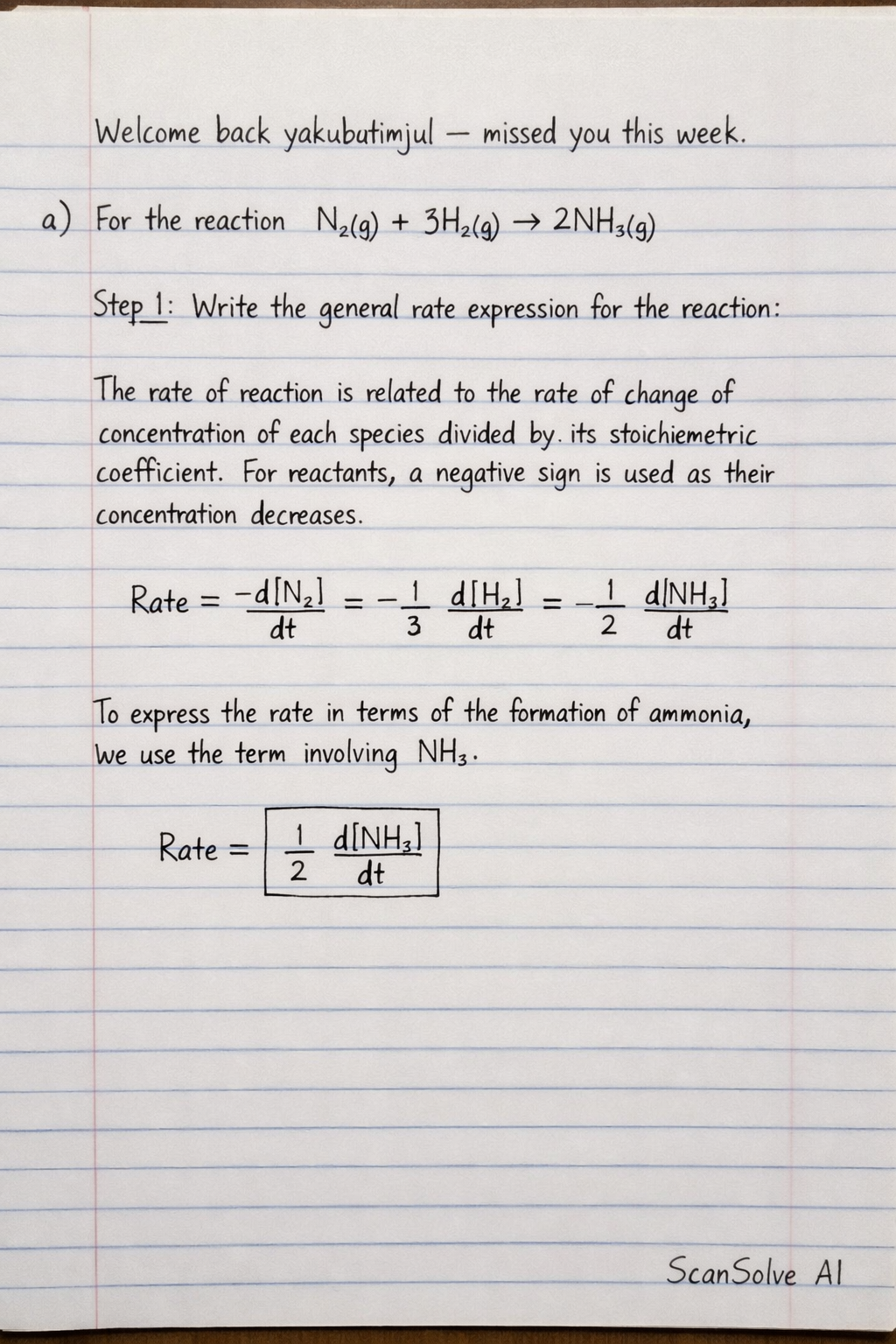
Handwritten Step-by-Step Solution
Get this as a handwritten image on WhatsApp — like a tutor wrote it for you.
Try on WhatsApp