We read your photo as:

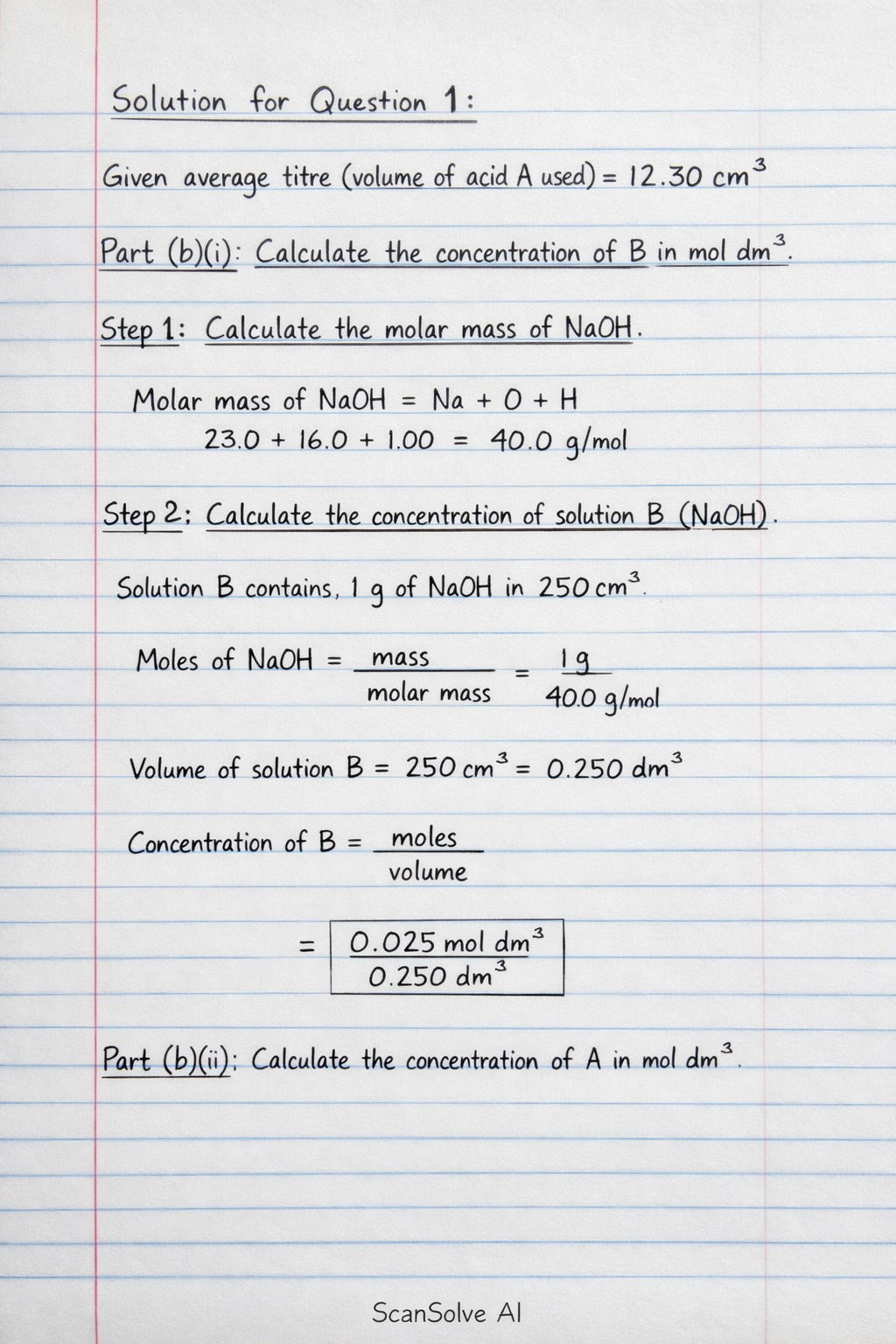
Given average titre (volume of acid A used) = 12.30 cm3

Chemistry

ScanSolve AI Answer

Step-by-step solution

4 steps

Here's the solution for Question 1:

Given average titre (volume of acid A used) = 12.30 cm312.30\text{ cm}^3

Part (b)(i): Calculate the concentration of B in mol dm−3\text{mol dm}^{-3}.

  1. Calculate the molar mass of NaOH\text{NaOH}.

    Molar mass of NaOH=Na+O+H=23.0+16.0+1.00=40.0 g/mol\text{Molar mass of NaOH} = \text{Na} + \text{O} + \text{H} = 23.0 + 16.0 + 1.00 = 40.0\text{ g/mol}
  2. Calculate the concentration of solution B (NaOH\text{NaOH}).

    Solution B contains 1 g1\text{ g} of NaOH\text{NaOH} in 250 cm3250\text{ cm}^3.

    Moles of NaOH=massmolar mass=1 g40.0 g/mol=0.025 mol\text{Moles of NaOH} = \frac{\text{mass}}{\text{molar mass}} = \frac{1\text{ g}}{40.0\text{ g/mol}} = 0.025\text{ mol} Volume of solution B=250 cm3=0.250 dm3\text{Volume of solution B} = 250\text{ cm}^3 = 0.250\text{ dm}^3 Concentration of B=molesvolume=0.025 mol0.250 dm3=0.10 mol dm−3\text{Concentration of B} = \frac{\text{moles}}{\text{volume}} = \frac{0.025\text{ mol}}{0.250\text{ dm}^3} = \boxed{0.10\text{ mol dm}^{-3}}

    Part (b)(ii): Calculate the concentration of A in mol dm−3\text{mol dm}^{-3}.

  3. Calculate the concentration of solution A (H2Y\text{H}_2\text{Y}) using titration data.

    The balanced chemical equation is: H2Y+2NaOH⟶Na2Y+2H2O\text{H}_2\text{Y} + 2\text{NaOH} \longrightarrow \text{Na}_2\text{Y} + 2\text{H}_2\text{O}
    From the equation, the mole ratio of H2Y\text{H}_2\text{Y} to NaOH\text{NaOH} is 1:21:2.
    Given:
    VA=12.30 cm3=0.01230 dm3V_A = 12.30\text{ cm}^3 = 0.01230\text{ dm}^3
    VB=25 cm3=0.025 dm3V_B = 25\text{ cm}^3 = 0.025\text{ dm}^3
    CB=0.10 mol dm−3C_B = 0.10\text{ mol dm}^{-3} (from Step 2)
    Using the titration formula CAVAnA=CBVBnB\frac{C_A V_A}{n_A} = \frac{C_B V_B}{n_B}:

    CA=nA×CB×VBnB×VA=1×0.10 mol dm−3×0.025 dm32×0.01230 dm3C_A = \frac{n_A \times C_B \times V_B}{n_B \times V_A} = \frac{1 \times 0.10\text{ mol dm}^{-3} \times 0.025\text{ dm}^3}{2 \times 0.01230\text{ dm}^3} CA=0.00250.0246 mol dm−3≈0.1016 mol dm−3C_A = \frac{0.0025}{0.0246}\text{ mol dm}^{-3} \approx \boxed{0.1016\text{ mol dm}^{-3}}

    Part (b)(iii): Calculate the number of hydrogen ions in 1dm31\text{dm}^3 of A.

  4. Calculate the number of hydrogen ions in 1dm31\text{dm}^3 of solution A.

    Concentration of A (CAC_A) = 0.1016 mol dm−30.1016\text{ mol dm}^{-3}.
    In 1 dm31\text{ dm}^3 of solution A, moles of H2Y=0.1016 mol\text{H}_2\text{Y} = 0.1016\text{ mol}.
    Since H2Y\text{H}_2\text{Y} is a diprotic acid, each molecule produces 2 H+\text{H}^+ ions.

    Moles of H+ ions in 1 dm3=2×0.1016 mol=0.2032 mol\text{Moles of H}^+\text{ ions in } 1\text{ dm}^3 = 2 \times 0.1016\text{ mol} = 0.2032\text{ mol}

    Using Avogadro's number (6.02×10²³ ions/mol6.02 \times 10^{23}\text{ ions/mol}):

    Number of H+ ions=0.2032 mol×6.02×1023 ions/mol≈1.22×1023 ions\text{Number of H}^+\text{ ions} = 0.2032\text{ mol} \times 6.02 \times 10^{23}\text{ ions/mol} \approx \boxed{1.22 \times 10^{23}\text{ ions}}

    Part (b)(iv): Calculate the volume of distilled water that should be added to 25cm325\text{cm}^3 of solution B in order to dilute it twice.

Was this helpful?

Still stuck on this one?

Ask a follow-up, and the answer starts from this question.

Got a different question?Ask your own question
Handwritten step-by-step solution preview

Handwritten Step-by-Step Solution

Get this as a handwritten image on WhatsApp — like a tutor wrote it for you.

Try on WhatsApp