We read your photo as:

Given Kc1 = 6.8 imes 10⁻⁴⁹ for NO2(g) ightleftharpoons NO(g) + O(g) and Kc2 = 5.8 imes 10⁻³⁴ for O3(g) + NO(g) ightleftharpoons NO2(g) + O2(g), calculate the equilibrium constant for O2(g) + O(g) ig

Chemistry

ScanSolve AI Answer

Answer

2.5×1081\mathbf{2.5 \times 10^{81}}

Step-by-step solution

4 steps

To calculate the equilibrium constant for the target reaction, we need to manipulate the given reactions.

Target reaction: O2(g)+O(g)⇌O3(g)O_2(g) + O(g) \rightleftharpoons O_3(g)

Given information:

  1. NO2(g)⇌NO(g)+O(g)NO_2(g) \rightleftharpoons NO(g) + O(g) with Kc1=6.8×10−49K_{c1} = 6.8 \times 10^{-49}
  2. O3(g)+NO(g)⇌NO2(g)+O2(g)O_3(g) + NO(g) \rightleftharpoons NO_2(g) + O_2(g) with Kc2=5.8×10⁻³⁴K_{c2} = 5.8 \times 10^{-34}
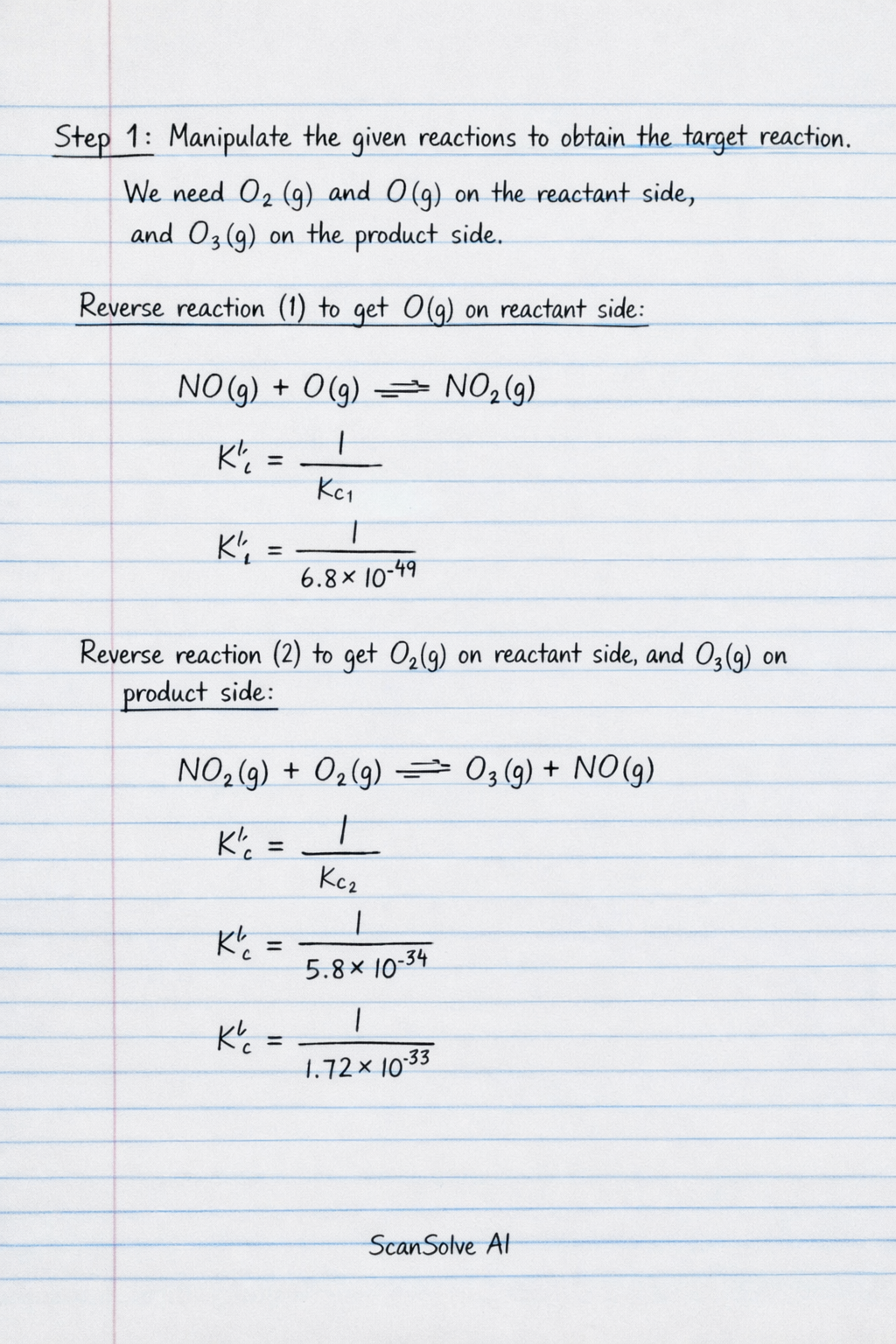
  1. Manipulate the given reactions to obtain the target reaction.

    We need O2(g)O_2(g) and O(g)O(g) on the reactant side, and O3(g)O_3(g) on the product side.

    Reverse reaction (1) to get O(g)O(g) on the reactant side:
    NO(g)+O(g)⇌NO2(g)NO(g) + O(g) \rightleftharpoons NO_2(g)
    The new equilibrium constant for this reversed reaction is Kc1′=1Kc1K_{c1}' = \frac{1}{K_{c1}}.

    Reverse reaction (2) to get O2(g)O_2(g) on the reactant side and O3(g)O_3(g) on the product side:
    NO2(g)+O2(g)⇌O3(g)+NO(g)NO_2(g) + O_2(g) \rightleftharpoons O_3(g) + NO(g)
    The new equilibrium constant for this reversed reaction is Kc2′=1Kc2K_{c2}' = \frac{1}{K_{c2}}.

  2. Add the manipulated reactions.

    Add the reversed reaction (1) and the reversed reaction (2):
    (NO(g)+O(g)⇌NO2(g))(NO(g) + O(g) \rightleftharpoons NO_2(g))
    ++
    (NO2(g)+O2(g)⇌O3(g)+NO(g))(NO_2(g) + O_2(g) \rightleftharpoons O_3(g) + NO(g))

    NO(g)+O(g)+NO2(g)+O2(g)⇌NO2(g)+O3(g)+NO(g)NO(g) + O(g) + NO_2(g) + O_2(g) \rightleftharpoons NO_2(g) + O_3(g) + NO(g)

  3. Cancel common species on both sides.

    Cancel NO(g)NO(g) and NO2(g)NO_2(g) from both sides of the equation:
    O(g)+O2(g)⇌O3(g)O(g) + O_2(g) \rightleftharpoons O_3(g)
    This is the target reaction.

  4. Calculate the overall equilibrium constant.

    When reactions are added, their equilibrium constants are multiplied.

    Kc=Kc1′×Kc2′K_c = K_{c1}' \times K_{c2}' Kc=1Kc1×1Kc2K_c = \frac{1}{K_{c1}} \times \frac{1}{K_{c2}} Kc=1(6.8×10−49)×(5.8×10−34)K_c = \frac{1}{(6.8 \times 10^{-49}) \times (5.8 \times 10^{-34})} Kc=1(6.8×5.8)×10−49−34K_c = \frac{1}{(6.8 \times 5.8) \times 10^{-49-34}} Kc=139.44×10−83K_c = \frac{1}{39.44 \times 10^{-83}} Kc=13.944×10−82K_c = \frac{1}{3.944 \times 10^{-82}} Kc≈0.25355×1082K_c \approx 0.25355 \times 10^{82} Kc≈2.5355×1081K_c \approx 2.5355 \times 10^{81}

    Rounding to two significant figures:

    Kc≈2.5×1081K_c \approx 2.5 \times 10^{81}

    The equilibrium constant for the reaction is 2.5×1081\mathbf{2.5 \times 10^{81}}.

Was this helpful?

Try one yourself

A new problem that tests the same skill.

Still stuck on this one?

Ask a follow-up, and the answer starts from this question.

Got a different question?Ask your own question
Handwritten step-by-step solution preview

Handwritten Step-by-Step Solution

Get this as a handwritten image on WhatsApp — like a tutor wrote it for you.

Try on WhatsApp