This computer science problem involves algorithmic thinking and programming concepts. The solution below explains the approach, logic, and implementation step by step.
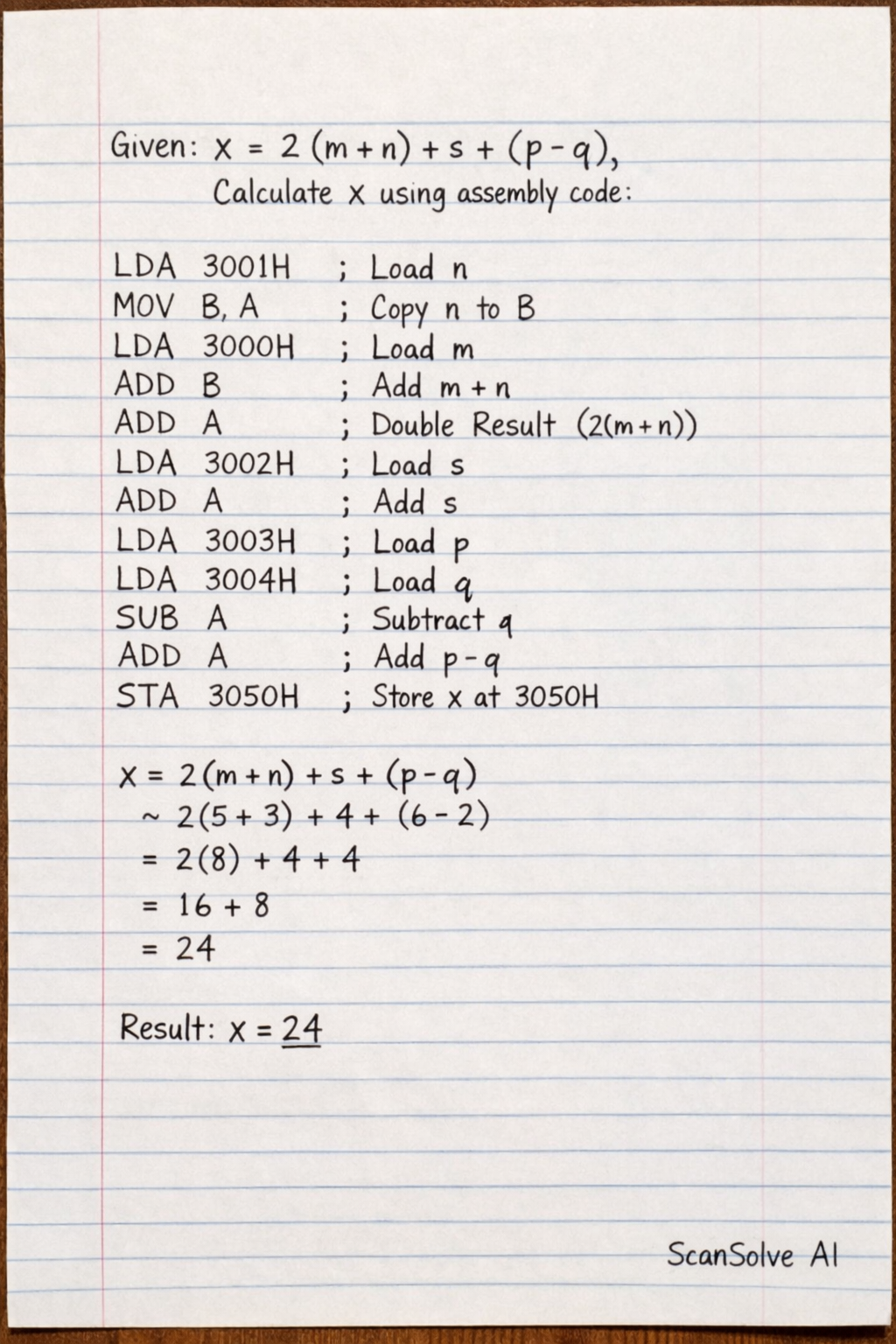
Given that x = 2(m + n) + s + (p − q), write an assembly language program to compute for x.
Computer Science

ScanSolve AI Answer
Here are the solutions to the questions from the image:
(b) Figure 2 shows a section of stack memory of a microprocessor with pointer at .
Given that , write an assembly language program to compute for .
Assuming the stack pointer (SP) at points to the top element 'm', and the stack grows towards higher memory addresses as depicted in the diagram (i.e., 'm' at , 'n' at , 's' at , '
Was this helpful?
Need help with your own homework?
Get instant step-by-step solutions to any question. Free to start.
Ask Your Question
Handwritten Step-by-Step Solution
Get this as a handwritten image on WhatsApp — like a tutor wrote it for you.
Try on WhatsAppMore Computer Science Questions
QThe installation of system software and application software for a single-user personal computer.Q4th generation of ComputerQWrite the generation of the computer, their years, their future, their example, and technologies of…QWork out a flow chart detailing the sequence of manufacture of the crane with its electromagnet.QList ten rules that every computer user should obey Full meaning of FRSC, EFCC, NSCDC, NEMA, SON, NA…
Still have questions?
Quick Answer
(b) Figure 2 shows a section of stack memory of a microprocessor with pointer at 3000H.
ScanSolve AI Answer
Here are the solutions to the questions from the image: (b) Figure 2 shows a section of stack memory of a microprocessor with pointer at 3000H. Given that x = 2(m + n) + s + (p - q), write an assembly language program to compute for x. Assuming the stack pointer (SP) at 3000H points to the top element 'm', and the stack grows towards higher memory addresses as depicted in the diagram (i.e., 'm' at 3000H, 'n' at 3001H, 's' at 3002H, '