Define the given values for m and n and the binary operation.
|Computer Science
Define the given values for m and n and the binary operation.
ScanSolve AI Answer
Answer
222
You're on a roll —
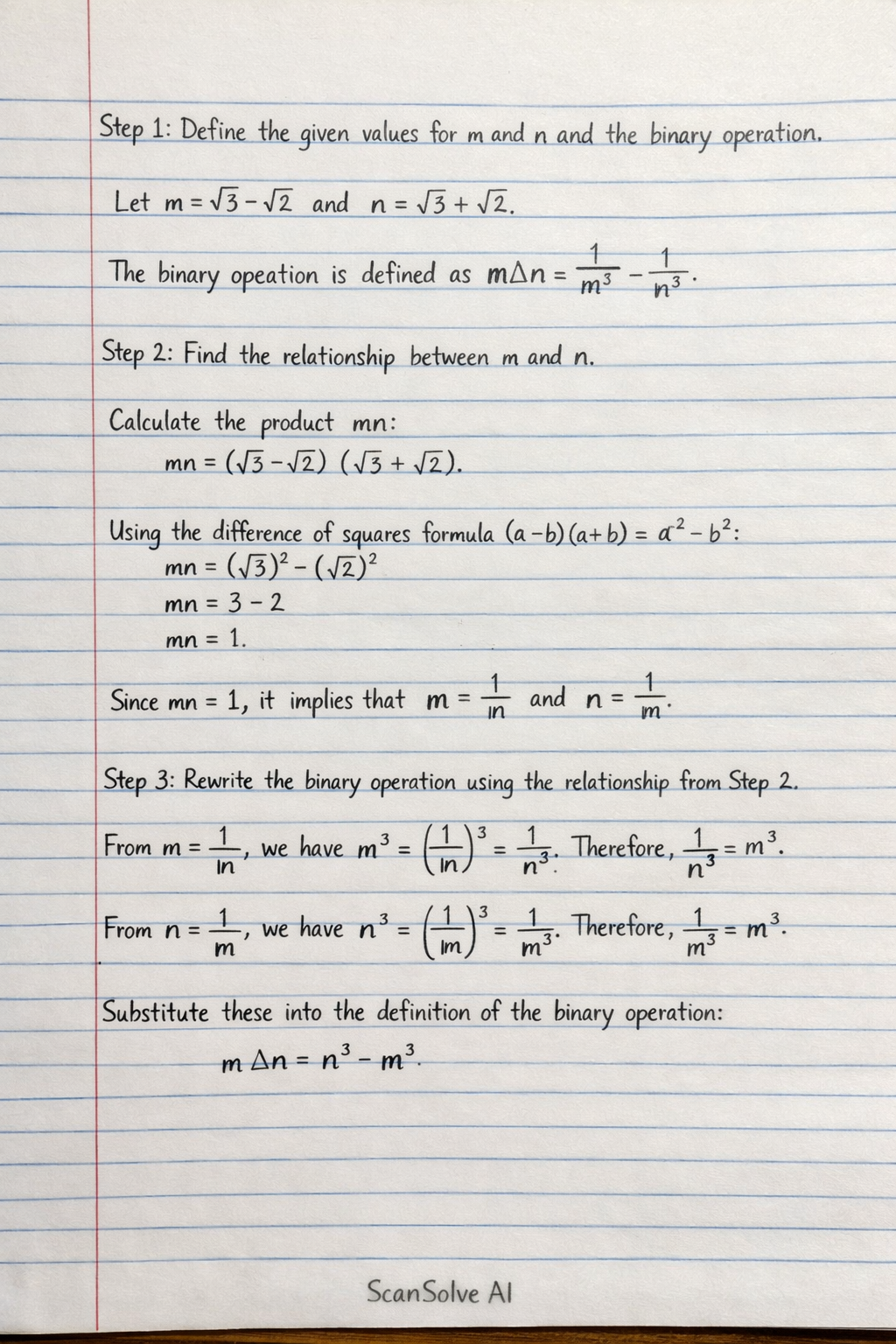
Step 1: Define the given values for m and n and the binary operation.
Let m=3−2 and n=3+2.
The binary operation is defined as mΔn=m31−n31.
Step 2: Find the relationship between m and n.
Calculate the product mn:
mn=(3−2)(3+2)
Using the difference of squares formula (a−b)(a+b)=a2−b2:
mn=(3)2−(2)2=3−2=1
Since mn=1, it implies that m=n1 and n=m1.
Step 3: Rewrite the binary operation using the relationship from Step 2.
From m=n1, we have m3=(n1)3=n31. Therefore, m31=n3.
From n=m1, we have n3=(m1)3=m31. Therefore, n31=m3.
Substitute these into the definition of the binary operation:
mΔn=n3−m3
Step 4: Calculate m3 and n3.
Using the binomial expansion (a−b)3=a3−3a2b+3ab2−b3:
m3=(3−2)3=(3)3−3(3)2(2)+3(3)(2)2−(2)3m3=33−3(3)2+33(2)−22m3=33−92+63−22m3=(3+6)3−(9+2)2=93−112
Using the binomial expansion (a+b)3=a3+3a2b+3ab2+b3:
n3=(3+2)3=(3)3+3(3)2(2)+3(3)(2)2+(2)3n3=33+3(3)2+33(2)+22n3=33+92+63+22n3=(3+6)3+(9+2)2=93+112
This computer science problem involves algorithmic thinking and programming concepts. The solution below explains the approach, logic, and implementation step by step.
ScanSolve AI Answer
You're on a roll — Step 1: Define the given values for m and n and the binary operation. Let m = sqrt(3) - sqrt(2) and n = sqrt(3) + sqrt(2). The binary operation is defined as m n = (1)/(m^3) - (1)/(n^3). Step 2: Find the relationship between m and n. Calculate the product mn: mn = (sqrt(3) - sqrt(2))(sqrt(3) + sqrt(2)) Using the difference of squares formula (a-b)(a+b) = a^2 - b^2: mn = (sqrt(3))^2 - (sqrt(2))^2 = 3 - 2 = 1 Since mn = 1, it implies that m = (1)/(n) and n = (1)/(m). Step 3: Rewrite the binary operation using the relationship from Step 2. From m = (1)/(n), we have m^3 = ((1)/(n))^3 = (1)/(n^3). Therefore, (1)/(m^3) = n^3. From n = (1)/(m), we have n^3 = ((1)/(m))^3 = (1)/(m^3). Therefore, (1)/(n^3) = m^3. Substitute these into the definition of the binary operation: m n = n^3 - m^3 Step 4: Calculate m^3 and n^3. Using the binomial expansion (a-b)^3 = a^3 - 3a^2b + 3ab^2 - b^3: m^3 = (sqrt(3) - sqrt(2))^3 = (sqrt(3))^3 - 3(sqrt(3))^2(sqrt(2)) + 3(sqrt(3))(sqrt(2))^2 - (sqrt(2))^3 m^3 = 3sqrt(3) - 3(3)sqrt(2) + 3sqrt(3)(2) - 2sqrt(2) m^3 = 3sqrt(3) - 9sqrt(2) + 6sqrt(3) - 2sqrt(2) m^3 = (3+6)sqrt(3) - (9+2)sqrt(2) = 9sqrt(3) - 11sqrt(2) Using the binomial expansion (a+b)^3 = a^3 + 3a^2b + 3ab^2 + b^3: n^3 = (sqrt(3) + sqrt(2))^3 = (sqrt(3))^3 + 3(sqrt(3))^2(sqrt(2)) + 3(sqrt(3))(sqrt(2))^2 + (sqrt(2))^3 n^3 = 3sqrt(3) + 3(3)sqrt(2) + 3sqrt(3)(2) + 2sqrt(2) n^3 = 3sqrt(3) + 9sqrt(2) + 6sqrt(3) + 2sqrt(2) n^3 = (3+6)sqrt(3) + (9+2)sqrt(2) = 9sqrt(3) + 11sqrt(2) Step 5: Evaluate n^3 - m^3. n^3 - m^3 = (9sqrt(3) + 11sqrt(2)) - (9sqrt(3) - 11sqrt(2)) n^3 - m^3 = 9sqrt(3) + 11sqrt(2) - 9sqrt(3) + 11sqrt(2) n^3 - m^3 = (9sqrt(3) - 9sqrt(3)) + (11sqrt(2) + 11sqrt(2)) n^3 - m^3 = 0 + 22sqrt(2) n^3 - m^3 = 22sqrt(2) The value of (sqrt(3) - sqrt(2)) (sqrt(3) + sqrt(2)) is 22sqrt(2). Drop the next question.