
We read your photo as:
Group 17 elements are known as halogens. a) What is the family name for Group 17 elements? b) State the order of reactivity of the elements F, Cl, Br, I, in increasing order. c) Which of these element
ScanSolve AI Answer
Step-by-step solution
6 stepsAnswer part a).
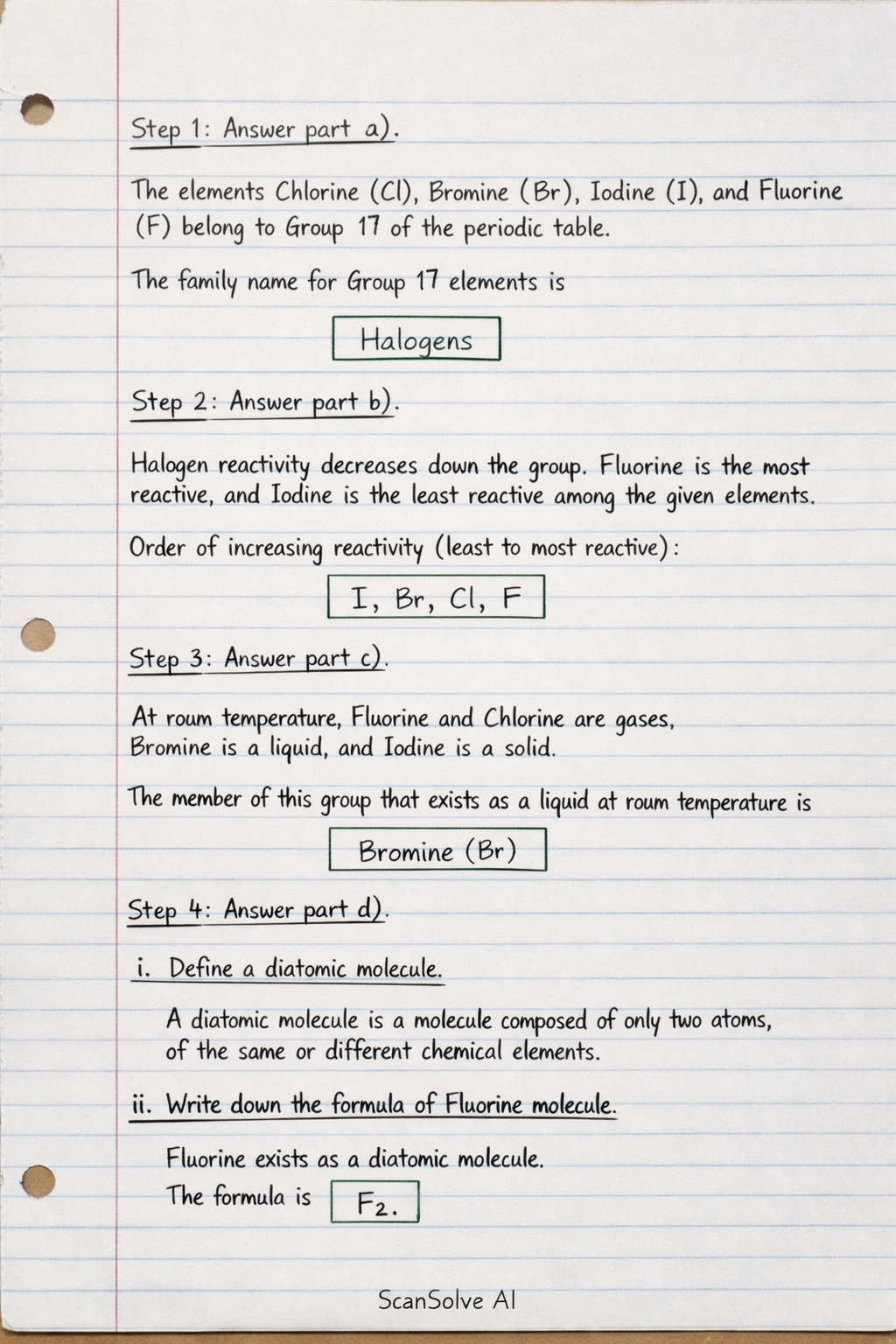
The elements Chlorine (Cl), Bromine (Br), Iodine (I), and Fluorine (F) belong to Group 17 of the periodic table.
The family name for Group 17 elements is .Answer part b).
Halogen reactivity decreases down the group. Fluorine is the most reactive, and Iodine is the least reactive among the given elements.
Order of increasing reactivity (least to most reactive):
Answer part c).
At room temperature, Fluorine and Chlorine are gases, Bromine is a liquid, and Iodine is a solid.
The member of this group that exists as a liquid at room temperature is .Answer part d).
i. Define a diatomic molecule.
A diatomic molecule is a molecule composed of only two atoms, of the same or different chemical elements.ii. Write down the formula of Fluorine molecule.
Fluorine exists as a diatomic molecule.
The formula is .iii. Apart from these elements name any other element that exists as a diatomic molecule.
Other elements that exist as diatomic molecules include .Answer part e).
i. Complete and balance the equation: KBr + Cl₂ →
Chlorine is more reactive than bromine, so it displaces bromine from potassium bromide.ii. Complete and balance the equation: NaCl + Br₂ →
Bromine is less reactive than chlorine, so it cannot displace chlorine from sodium chloride.Answer part f).
is used in the treatment of tap water for disinfection.
Still stuck on this one?
Ask a follow-up, and the answer starts from this question.
More Chemistry Questions
Handwritten Step-by-Step Solution
Get this as a handwritten image on WhatsApp — like a tutor wrote it for you.
Try on WhatsApp