We read your photo as:

Calculate the heat of combustion of ethene at constant pressure, given the standard enthalpy of combustion is -1411 kJ/mol at 17°C.

Chemistry

ScanSolve AI Answer

Answer

ΔH=−1394.37 kJ\Delta H = -1394.37 \text{ kJ}

Step-by-step solution

4 steps

Here's how to calculate the heat of combustion at constant pressure:

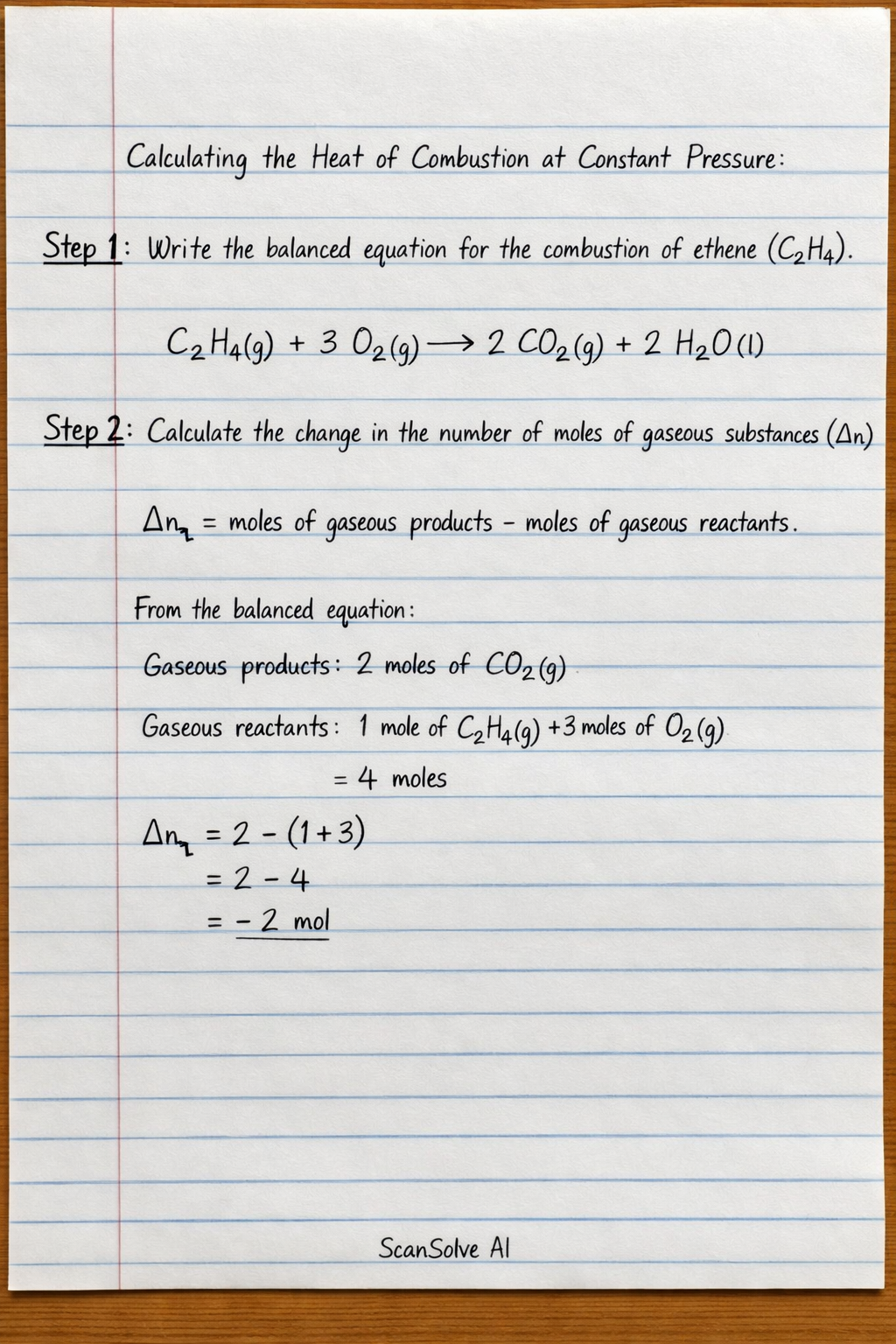
  1. Write the balanced chemical equation for the combustion of ethene (alkylene, C2_2H4_4).

    Combustion of ethene with oxygen produces carbon dioxide and water. Since water is specified to be in the liquid state, the equation is:

    C2H4(g)+3O2(g)⟶2CO2(g)+2H2O(l)\text{C}_2\text{H}_4(\text{g}) + 3\text{O}_2(\text{g}) \longrightarrow 2\text{CO}_2(\text{g}) + 2\text{H}_2\text{O}(\text{l})
  2. Calculate the change in the number of moles of gaseous substances (Δng\Delta n_g).

    Δng\Delta n_g is the moles of gaseous products minus the moles of gaseous reactants.

    Δng=(moles of gaseous products)−(moles of gaseous reactants)\Delta n_g = (\text{moles of gaseous products}) - (\text{moles of gaseous reactants})

    From the balanced equation:
    Gaseous products: 2 moles of CO2(g)\text{CO}_2(\text{g})
    Gaseous reactants: 1 mole of C2H4(g)+3\text{C}_2\text{H}_4(\text{g}) + 3 moles of O2(g)=4\text{O}_2(\text{g}) = 4 moles

    Δng=2−(1+3)=2−4=−2 mol\Delta n_g = 2 - (1 + 3) = 2 - 4 = -2 \text{ mol}
  3. Convert the given temperature to Kelvin and the gas constant R to kJ K−1^{-1} mol−1^{-1}.

    Given temperature T=17∘CT = 17^\circ\text{C}.

    T(K)=17+273.15=290.15 KT(\text{K}) = 17 + 273.15 = 290.15 \text{ K}

    Given gas constant R=8.314 J K−1 mol−1R = 8.314 \text{ J K}^{-1} \text{ mol}^{-1}.

    R=8.314 J K−1 mol−1×1 kJ1000 J=0.008314 kJ K−1 mol−1R = 8.314 \text{ J K}^{-1} \text{ mol}^{-1} \times \frac{1 \text{ kJ}}{1000 \text{ J}} = 0.008314 \text{ kJ K}^{-1} \text{ mol}^{-1}
  4. Calculate the heat of combustion at constant pressure (ΔH\Delta H) using the relationship between ΔH\Delta H and ΔU\Delta U.

    The heat of combustion at constant volume (ΔU\Delta U) is given as −1389.55 kJ-1389.55 \text{ kJ}.
    The formula relating ΔH\Delta H and ΔU\Delta U is:

    ΔH=ΔU+ΔngRT\Delta H = \Delta U + \Delta n_g RT

    Substitute the values:

    ΔH=−1389.55 kJ+(−2 mol)×(0.008314 kJ K−1 mol−1)×(290.15 K)\Delta H = -1389.55 \text{ kJ} + (-2 \text{ mol}) \times (0.008314 \text{ kJ K}^{-1} \text{ mol}^{-1}) \times (290.15 \text{ K}) ΔH=−1389.55 kJ−(2×0.008314×290.15) kJ\Delta H = -1389.55 \text{ kJ} - (2 \times 0.008314 \times 290.15) \text{ kJ} ΔH=−1389.55 kJ−4.8248 kJ\Delta H = -1389.55 \text{ kJ} - 4.8248 \text{ kJ} ΔH=−1394.3748 kJ\Delta H = -1394.3748 \text{ kJ}

    Rounding to two decimal places:

    ΔH=−1394.37 kJ\Delta H = \boxed{-1394.37 \text{ kJ}}
Was this helpful?

Still stuck on this one?

Ask a follow-up, and the answer starts from this question.

Got a different question?Ask your own question
Handwritten step-by-step solution preview

Handwritten Step-by-Step Solution

Get this as a handwritten image on WhatsApp — like a tutor wrote it for you.

Try on WhatsApp