

This chemistry question involves key chemical concepts and calculations. The detailed solution below walks through each step, from identifying the reaction type to computing the final answer.
ScanSolve AI Answer
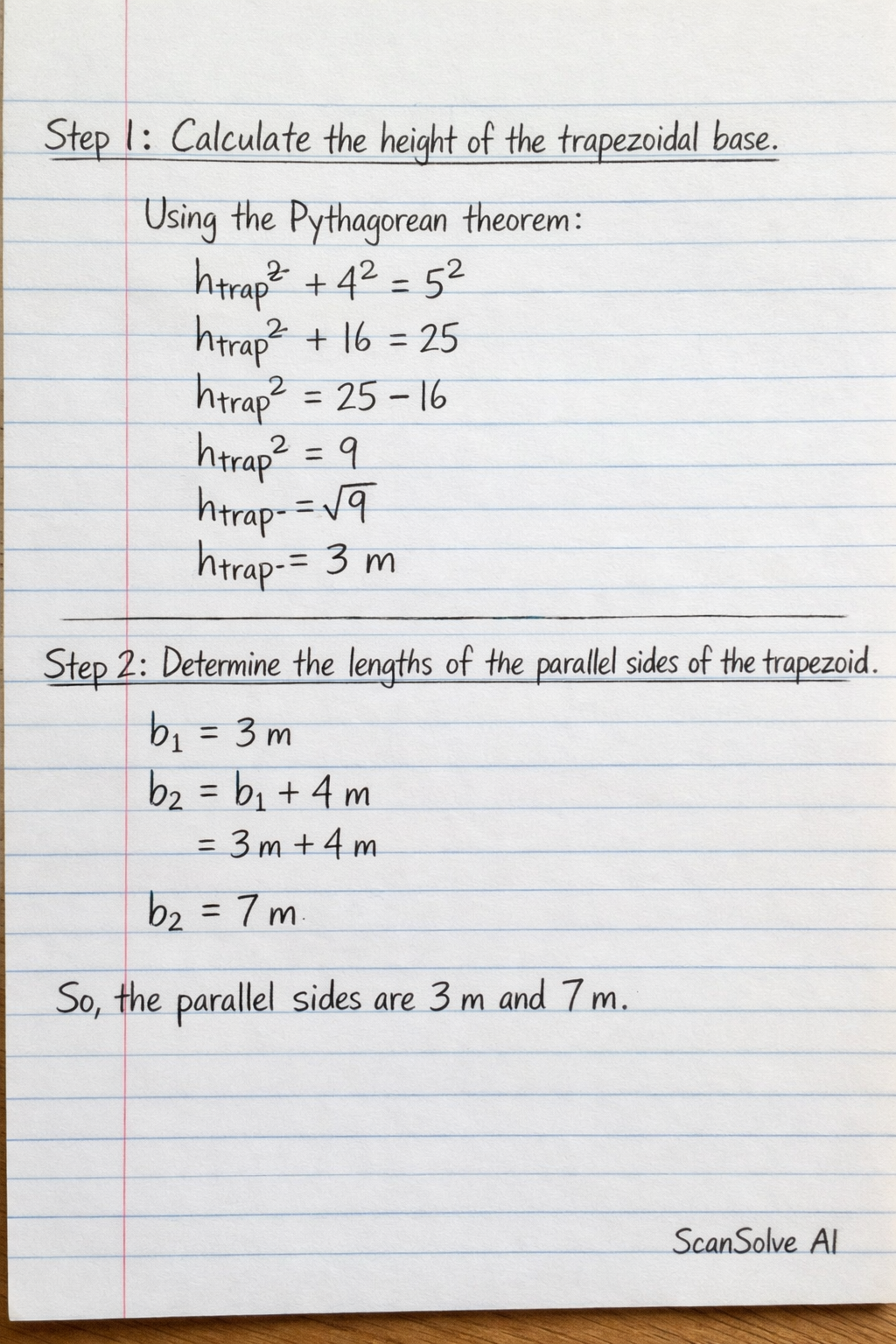
You're on a roll — here's how to calculate the volume of the prism: The shape is a prism with a trapezoidal base. To find the volume, we need to calculate the area of the trapezoidal base and then multiply it by the length of the prism. Step 1: Calculate the height of the trapezoidal base. From the diagram, we can form a right-angled triangle within the trapezoid. The hypotenuse is the slanted side (5 m), and one leg is the horizontal difference between the parallel sides (implied as 4 m from the student's calculation 5^2 - 4^2). Let h_trap be the height of the trapezoid. Using the Pythagorean theorem: h_trap^2 + 4^2 = 5^2 h_trap^2 + 16 = 25 h_trap^2 = 25 - 16 h_trap^2 = 9 h_trap = sqrt(9) h_trap = 3 m Step 2: Determine the lengths of the parallel sides of the trapezoid. One parallel side (b_1) is given as 3 m. The other parallel side (b_2) is the sum of b_1 and the horizontal difference: b_2 = 3 m + 4 m = 7 m So, the parallel sides are 3 m and 7 m. Step 3: Calculate the area of the trapezoidal base (A_base). The formula for the area of a trapezoid is A = (1)/(2) (b_1 + b_2) h_trap. A_base = (1)/(2) (3 m + 7 m) × 3 m A_base = (1)/(2) (10 m) × 3 m A_base = 5 m × 3 m A_base = 15 m^2 Step 4: Calculate the volume of the prism. The formula for the volume of a prism is V = A_base × L, where L is the length of the prism. From the diagram, the length of the prism is 15 m. V = 15 m^2 × 15 m V = 225 m^3 The volume of the prism is 225 m^3. What's next?