
We read your photo as:
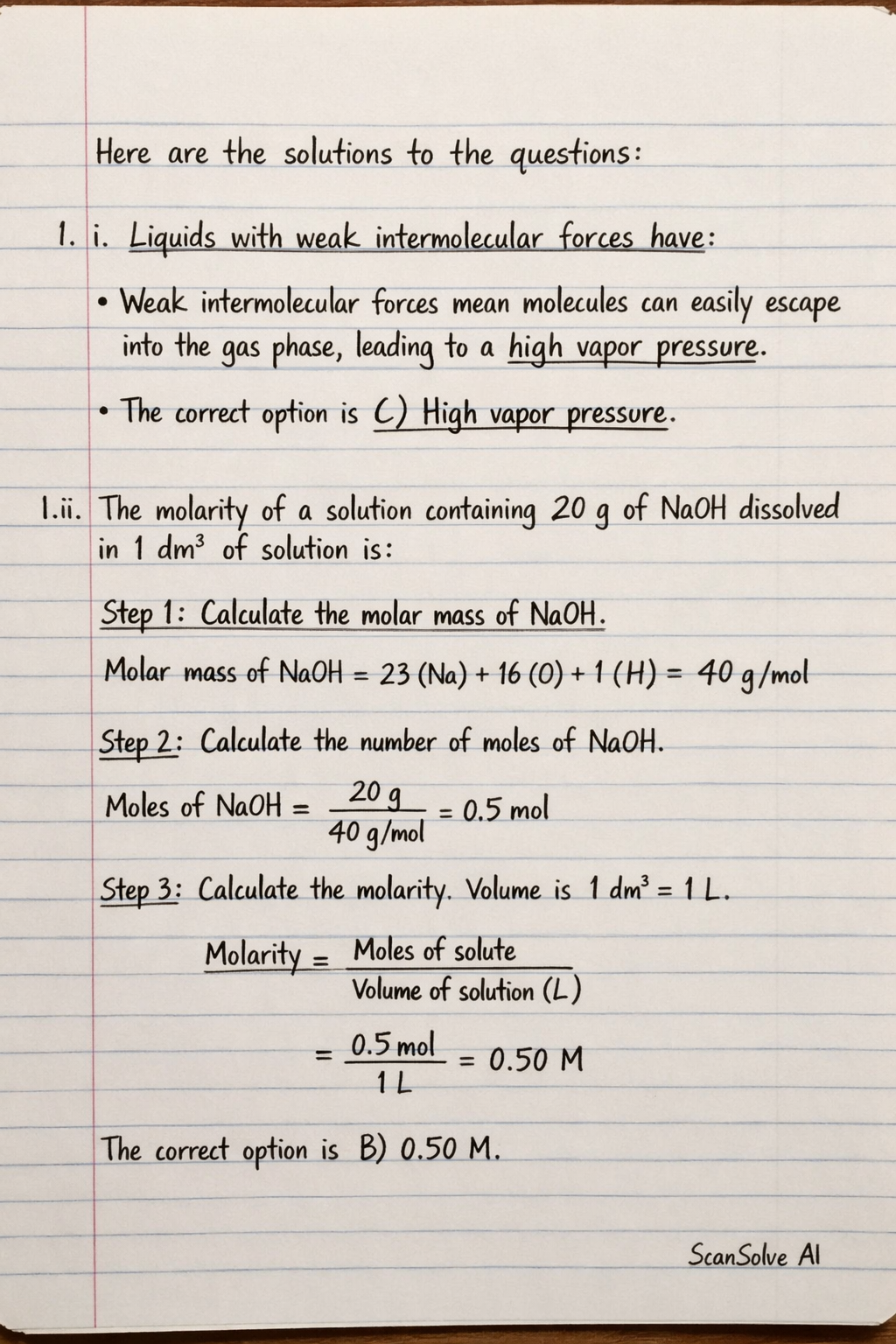
Here are the solutions to the questions: i. Liquids with weak intermolecular forces have: Weak intermolecular forces mean molecules can easily escape into the gas phase, leading to a high vapor pressu
ScanSolve AI Answer
Answer
High vapor pressure
Step-by-step solution
3 stepsHere are the solutions to the questions:
1.i. Liquids with weak intermolecular forces have:
- Weak intermolecular forces mean molecules can easily escape into the gas phase, leading to a high vapor pressure.
- The correct option is C) High vapor pressure.
1.ii. The molarity of a solution containing of NaOH dissolved in enough water to make solution is:
Calculate the molar mass of NaOH.
Calculate the number of moles of NaOH.
Calculate the molarity.
The volume is .
- The correct option is B) 0.50 M.
1.iii. The mixture that can be separated by ordinary filtration is:
- Filtration is used to separate insoluble solid particles from a liquid. A suspension contains particles large enough to be trapped by a filter.
- The correct option is C) Suspension.
1.iv. The oxidation number of chlorine in MgCl₂ is:
- Magnesium (Mg) is an alkaline earth metal and always has an oxidation number of in compounds.
- Let the oxidation number of chlorine (Cl) be . Since MgCl₂ is a neutral compound, the sum of oxidation numbers must be zero.
- The correct option is A) -1.
1.v. The particles which move towards the cathode in an electrolytic cell are:
- The cathode is the negatively charged electrode in an electrolytic cell. Positively charged ions, called cations, are attracted to the cathode.
- The correct option is D) Cations.
1.vi. Down the group, ionization energy of both alkali and alkaline earth metals:
- As you move down a group in the periodic table, the atomic size increases, and the outermost electrons are further from the nucleus and experience more shielding. This makes it easier to remove an electron, so the ionization energy decreases.
- The correct option is B) Decreases.
1.vii. The branch of chemistry which studies chemical reactions occurring in living organisms is:
- Biochemistry is the study of chemical processes within and relating to living organisms.
- The correct option is B) Biochemistry.
1.viii. The molecular formula of glucose is:
- The molecular formula for glucose, a simple sugar, is .
- The correct option is C) C₆H₁₂O₆.
1.ix. The isotope of hydrogen with one neutron is called:
- Protium () has 0 neutrons.
- Deuterium () has 1 neutron ().
- Tritium () has 2 neutrons ().
- The correct option is B) Deuterium.
1.x. Increase in electronegativity across a period is due to:
- Across a period from left to right, the nuclear charge increases (more protons), and the atomic size decreases (electrons are pulled closer to the nucleus). This stronger attraction for electrons leads to an increase in electronegativity.
- The correct option is D) Increase in nuclear charge and decrease in atomic size.
1.xi. According to the octet rule, atoms achieve stability by:
- The octet rule states that atoms tend to react in such a way that they achieve a stable electron configuration with eight electrons in their outermost (valence) shell.
- The correct option is C) Completing eight electrons in valence shell.
1.xii. Ionic compounds conduct electricity when they are:
- Ionic compounds conduct electricity when their ions are free to move. This occurs when they are dissolved in water (forming an aqueous solution) or when they are in the molten state. In the solid state, the ions are fixed in a lattice and cannot move.
- The correct option is B) Dissolved in water and molten.
Try one yourself
A new problem that tests the same skill.
Still stuck on this one?
Ask a follow-up, and the answer starts from this question.
More Chemistry Questions
Handwritten Step-by-Step Solution
Get this as a handwritten image on WhatsApp — like a tutor wrote it for you.
Try on WhatsApp