
We read your photo as:
Explain Hund's Rule and why half-filled and fully-filled sub-shells are particularly stable. Calculate the relative abundance of Boron isotopes given the RAM is 10.81 and isotopes are 10B and 11B. Exp
ScanSolve AI Answer
Here are the solutions to the questions from the image:
c) According to Hund's Rule, electrons will occupy each orbital within a sub-shell singly with parallel spins before any orbital is doubly occupied. This arrangement minimizes electron-electron repulsion and maximizes exchange energy, leading to a more stable configuration. For a sub-shell, this means that a half-filled configuration (, with one electron in each of the three orbitals, all with parallel spins) or a fully-filled configuration () is particularly stable due to this principle and increased symmetry.
a) The relative atomic mass (RAM) of Boron is given as 10.81. The two isotopes are and . The RAM is a weighted average of the masses of its isotopes. Since 10.81 is closer to 11 (difference of 0.19) than it is to 10 (difference of 0.81), the isotope with the mass number 11 must be present in a higher proportion.
The more abundant isotope is .
b) The relative atomic mass of an element is never a whole number because it is the weighted average of the masses of all its naturally occurring isotopes. Most elements exist as a mixture of two or more isotopes, each with a different mass number and a specific natural abundance. This averaging process, combined with the fact that the exact mass of protons and neutrons is not precisely 1 atomic mass unit, results in a non-integer value.
Still stuck on this one?
Ask a follow-up, and the answer starts from this question.
More Chemistry Questions
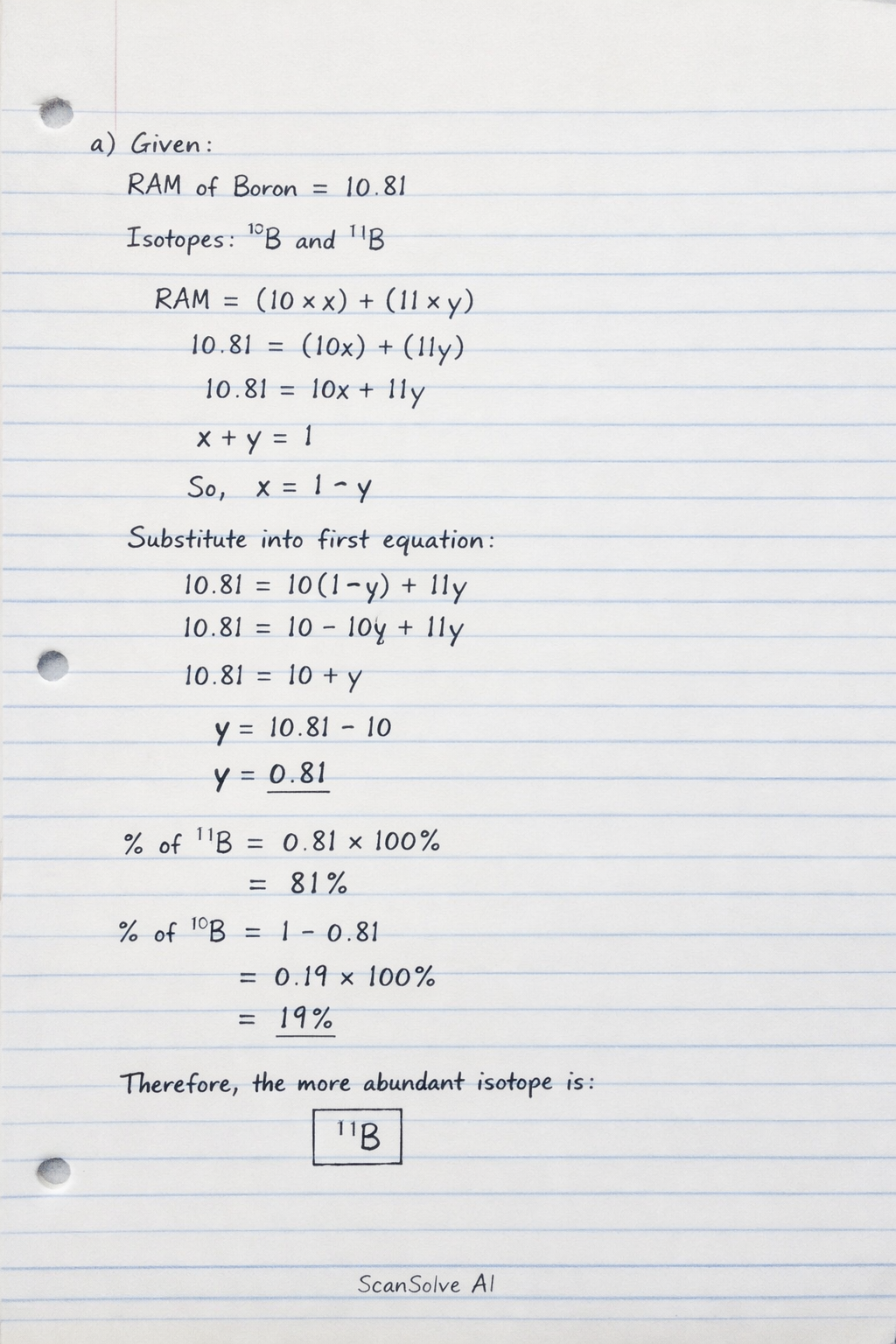
Handwritten Step-by-Step Solution
Get this as a handwritten image on WhatsApp — like a tutor wrote it for you.
Try on WhatsApp