
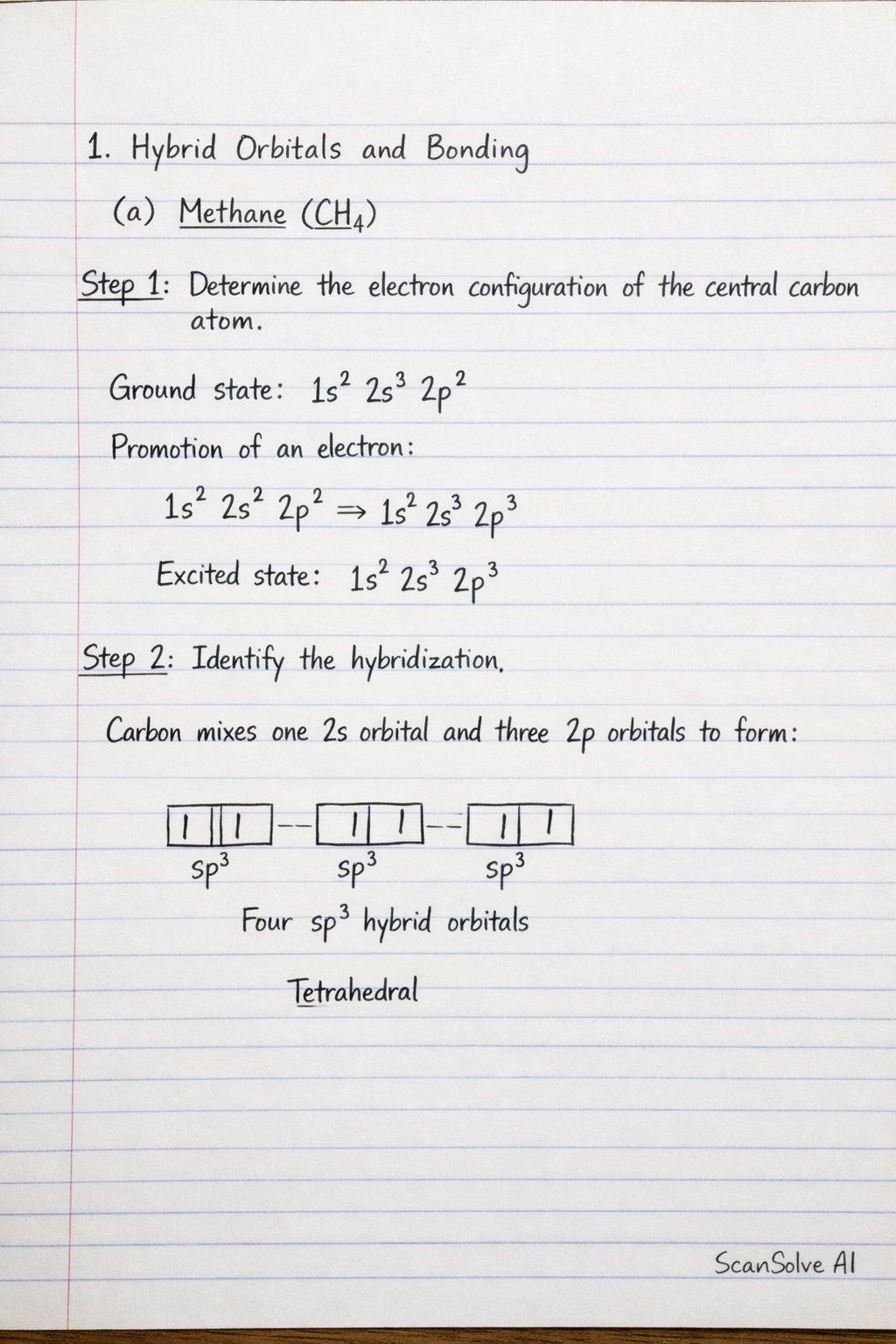
We read your photo as:
Explain the hybridization and bonding in methane (CH4) and ethyne (C2H2), including their molecular geometries.
ScanSolve AI Answer
Answers
2 partsStep-by-step solution
12 stepsI see your notes on the orbital diagrams for carbon, ethyne, and benzene. Your diagrams for the ground and excited states of carbon are ✅ Correct. Your statement that ethyne involves hybridization and forms a linear structure is ✅ Correct. Your observation that carbon in benzene is hybridized and forms sigma bonds is also ✅ Correct.
Now, let's provide the complete solutions for the questions asked.
1. Hybrid Orbitals and Bonding
Part a· 3 steps
Methane (CH₄)
Determine the electron configuration of the central carbon atom.
The ground state electron configuration of carbon is . To form four bonds, one electron from the orbital is promoted to an empty orbital, resulting in an excited state configuration of .
Identify the hybridization.
The carbon atom mixes one orbital and three orbitals to form four equivalent hybrid orbitals.
Describe the bonding.
Each of the four hybrid orbitals on carbon contains one electron. Each hybrid orbital overlaps head-on with the orbital of a hydrogen atom (which also contains one electron) to form a strong sigma () bond. This results in four C-H sigma bonds. The hybridization leads to a tetrahedral geometry around the carbon atom with bond angles of .
Part b
Ethyne (H-C≡C-H)
Determine the electron configuration of each carbon atom.
Each carbon atom has an excited state electron configuration of .
Identify the hybridization.
Each carbon atom is bonded to one hydrogen and one other carbon atom, forming two electron domains. Therefore, each carbon atom undergoes hybridization, mixing one orbital and one orbital to form two hybrid orbitals. Two orbitals remain unhybridized.
Describe the bonding.
- One hybrid orbital on each carbon overlaps with the orbital of a hydrogen atom to form a C-H sigma () bond.
- The other hybrid orbital on each carbon overlaps head-on with the hybrid orbital of the adjacent carbon atom to form a C-C sigma () bond.
- The two unhybridized orbitals on each carbon (oriented perpendicular to each other and to the orbitals) overlap side-by-side with the corresponding unhybridized orbitals on the adjacent carbon atom to form two pi () bonds. This results in a triple bond between the carbon atoms (one and two bonds) and two C-H sigma bonds. The hybridization leads to a linear geometry around each carbon atom with bond angles of .
2. Valence Bond Theory and Bonding in NH₃
Determine the electron configuration of the central nitrogen atom.
Nitrogen has an electron configuration of . In its valence shell, it has one lone pair in the orbital and three unpaired electrons in the orbitals.
Apply the concept of hybridization within Valence Bond Theory.
To explain the observed bond angles and geometry, the nitrogen atom undergoes hybridization. It mixes its one orbital and three orbitals to form four equivalent hybrid orbitals.
Describe the formation of hybrid orbitals and bonding.
- One of these hybrid orbitals contains the lone pair of electrons.
- The other three hybrid orbitals each contain one unpaired electron and overlap head-on with the orbital of a hydrogen atom (each containing one electron) to form three N-H sigma () bonds.
Explain the molecular geometry.
The four hybrid orbitals arrange themselves in a tetrahedral electron geometry. However, because one position is occupied by a lone pair, the molecular geometry of NH₃ is trigonal pyramidal. The lone pair exerts greater repulsion on the bonding pairs, compressing the H-N-H bond angles from the ideal to approximately .
3. Bonding in Benzene (C₆H₆)
Since you mentioned benzene in your notes, here's a brief explanation:
Determine the hybridization of each carbon atom.
Each carbon atom in benzene is bonded to two other carbon atoms and one hydrogen atom, forming three electron domains. Therefore, each carbon atom undergoes hybridization, mixing one orbital and two orbitals to form three hybrid orbitals. One orbital remains unhybridized.
Describe the bonding.
- Each hybrid orbital on a carbon atom forms a sigma () bond: two with adjacent carbon atoms and one with a hydrogen atom. This forms the hexagonal ring structure and the C-H bonds.
- The unhybridized orbital on each carbon atom (perpendicular to the plane of the ring) overlaps side-by-side with the unhybridized orbitals of its neighboring carbon atoms. This forms a delocalized pi () electron system above and below the plane of the ring, giving benzene its characteristic stability. The hybridization leads to a trigonal planar geometry around each carbon atom with bond angles of .
Try one yourself
A new problem that tests the same skill.
Still stuck on this one?
Ask a follow-up, and the answer starts from this question.
More Chemistry Questions
Handwritten Step-by-Step Solution
Get this as a handwritten image on WhatsApp — like a tutor wrote it for you.
Try on WhatsApp