
We read your photo as:
Hydrochloric acid reacts with magnesium oxide (a basic oxide) to form a salt and water.
Chemistry
ScanSolve AI Answer
b)
(i)
Hydrochloric acid reacts with magnesium oxide (a basic oxide) to form a salt and water.
(ii)
Hydrochloric acid reacts with zinc metal (a metal above hydrogen in the reactivity series) to form a salt and hydrogen gas.
(iii)
Hydrochloric acid reacts with calcium hydrogen carbonate (a hydrogen carbonate) to form a salt, water, and carbon dioxide gas.
(iv)
Hydrochloric acid reacts with potassium hydroxide (a base) in a neutralization reaction to form a salt and water.
Was this helpful?
Still stuck on this one?
Ask a follow-up, and the answer starts from this question.
Got a different question?Ask your own question
More Chemistry Questions
QWrite the balanced chemical equation for the neutralization of Magnesium Hydroxide by Hydrochloric…QBalance the chemical equation for the reaction between magnesium and hydrochloric acid.QCompare the reactivity of calcium and magnesium, provide balanced chemical equations for their…QWrite a balanced equation for the reaction which takes place when a mixture of concentrated…QDetermine the relative reactivity of calcium and magnesium by observing their reactions with dilute…
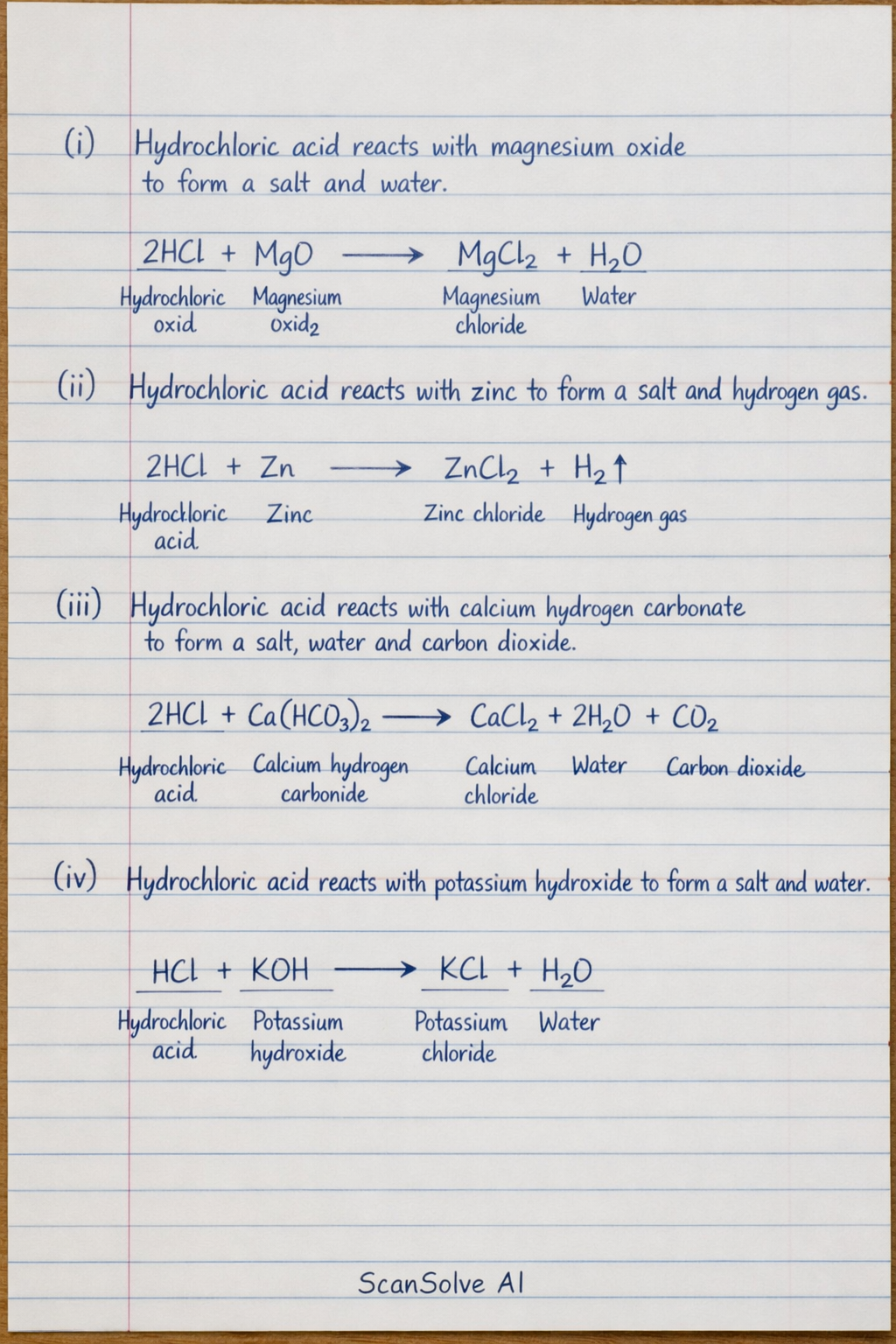
Handwritten Step-by-Step Solution
Get this as a handwritten image on WhatsApp — like a tutor wrote it for you.
Try on WhatsApp