
We read your photo as:
I) Add dilute hydrochloric acid to sodium carbonate in a conical flask.
ScanSolve AI Answer
a)
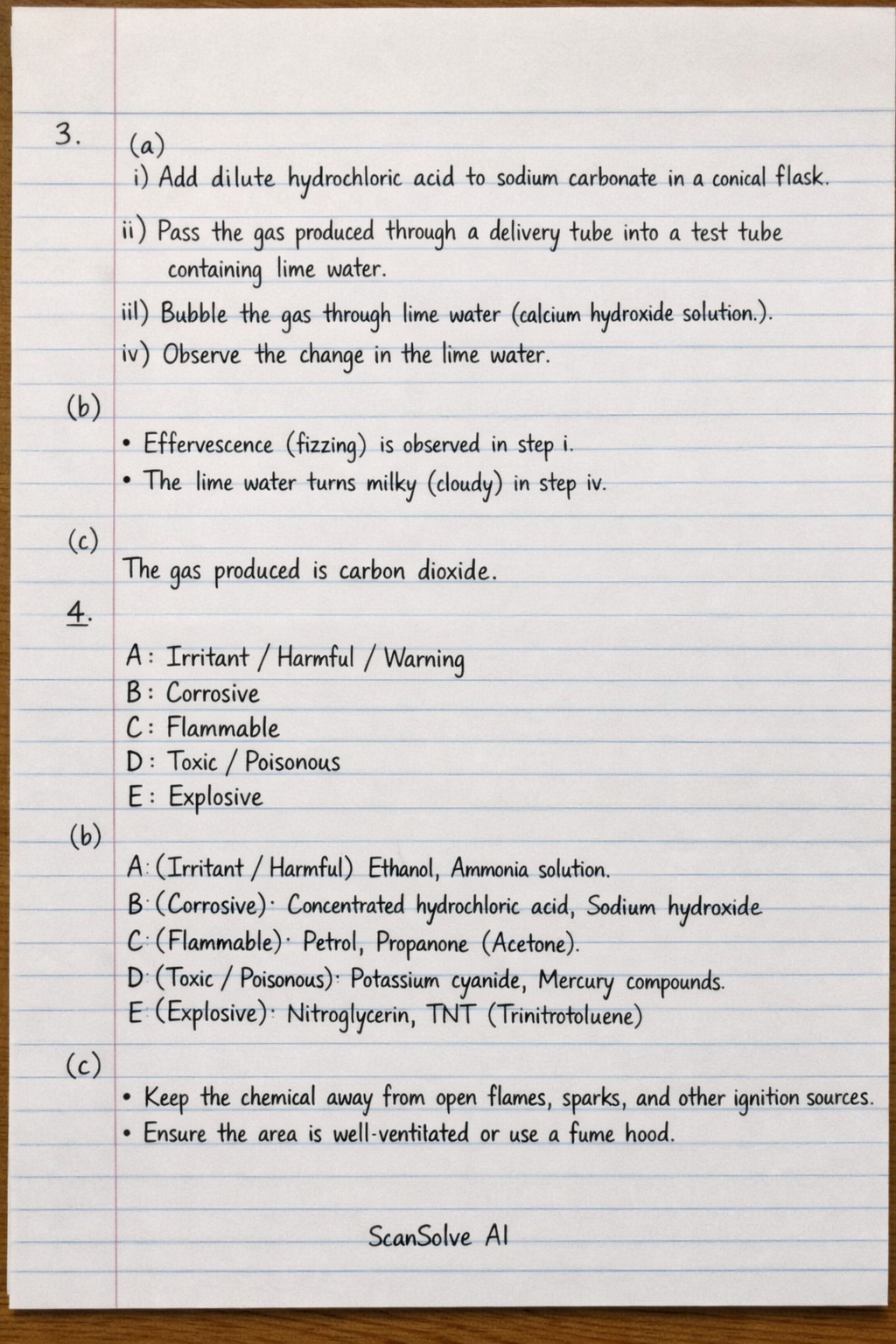
i) Add dilute hydrochloric acid to sodium carbonate in a conical flask.
ii) Pass the gas produced through a delivery tube into a test tube containing lime water.
iii) Bubble the gas through lime water (calcium hydroxide solution).
iv) Observe the change in the lime water.
b)
- Effervescence (fizzing) is observed in step I.
- The lime water turns milky (cloudy) in step IV.
c) The gas produced is carbon dioxide.
a)
A: Irritant / Harmful / Warning
B: Corrosive
C: Flammable
D: Toxic / Poisonous
E: Explosive
b)
A (Irritant/Harmful): Ethanol, Ammonia solution
B (Corrosive): Concentrated hydrochloric acid, Sodium hydroxide
C (Flammable): Petrol, Propanone (Acetone)
D (Toxic/Poisonous): Potassium cyanide, Mercury compounds
E (Explosive): Nitroglycerin, TNT (Trinitrotoluene)
c)
- Keep the chemical away from open flames, sparks, and other ignition sources.
- Ensure the area is well-ventilated or use a fume hood.
Still stuck on this one?
Ask a follow-up, and the answer starts from this question.
More Chemistry Questions
Handwritten Step-by-Step Solution
Get this as a handwritten image on WhatsApp — like a tutor wrote it for you.
Try on WhatsApp