
We read your photo as:
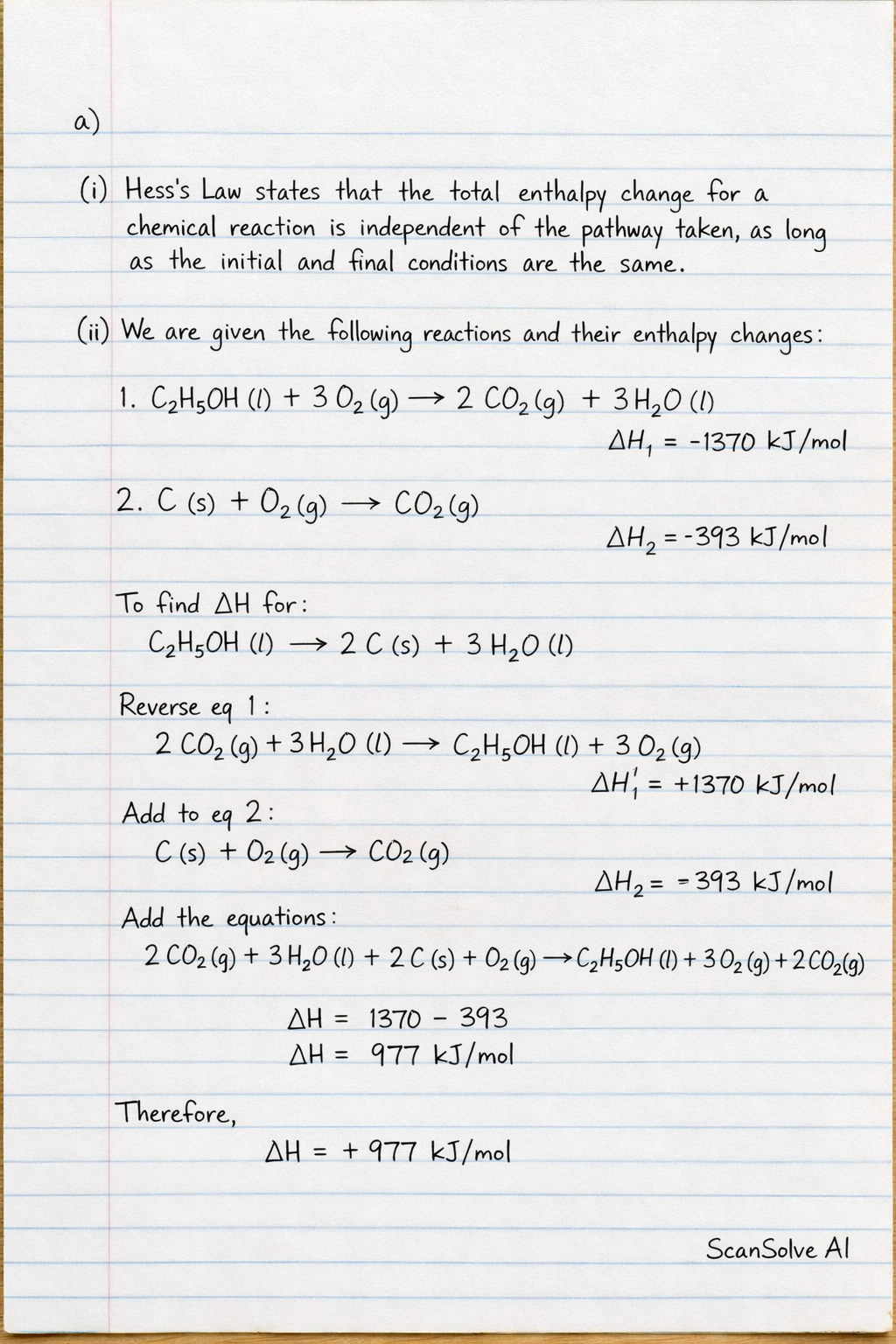
Hess's Law states that the total enthalpy change for a chemical reaction is independent of the pathway taken, as long as the initial and final conditions are the same.
Chemistry
ScanSolve AI Answer
Here's the solution to your question:
a)
(i) Hess's Law states that the total enthalpy change for a chemical reaction is independent of the pathway taken, as long as the initial and final conditions are the same.
(ii) We are given the following reactions and their enthalpy changes:
- $\text{C}_
Was this helpful?
Still stuck on this one?
Ask a follow-up, and the answer starts from this question.
Got a different question?Ask your own question
More Chemistry Questions
QA) Hess's Law of Constant Heat Summation states that the total enthalpy change for a chemical…QA) i) State Hess's law. ii) State the standard conditions for enthalpy measurement.QState Hess's Law of constant heat summation. ii. From the H enthalpy values, determine the amount of…QState Hess's law of constant heat summation.QWhat is hess law
Handwritten Step-by-Step Solution
Get this as a handwritten image on WhatsApp — like a tutor wrote it for you.
Try on WhatsApp