We read your photo as:

I) Hydroxonium ion ii) Ammonium ion. 4. Calculate the volume of acidified potassium manganate(VII) required to react with 200 cm3 of 0.02 mol dm-3 hydrogen peroxide. The equation is 2MnO4-(aq) + 6H+(a

Chemistry

ScanSolve AI Answer

This answer stops before the end.

It was cut off when it was first written. Ask ScanSolve this question again for the full working.

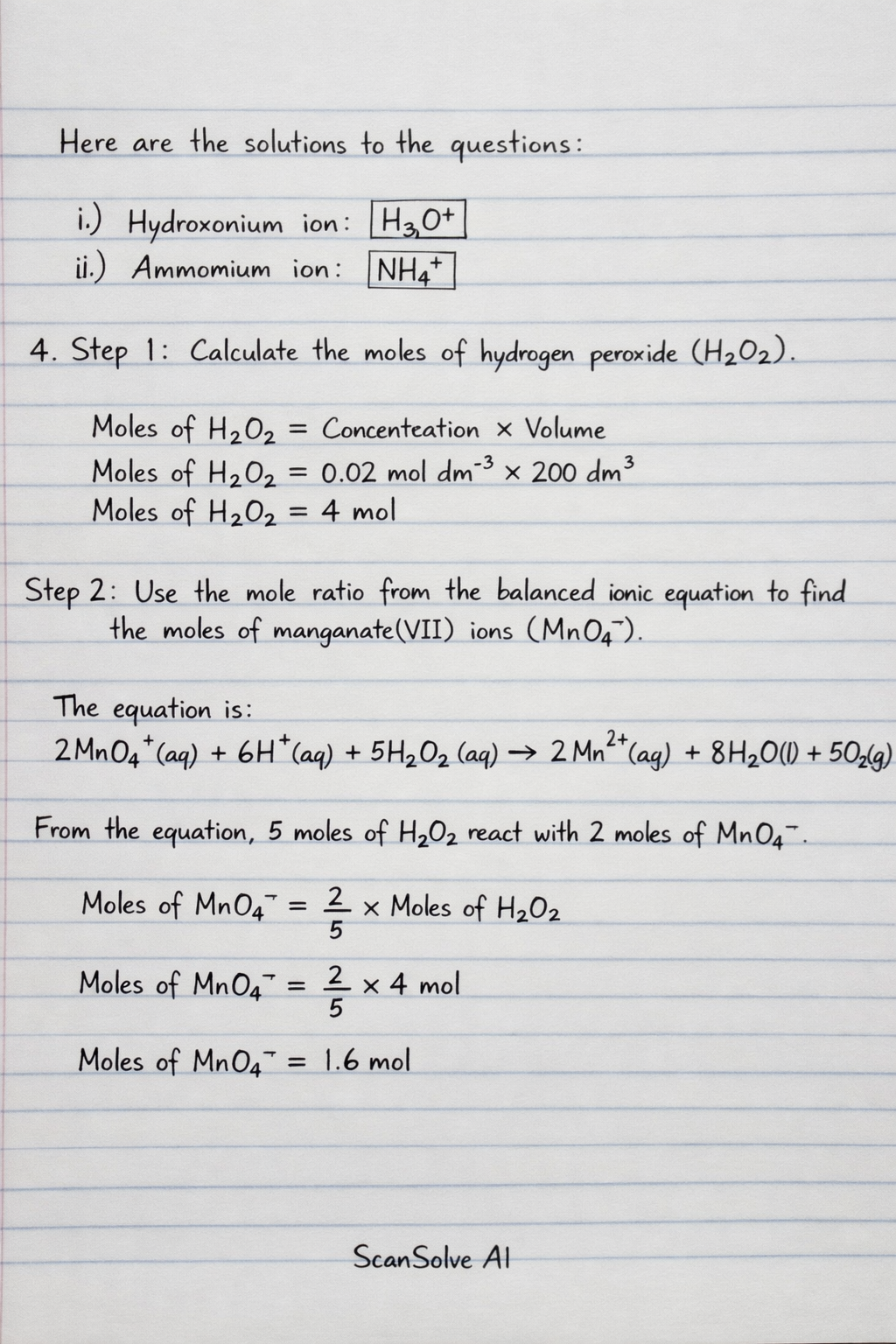
Here are the solutions to the questions:

  1. i) Hydroxonium ion: H3O+\boxed{\text{H}_3\text{O}^+} ii) Ammonium ion: NH4+\boxed{\text{NH}_4^+}

  2. Step 1: Calculate the moles of hydrogen peroxide (H2O2\text{H}_2\text{O}_2).

    Moles of H2O2=Concentration×Volume\text{Moles of H}_2\text{O}_2 = \text{Concentration} \times \text{Volume} Moles of H2O2=0.02 mol dm−3×200 dm3=4 mol\text{Moles of H}_2\text{O}_2 = 0.02 \text{ mol dm}^{-3} \times 200 \text{ dm}^3 = 4 \text{ mol}

    Step 2: Use the mole ratio from the balanced ionic equation to find the moles of manganate(VII) ions (MnO4−\text{MnO}_4^-).
    The equation is: 2MnO4−(aq)+6H+(aq)+5H2O2(aq)⟶2Mn2+(aq)+8H2O(l)+5O2(g)2\text{MnO}_4^-(\text{aq}) + 6\text{H}^+(\text{aq}) + 5\text{H}_2\text{O}_2(\text{aq}) \longrightarrow 2\text{Mn}^{2+}(\text{aq}) + 8\text{H}_2\text{O}(\text{l}) + 5\text{O}_2(\text{g})
    From the equation, 5 moles of H2O25 \text{ moles of H}_2\text{O}_2 react with 2 moles of MnO4−2 \text{ moles of MnO}_4^-.

    Moles of MnO4−=25×Moles of H2O2\text{Moles of MnO}_4^- = \frac{2}{5} \times \text{Moles of H}_2\text{O}_2 Moles of MnO4−=25×4 mol=1.6 mol\text{Moles of MnO}_4^- = \frac{2}{5} \times 4 \text{ mol} = 1.6 \text{ mol}

    Step 3: Calculate the volume of acidified potassium manganate(VII).

    Volume of KMnO4=Moles of MnO4−Concentration of KMnO4\text{Volume of KMnO}_4 = \frac{\text{Moles of MnO}_4^-}{\text{Concentration of KMnO}_4} Volume of KMnO4=1.6 mol0.02 mol dm−3=80 dm3\text{Volume of KMnO}_4 = \frac{1.6 \text{ mol}}{0.02 \text{ mol dm}^{-3}} = 80 \text{ dm}^3

    The volume of acidified potassium manganate(VII) is 80 dm3\boxed{80 \text{ dm}^3}.

  3. Step 1: Calculate the moles of magnesium (Mg).

    Moles of Mg=Mass of MgMolar mass of Mg\text{Moles of Mg} = \frac{\text{Mass of Mg}}{\text{Molar mass of Mg}} Moles of Mg=3.6 g24 g/mol=0.15 mol\text{Moles of Mg} = \frac{3.6 \text{ g}}{24 \text{ g/mol}} = 0.15 \text{ mol}

    Step 2: Calculate the mass of chlorine (Cl) in the chloride formed.

Was this helpful?

Still stuck on this one?

Ask a follow-up, and the answer starts from this question.

Got a different question?Ask your own question
Handwritten step-by-step solution preview

Handwritten Step-by-Step Solution

Get this as a handwritten image on WhatsApp — like a tutor wrote it for you.

Try on WhatsApp