
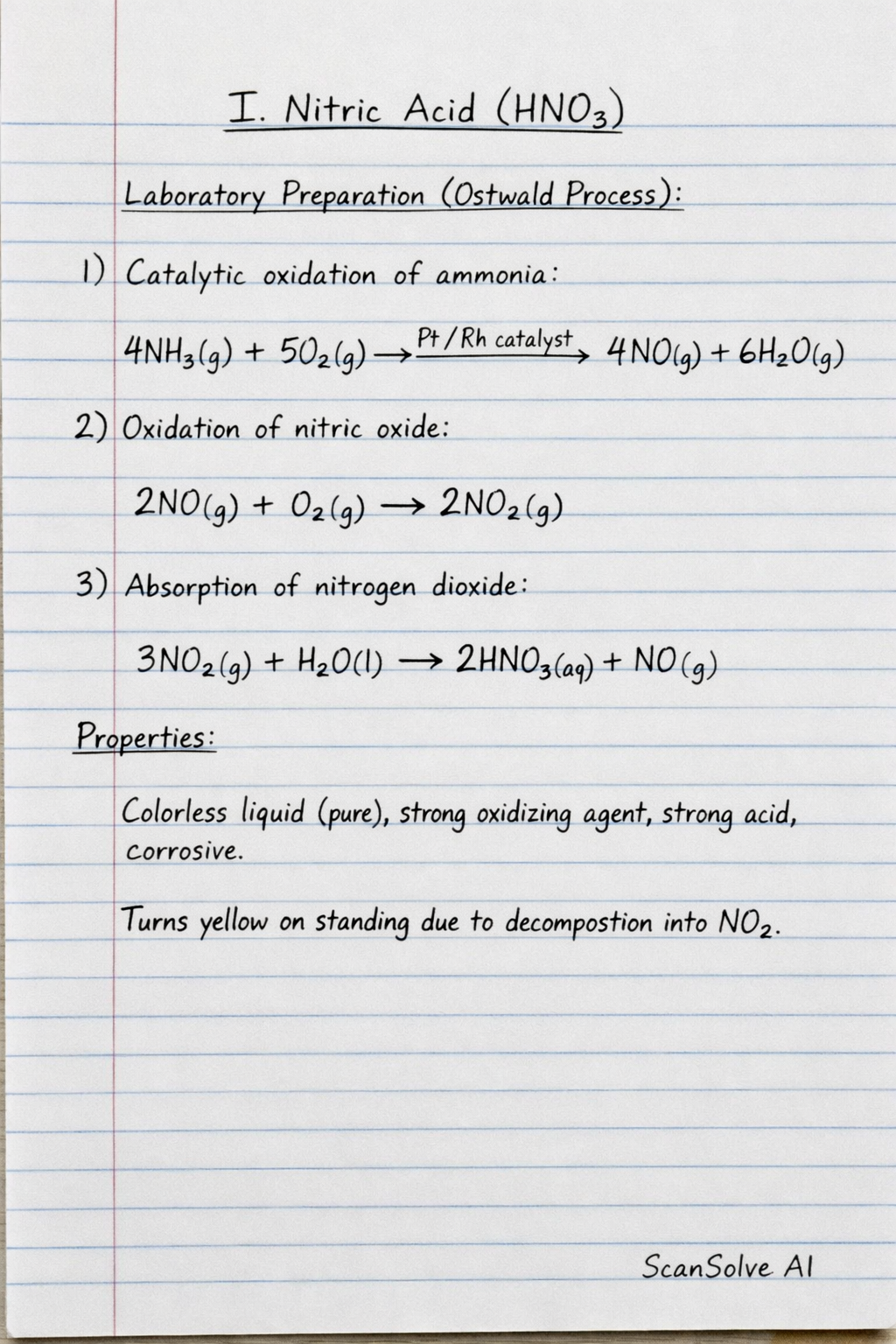
We read your photo as:
I. Nitric Acid (HNO₃)
Chemistry
ScanSolve AI Answer
Here is an explanation of the topics outlined in your image:
I. Nitric Acid ()
- Laboratory Preparation from Ammonia (Ostwald Process): This is an industrial process, not typically a lab preparation. It involves three main steps:
- Catalytic oxidation of ammonia: Ammonia is oxidized with air over a platinum-rhodium catalyst at high temperature.
- Oxidation of nitric oxide: Nitric oxide reacts with excess oxygen to form nitrogen dioxide.
- Absorption of nitrogen dioxide: Nitrogen dioxide is absorbed in water to form nitric acid.
- Properties: Colorless liquid (pure), strong oxidizing agent, strong acid, corrosive. It turns yellow on standing due to decomposition into nitrogen dioxide.
- Uses: Manufacture of fertilizers (e.g., ammonium nitrate), explosives (e.g., nitroglycerin, TNT), dyes, and plastics.
- Oxides of Nitrogen:
- Nitrous oxide (): Colorless gas, "laughing gas," neutral oxide.
- Nitric oxide (): Colorless gas, reacts with oxygen to form , neutral oxide.
- Nitrogen dioxide (): Reddish-brown gas, pungent odor, acidic oxide, contributes to acid rain.
- Dinitrogen trioxide (): Blue liquid, acidic oxide.
- Dinitrogen tetroxide (): Colorless gas/liquid, exists in equilibrium with .
- Dinitrogen pentoxide (): White solid, acidic oxide.
II. Carbon
- Allotropes: Uses & Properties:
- Diamond:
- Properties: Extremely hard, high melting point, non-conductor of electricity, transparent, high refractive index.
- Uses: Cutting tools (drills, saws), abrasives, jewelry.
- Graphite:
- Properties: Soft, slippery, good conductor of electricity, high melting point, opaque.
- Uses: Pencil leads, lubricants, electrodes in electrolysis, moderator in nuclear reactors.
- Amorphous Carbon (e.g., charcoal, coke, carbon black):
- Properties: Irregular structure, porous, good adsorbent.
- Uses: Adsorbent (activated charcoal), fuel, pigment (carbon black).
- Diamond:
- Laboratory Preparation of Carbon Dioxide (): Reaction of a carbonate (like calcium carbonate, marble chips) with a dilute acid (like hydrochloric acid).
- Properties and Uses of Carbon Dioxide ():
- Properties: Colorless, odorless gas, denser than air, sparingly soluble in water (forming carbonic acid), does not support combustion, sublimes at (dry ice).
- Uses: Fire extinguishers, carbonation of beverages, refrigerant (dry ice), photosynthesis in plants.
- Carbon (II) Oxide (Carbon Monoxide, ):
- Properties: Colorless, odorless, highly toxic gas, slightly less dense than air, burns with a blue flame, good reducing agent.
- Formation: Incomplete combustion of carbon-containing fuels (e.g., in car engines, charcoal grills with insufficient oxygen).
- Coal: A fossil fuel formed from the decomposition of plant matter over millions of years under heat and pressure. It is primarily composed of carbon with varying amounts of other elements.
- Uses: Major source of energy for electricity generation, production of coke, and as a chemical feedstock.
- Coke: A solid carbonaceous residue derived from destructive distillation of coal in the absence of air. It is a purer form of carbon than coal.
- Uses: Reducing agent in blast furnaces for iron extraction, fuel (e.g., in foundries), production of synthesis gas.
Was this helpful?
Still stuck on this one?
Ask a follow-up, and the answer starts from this question.
Got a different question?Ask your own question
More Chemistry Questions
QCalculate the moles of nitric acid (HNO₃) used.QI: Concentrated sulphuric acidQThe following flow chart shows the industrial manufacture of Nitric (V) acid. a) Identify substance…QYou are provided with HNO3 with 70% purity and density of 1.38 g/cm³. Calculate: (i) the…QSolution A: Sulfuric Acid (H2SO4)
Handwritten Step-by-Step Solution
Get this as a handwritten image on WhatsApp — like a tutor wrote it for you.
Try on WhatsApp