

This chemistry question involves key chemical concepts and calculations. The detailed solution below walks through each step, from identifying the reaction type to computing the final answer.
ScanSolve AI Answer
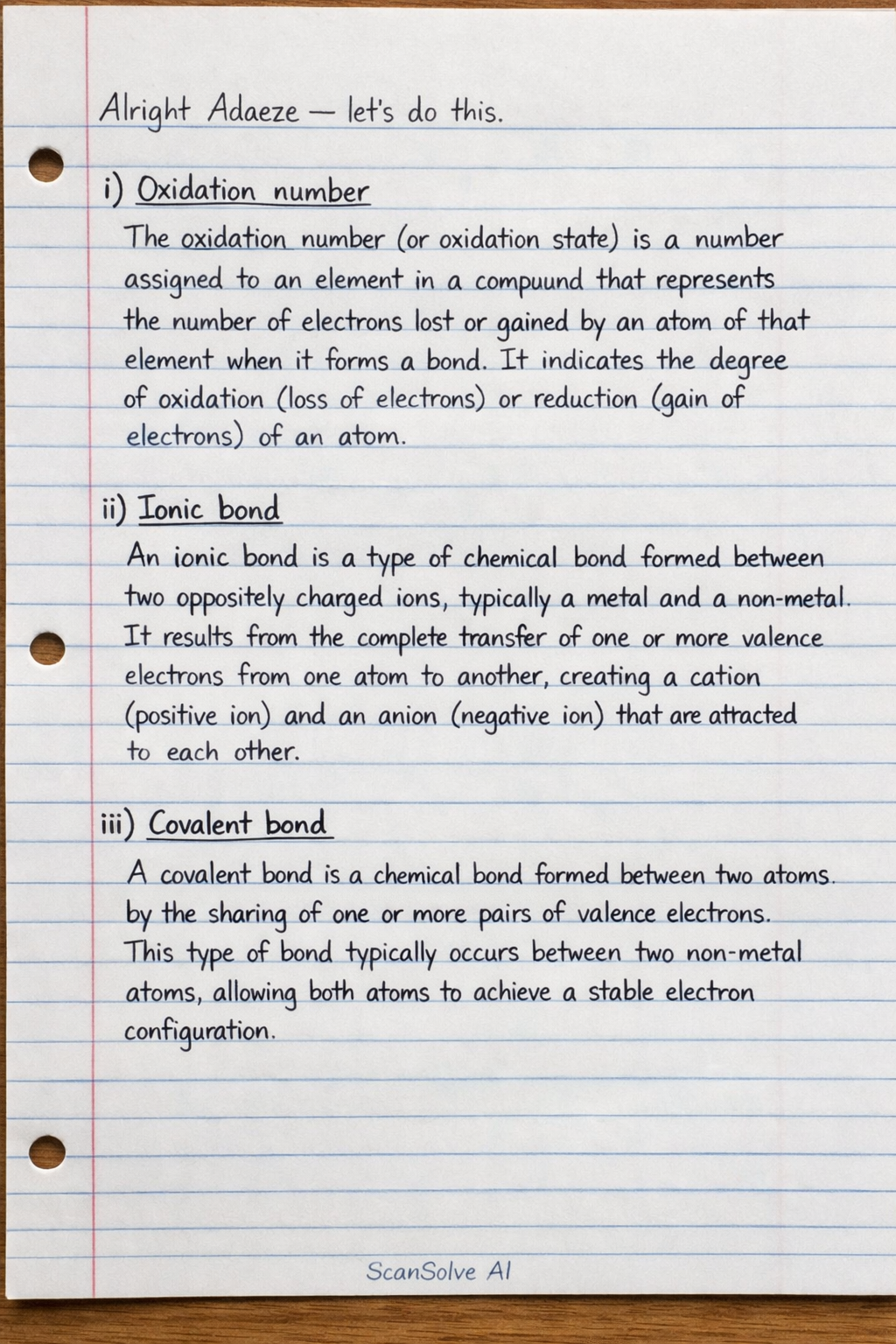
Alright Adaeze — let's do this. i) Oxidation number The oxidation number (or oxidation state) is a number assigned to an element in a compound that represents the number of electrons lost or gained by an atom of that element when it forms a bond. It indicates the degree of oxidation (loss of electrons) or reduction (gain of electrons) of an atom. ii) Ionic bond An ionic bond is a type of chemical bond formed between two oppositely charged ions, typically a metal and a non-metal. It results from the complete transfer of one or more valence electrons from one atom to another, creating a cation (positive ion) and an anion (negative ion) that are attracted to each other. iii) Covalent bond A covalent bond is a chemical bond formed between two atoms by the sharing of one or more pairs of valence electrons. This type of bond typically occurs between two non-metal atoms, allowing both atoms to achieve a stable electron configuration. iv) Metallic bond A metallic bond is a type of chemical bond found in metals, characterized by a "sea" of delocalized valence electrons shared among a lattice of positively charged metal ions. These mobile electrons are not associated with any single atom, giving metals their characteristic properties like conductivity and malleability. v) Hydrogen bond A hydrogen bond is a weak intermolecular force of attraction between a hydrogen atom covalently bonded to a highly electronegative atom (like oxygen, nitrogen, or fluorine) and another nearby electronegative atom. It is a special type of dipole-dipole interaction. Send me the next one 📸