
We read your photo as:
How do I record and calculate my burette readings and average volume for a titration experiment, given methyl orange as the indicator?
ScanSolve AI Answer
Answer
Step-by-step solution
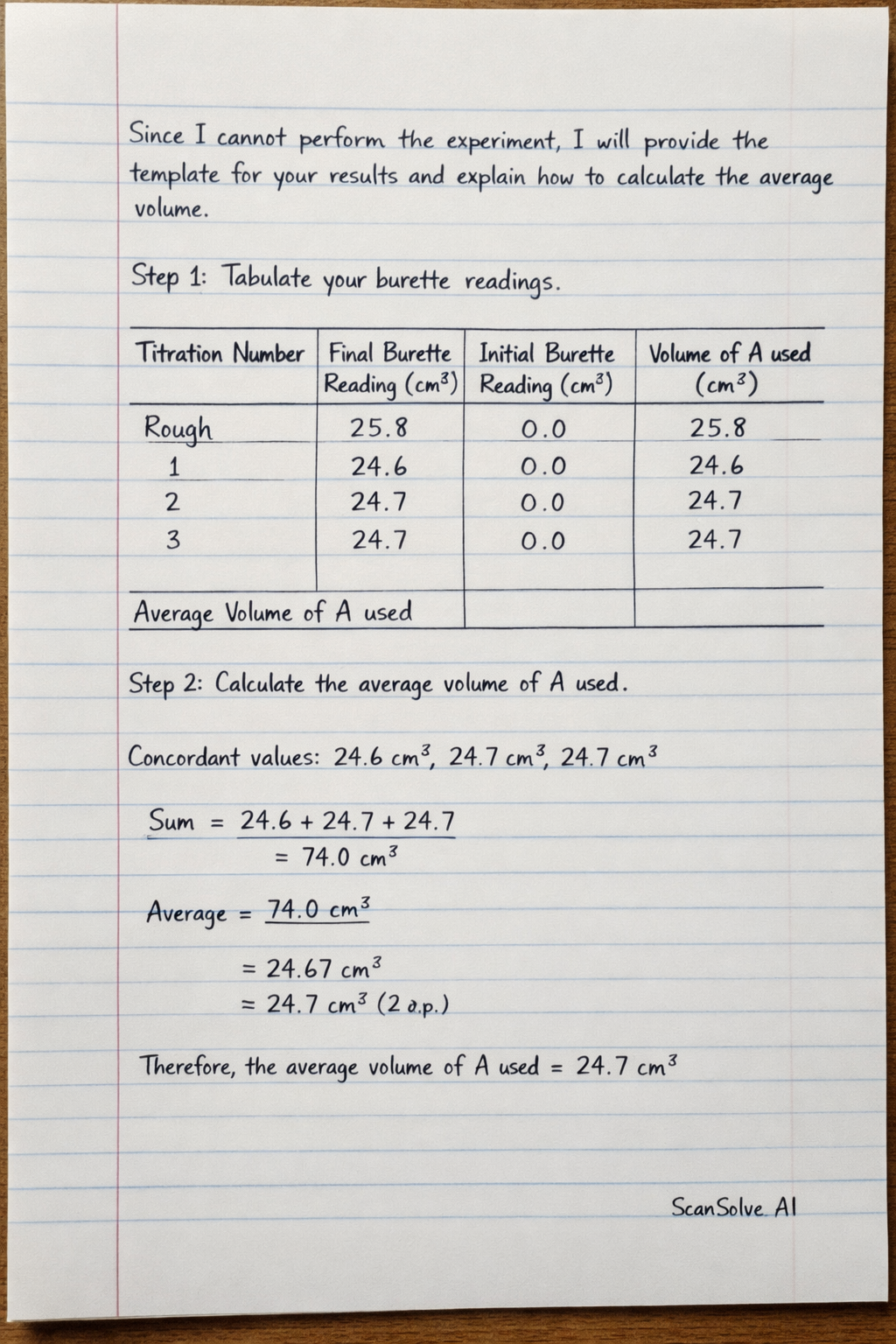
3 stepsSince I cannot perform the experiment, I will provide the template for your results and explain how to calculate the average volume.
Tabulate your burette readings.
You should record your initial and final burette readings, and then calculate the volume of solution A used for each titration. Aim for at least two concordant readings (within of each other).
Calculate the average volume of A used.
Select the concordant titre values (those that are very close to each other, typically within ). Sum these concordant values and divide by the number of values.
For example, if your concordant readings were , , and :
Indicator information.
The indicator specified is methyl orange. In an acidic solution, methyl orange is red/pink. In a basic solution, it is yellow. At the endpoint of this titration (weak acid with strong base), the color change will be from yellow to orange.
Still stuck on this one?
Ask a follow-up, and the answer starts from this question.
More Chemistry Questions
Handwritten Step-by-Step Solution
Get this as a handwritten image on WhatsApp — like a tutor wrote it for you.
Try on WhatsApp