
We read your photo as:
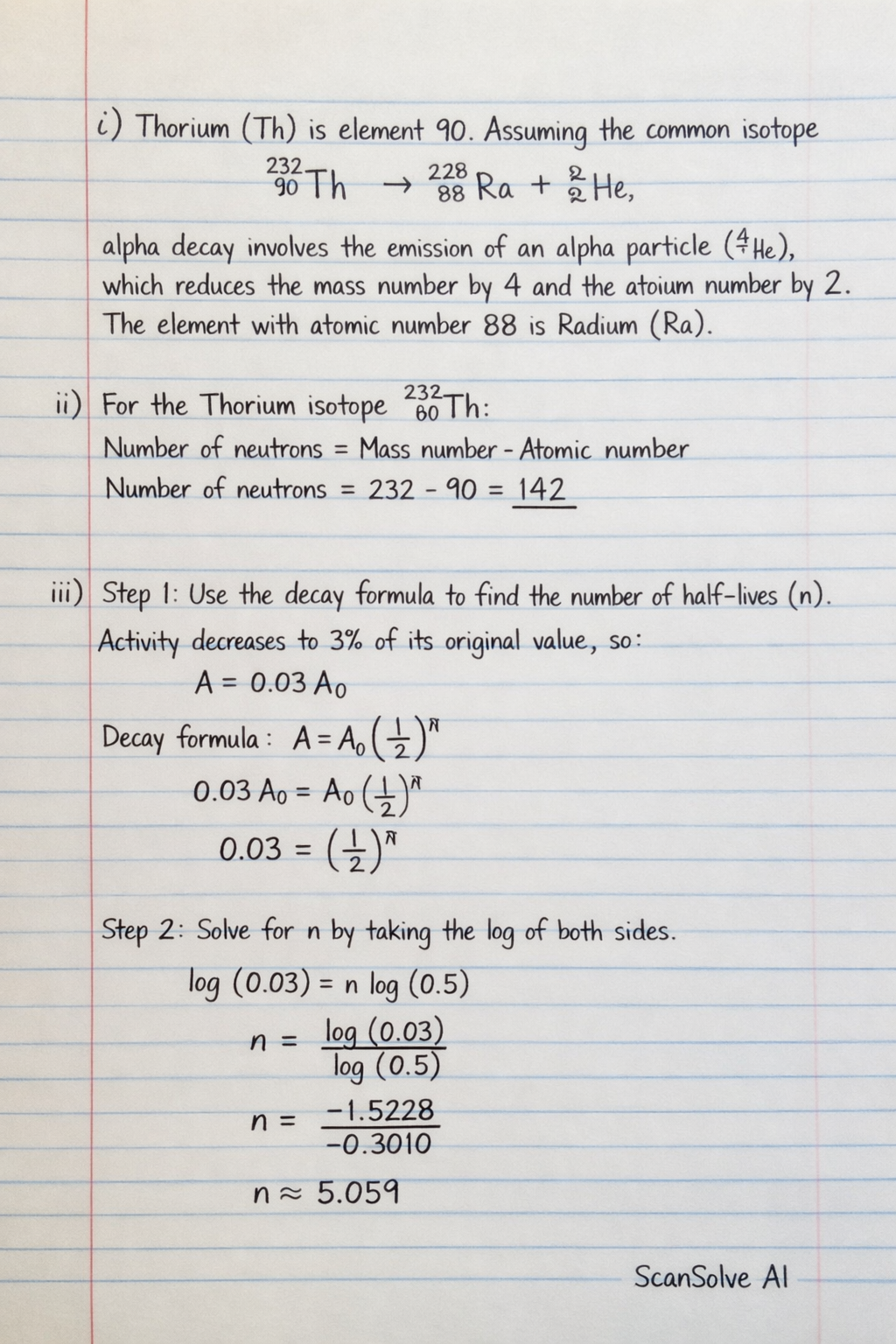
I) Thorium (Th) is element 90. Assuming the common isotope 232Th, alpha decay involves the emission of an alpha particle (42He), which reduces the mass number by 4 and the ato
ScanSolve AI Answer
Answers
2 partsStep-by-step solution
3 stepsPart c(ii)
For the Thorium isotope
i) Thorium (Th) is element 90. Assuming the common isotope , alpha decay involves the emission of an alpha particle (), which reduces the mass number by 4 and the atomic number by 2. The element with atomic number 88 is Radium (Ra).
Number of neutrons = Mass number - Atomic number
Part c(iii)
Use the decay formula to find the number of half-lives ().
The activity () decreases to 3% of its original value (), so .
The decay formula is .Solve for by taking the logarithm of both sides.
Calculate the total time ().
Given half-life () = 24 days.
Part d
i) The observation that led to the conclusion that the nucleus is present in the atom was that a very small fraction of alpha particles were deflected at large angles, with some even bouncing back. This indicated a small, dense, positively charged region within the atom.
ii) The observation that led to the conclusion that most of the atom is voluminous and comprises mostly of negatively charged particles of negligible mass was that most alpha particles passed straight through the gold foil without any deflection. This indicated that the atom is largely empty space, with electrons occupying a large volume but contributing little to the atom's mass or ability to deflect alpha particles.
Part e
i) The line emission spectrum of atomic hydrogen consists of discrete, distinct lines of specific wavelengths (or frequencies), rather than a continuous band. These lines are grouped into series (e.g., Lyman in the ultraviolet, Balmer in the visible, Paschen in the infrared), with the lines within each series converging at higher frequencies/shorter wavelengths.
ii) For a chloride ion (), which has 18 electrons (), a graph of against the number of electrons removed would show a general increase. There would be significant jumps in ionization energy when an electron is removed from a new, more stable, inner electron shell. Specifically, a large jump would occur after the 8th electron is removed (moving from the shell to the shell), and another large jump would occur after the 16th electron is removed (moving from the shell to the shell). The graph would appear as a series of increasing steps.
Try one yourself
A new problem that tests the same skill.
Still stuck on this one?
Ask a follow-up, and the answer starts from this question.
More Chemistry Questions
Handwritten Step-by-Step Solution
Get this as a handwritten image on WhatsApp — like a tutor wrote it for you.
Try on WhatsApp