
We read your photo as:
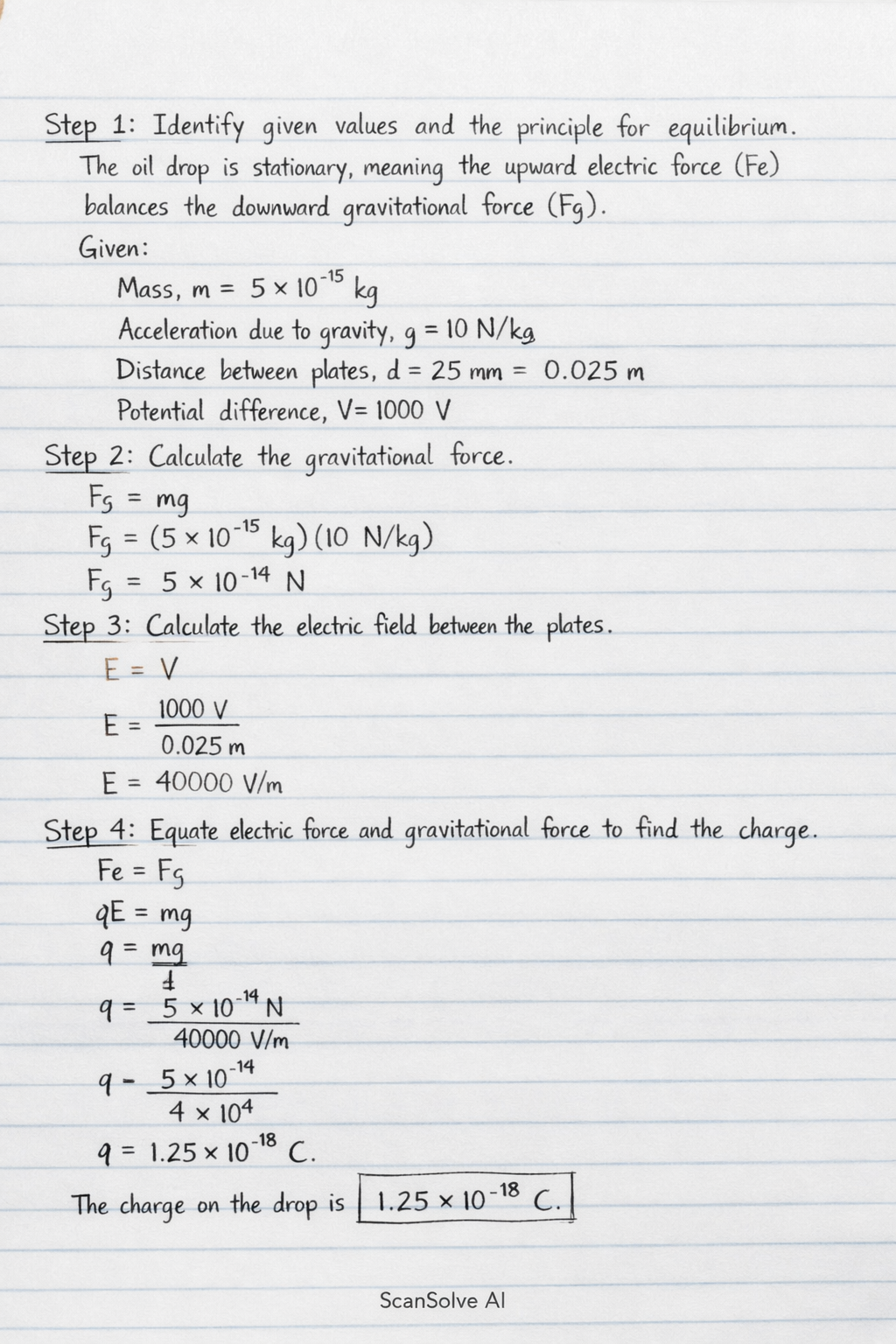
Identify given values and the principle for equilibrium.
ScanSolve AI Answer
Answers
5 partsStep-by-step solution
13 stepsStep 1: Identify given values and the principle for equilibrium.
The oil drop is stationary, meaning the upward electric force () balances the downward gravitational force ().
Given:
Mass,
Acceleration due to gravity,
Distance between plates,
Potential difference,
Step 2: Calculate the gravitational force.
Step 3: Calculate the electric field between the plates.
Step 4: Equate electric force and gravitational force to find the charge.
The charge on the drop is .
Part a· 2 steps
The capacitance of and in series.
Identify given values and the formula for the time constant.
Given:
Resistance,
Time constant,
The time constant for an RC circuit is given by , where is the equivalent capacitance.Calculate the equivalent capacitance .
The capacitance of and in series is .
Part b
The capacitance of if has a capacitance of .
Identify given values and the formula for capacitors in series.
Given:
Equivalent capacitance, (from part a))
Capacitance of
For capacitors in series, the equivalent capacitance is given by:Solve for .
The capacitance of is .
Part b(i)
The current in the resistor.
Identify given values and the circuit configuration.
Given:
Current in resistor,
The and resistors are connected in parallel. In a parallel circuit, the voltage across each branch is the same.Calculate the voltage across the resistor.
Using Ohm's Law, :
Calculate the current in the resistor.
Since the resistors are in parallel, .
The current in the resistor is .
Part b(ii)
The internal resistance, .
Calculate the total current flowing from the battery.
The total current () is the sum of the currents in the parallel branches.
Calculate the equivalent resistance of the parallel combination.
For parallel resistors:
Calculate the total external resistance.
The parallel combination () is in series with the resistor.
Use the EMF equation to find the internal resistance .
Given EMF, .
The total current from the battery is given by:Divide both sides by :
The internal resistance is .
Part b(iii)
The terminal potential difference of the battery.
Use the formula for terminal potential difference.
The terminal potential difference () is given by:
Given:
EMF,
Total current, (from part ii))
Internal resistance, (from part ii))Calculate .
The terminal potential difference of the battery is .
Try one yourself
A new problem that tests the same skill.
Still stuck on this one?
Ask a follow-up, and the answer starts from this question.
More Chemistry Questions
Handwritten Step-by-Step Solution
Get this as a handwritten image on WhatsApp — like a tutor wrote it for you.
Try on WhatsApp