

This mathematics problem involves applying core mathematical principles and formulas. Below you will find a complete step-by-step solution with detailed explanations for each step, helping you understand not just the answer but the method behind it.
ScanSolve AI Answer
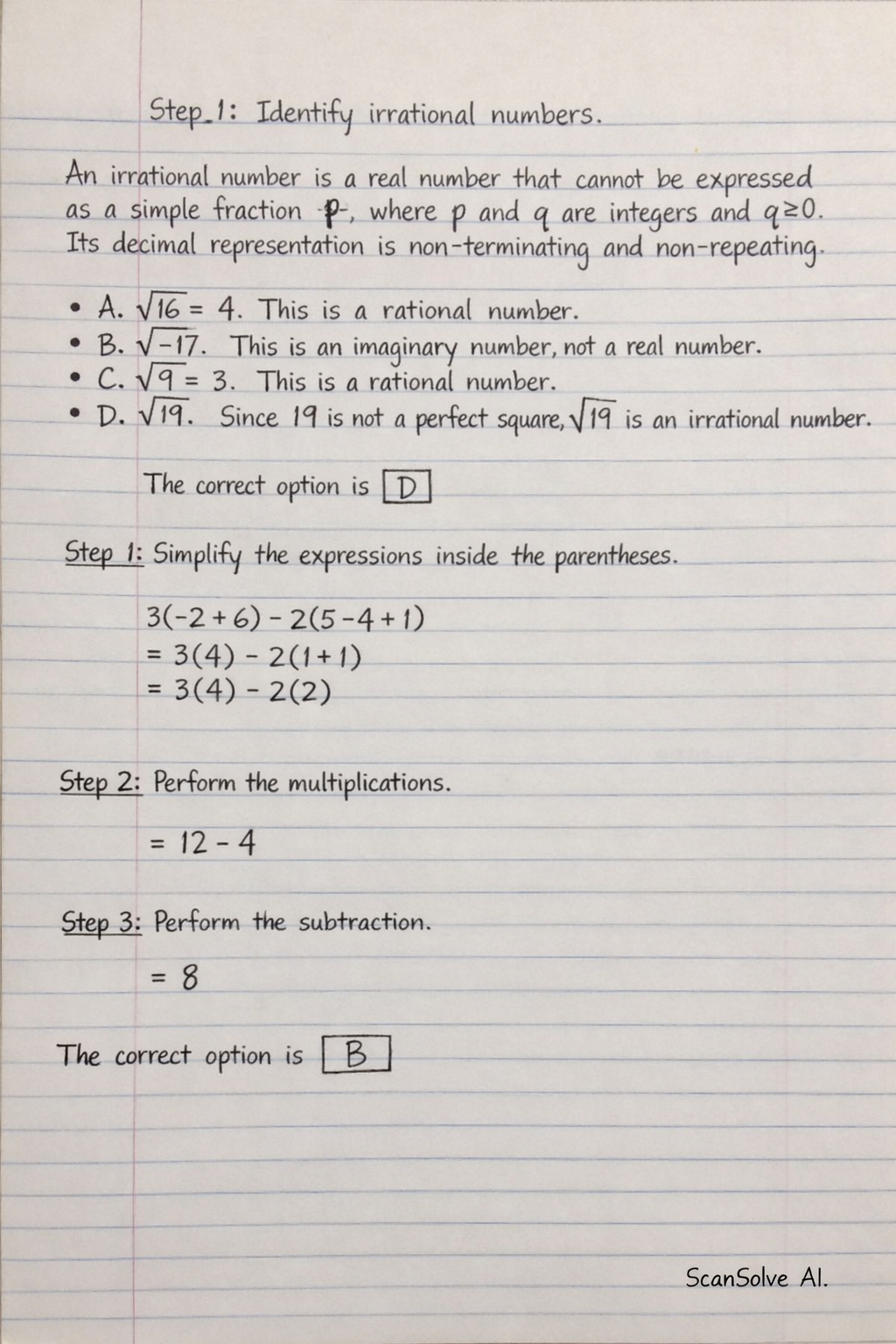
Step 1: Identify irrational numbers. An irrational number is a real number that cannot be expressed as a simple fraction (p)/(q), where p and q are integers and q ≠ 0. Its decimal representation is non-terminating and non-repeating. A: sqrt(16) = 4. This is a rational number. B: sqrt(-17). This is an imaginary number, not a real number. C: sqrt(9) = 3. This is a rational number. D: sqrt(19). Since 19 is not a perfect square, sqrt(19) is an irrational number. The correct option is D. D Step 1: Simplify the expressions inside the parentheses. 3(-2+6) - 2(5-4+1) = 3(4) - 2(1+1) = 3(4) - 2(2) Step 2: Perform the multiplications. = 12 - 4 Step 3: Perform the subtraction. = 8 The correct option is B. B Step 1: Move the decimal point to the right until there is only one non-zero digit to its left. The number is 0.0000125. Move the decimal point 5 places to the right to get 1.25. Step 2: Determine the power of 10. Since the decimal point was moved 5 places to the right, the exponent of 10 is -5. 0.0000125 = 1.25 × 10^-5 The correct option is B. B Step 1: Apply the exponent rule x^m × x^n = x^m+n for the base a. a^3 × a^2 c = a^3+2 c Step 2: Simplify the exponent. = a^5 c The correct option is A. A Step 1: Express the base 4 as a power of 2. 4 = 2^2 Substitute this into the expression: 4^x+12^x = (2^2)^x+12^x Step 2: Apply the exponent rule (x^m)^n = x^mn to the numerator. = 2^2(x+1)2^x = 2^2x+22^x Step 3: Apply the exponent rule (x^m)/(x^n) = x^m-n. = 2^(2x+2) - x = 2^2x - x + 2 = 2^x+2 The correct option is C. C Step 1: Rewrite terms with negative exponents using x^-n = (1)/(x^n). 2^-2 × 6^3 × 3^-2 = (1)/(2^2) × 6^3 × (1)/(3^2) Step 2: Calculate the powers. = (1)/(4) × 216 × (1)/(9) Step 3: Multiply the fractions. = (216)/(4 × 9) = (216)/(36) Step 4: Perform the division. = 6 Alternatively: Step 1: Express 6^3 as (2 × 3)^3. 2^-2 × 6^3 × 3^-2 = 2^-2 × (2 × 3)^3 × 3^-2 Step 2: Apply the exponent rule (xy)^n = x^n y^n. = 2^-2 × 2^3 × 3^3 × 3^-2 Step 3: Group terms with the same base and apply x^m × x^n = x^m+n. = (2^-2 × 2^3) × (3^3 × 3^-2) = 2^-2+3 × 3^3-2 = 2^1 × 3^1 Step 4: Perform the multiplication. = 2 × 3 = 6 The correct option is A. A