
We read your photo as:
How many kilometers did he cover in the first 2 hours?
Mathematics
ScanSolve AI Answer
Step-by-step solution
12 stepshere are the solutions to the questions based on the graph:
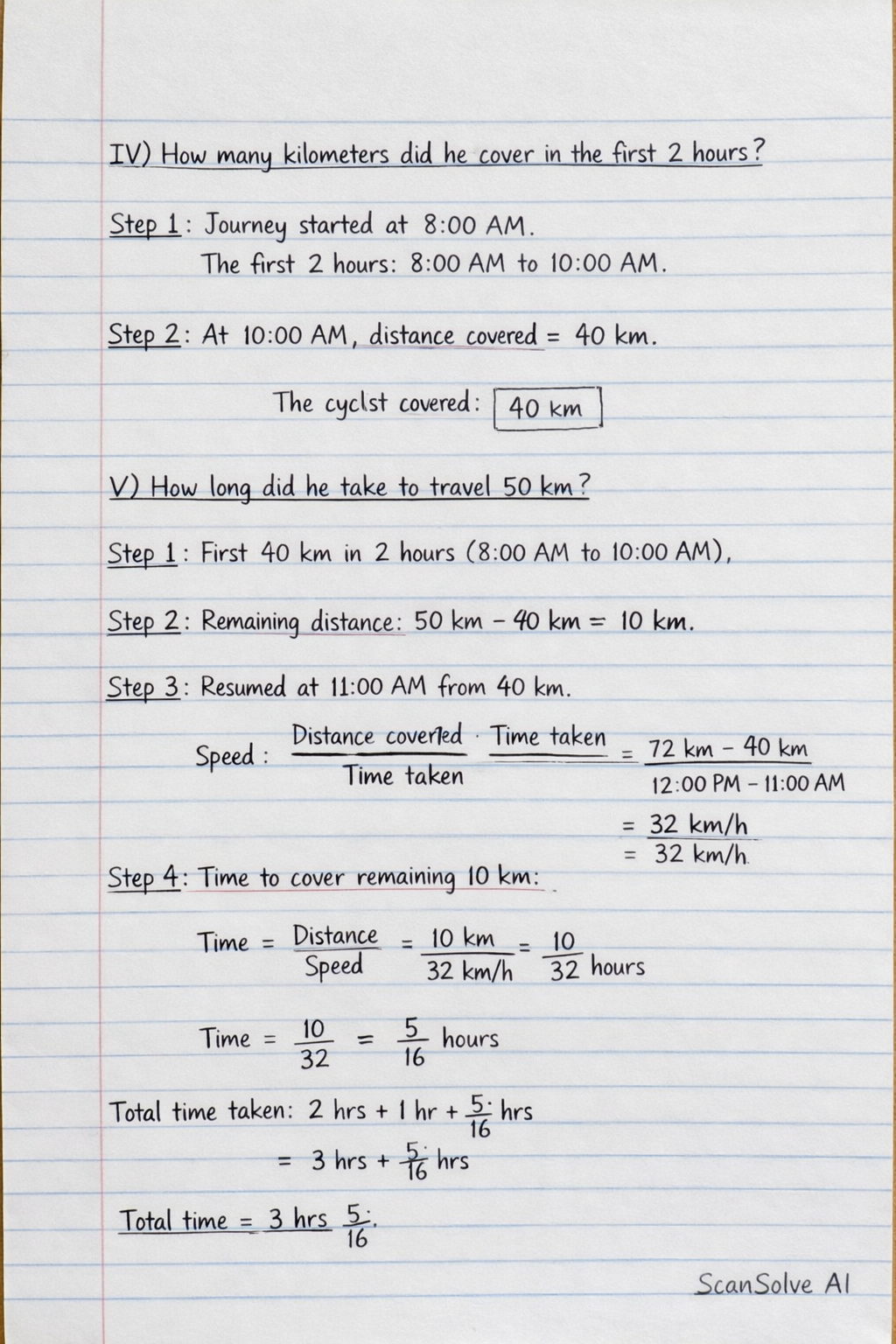
IV) How many kilometers did he cover in the first 2 hours?
The journey started at 8:00 AM.
The first 2 hours would be from 8:00 AM to 10:00 AM.
Looking at the graph, at 10:00 AM, the distance covered is 40 km.
The cyclist covered:
V) How long did he take to travel 50km?
From the graph, the cyclist covered the first 40 km in 2 hours (from 8:00 AM to 10:00 AM).
The remaining distance to reach 50 km is .
After a rest period, the cyclist resumed travel at 11:00 AM from 40 km.
The speed during this final segment (from 11:00 AM to 12:00 PM) is calculated as:
Calculate the time taken to cover the remaining 10 km at this speed
Convert the fractional hours to minutes
Add the time for the first 40 km and the time for the next 10 km to get the total travel time (excluding rest).
Total travel time = 2 hours + 18.75 minutes.
The cyclist took:VI) At what speed was the cyclist travelling between town P and town Q?
Town P is the starting point (0 km) and Town Q is the end point (72 km).
The total distance covered from Town P to Town Q is 72 km.
The total time elapsed from the start (8:00 AM) to the end (12:00 PM) is 4 hours.
Calculate the average speed for the entire journey
The cyclist was travelling at an average speed of:
Was this helpful?
Still stuck on this one?
Ask a follow-up, and the answer starts from this question.
Got a different question?Ask your own question
More Mathematics Questions
QI) How many kilometers did the cyclist cover in the first 2 hours? ii) At what time did the cyclist…QA motorist covered 10.8km in 45 minutes. Calculate his speed in kilometers per hour.QJosephat travelled for 1.5 hours at 116 km/hr, then rested for 30 minutes, and finally travelled 150…QA journey consists of three parts. Part 1: 2 hours at 60 km/h. Part 2: 30 minutes at 10 km/h. Part…QKaari travelled 24 kilometres and arrived at her destination at 10:00 a.m. having left at 8:00 a.m…
Handwritten Step-by-Step Solution
Get this as a handwritten image on WhatsApp — like a tutor wrote it for you.
Try on WhatsApp