
We read your photo as:
Ambrose drives at 50 km/h for 2 hours, rests for 1 hour, and then drives another 70 km in 1.5 hours. Draw a distance-time graph to illustrate the journey.
ScanSolve AI Answer
Step-by-step solution
9 stepshere are the solutions for ITEM 4 and ITEM 5.
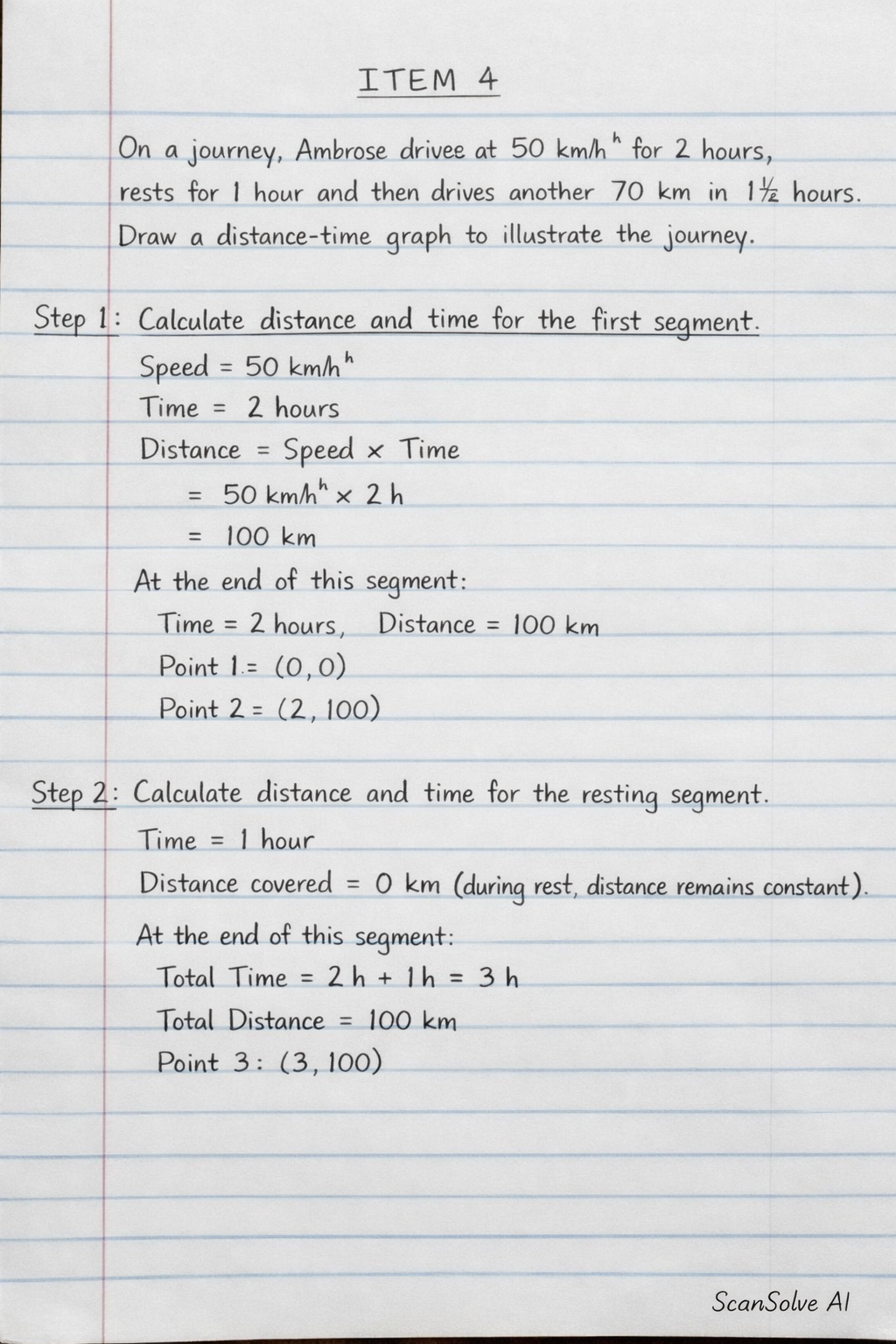
ITEM 4
On a journey, Ambrose drives at for 2 hours, rests for 1 hour and then drives another in hours. Draw a distance time graph to illustrate the journey.
To draw a distance-time graph, we need to determine the total distance covered and the total time taken at different stages of the journey.
Calculate distance and time for the first segment.
- Speed =
- Time = 2 hours
- Distance = Speed Time = At the end of this segment: Time = 2 hours, Distance = 100 km. Point 1: Point 2:
Calculate distance and time for the resting segment.
- Time = 1 hour
- Distance covered = 0 km (during rest, distance remains constant) At the end of this segment: Total Time = , Total Distance = 100 km. Point 3:
Calculate distance and time for the third segment.
- Distance =
- Time = At the end of this segment: Total Time = , Total Distance = . Point 4:
Describe the distance-time graph.
The graph will have "Time (hours)" on the x-axis and "Distance (km)" on the y-axis.
- From to : A straight line with a positive slope, representing constant speed.
- From to : A horizontal line, representing no change in distance (rest period).
- From to : A straight line with a positive slope, representing constant speed.
The key points for the graph are:
- Start:
- After 2 hours:
- After 3 hours (including 1 hour rest):
- After 4.5 hours (total journey):
ITEM 5
In a survey carried out in a vehicle park, it was found that 40% were saloon cars, 25% buses, 20% lorries and 15% motorcycles. Represent this information on a pie-chart.To represent this information on a pie chart, we need to calculate the angle for each category. A full circle is .
Calculate the angle for saloon cars.
Calculate the angle for buses.
Calculate the angle for lorries.
Calculate the angle for motorcycles.
Verify that the sum of the angles is .
The angles are correct. To draw the pie chart, you would divide a circle into sectors with these calculated angles.
Still stuck on this one?
Ask a follow-up, and the answer starts from this question.
More Mathematics Questions
Handwritten Step-by-Step Solution
Get this as a handwritten image on WhatsApp — like a tutor wrote it for you.
Try on WhatsApp