
We read your photo as:
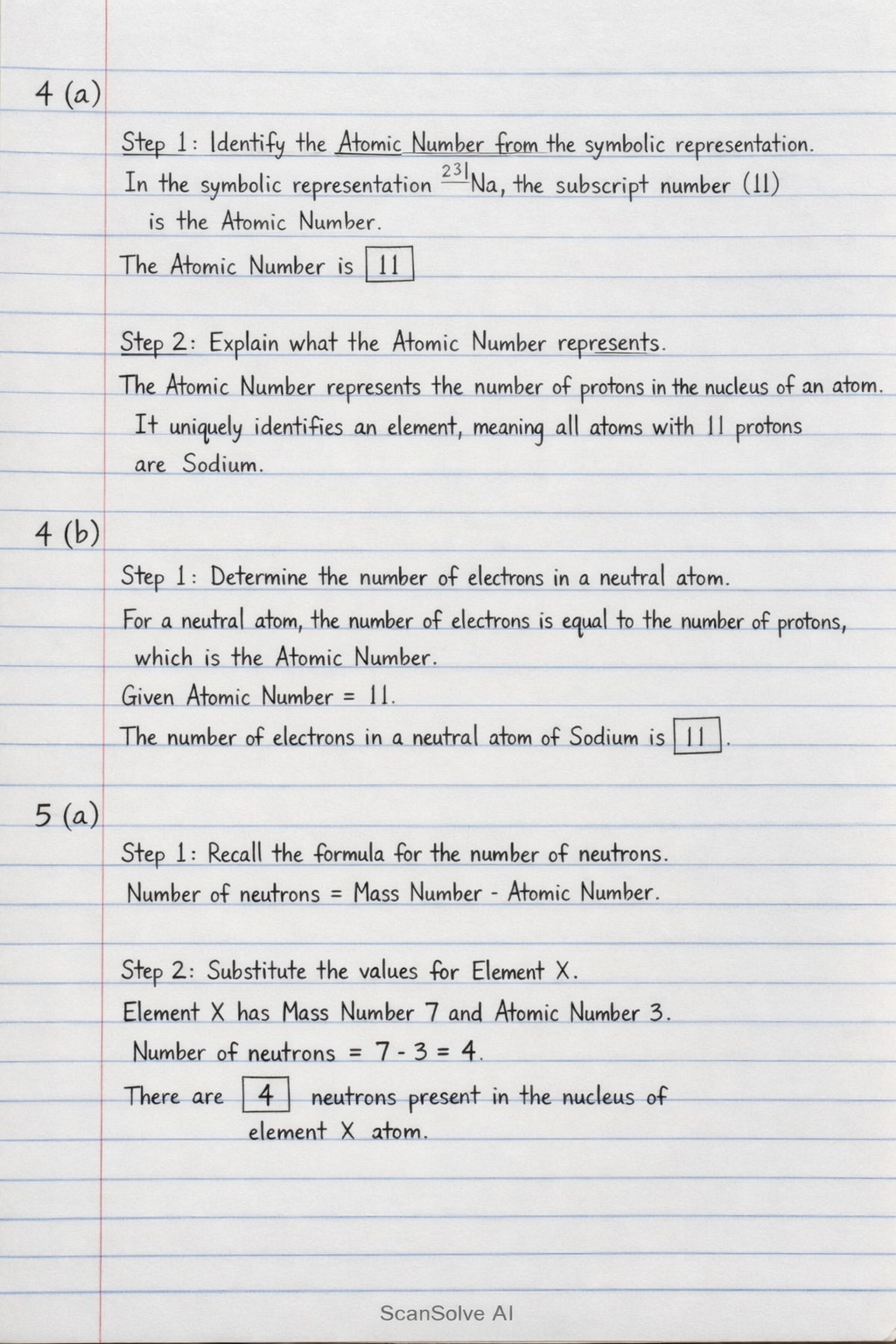
Identify the Atomic Number from the symbolic representation.
ScanSolve AI Answer
Step-by-step solution
11 steps4 (a)
Identify the Atomic Number from the symbolic representation.
In the symbolic representation , the subscript number (11) is the Atomic Number.
The Atomic Number is .Explain what the Atomic Number represents.
The Atomic Number represents the number of protons in the nucleus of an atom. It uniquely identifies an element, meaning all atoms with 11 protons are Sodium.
4 (b)
Determine the number of electrons in a neutral atom.
For a neutral atom, the number of electrons is equal to the number of protons, which is the Atomic Number.
Given Atomic Number = 11.
The number of electrons in a neutral atom of Sodium is .5 (a)
Recall the formula for the number of neutrons.
Number of neutrons = Mass Number - Atomic Number.
Substitute the values for Element X.
Element X has Mass Number 7 and Atomic Number 3.
Number of neutrons = .
There are neutrons present in the nucleus of element X atom.5 (b)
Determine the elements based on their atomic numbers.
Element X has Atomic Number 3 (Lithium, Li).
Element Y has Atomic Number 4 (Beryllium, Be).Determine the electron configurations.
For Element X (Atomic Number 3): . The highest principal energy level is 2.
For Element Y (Atomic Number 4): . The highest principal energy level is 2.Identify the Period.
The period number in the periodic table corresponds to the highest principal energy level (number of electron shells) occupied by electrons. Since both elements have their outermost electrons in the second energy level, they are located in Period .
6 (a)
Recall the definition of Atomic Number.
The Atomic Number of an atom is equal to the number of protons in its nucleus.
Given: Phosphorus has 15 protons.
Its atomic number is .6 (b)
Determine the number of electrons for a neutral Phosphorus atom.
Since the atomic number is 15, a neutral Phosphorus atom has 15 electrons.
Write the electron configuration by filling orbitals in order.
The electron configuration of Phosphorus is .
Still stuck on this one?
Ask a follow-up, and the answer starts from this question.
More Chemistry Questions
Handwritten Step-by-Step Solution
Get this as a handwritten image on WhatsApp — like a tutor wrote it for you.
Try on WhatsApp