
We read your photo as:
Identify the correct options for the following questions regarding units, significant figures, separation techniques, and chemical properties:
ScanSolve AI Answer
Answer
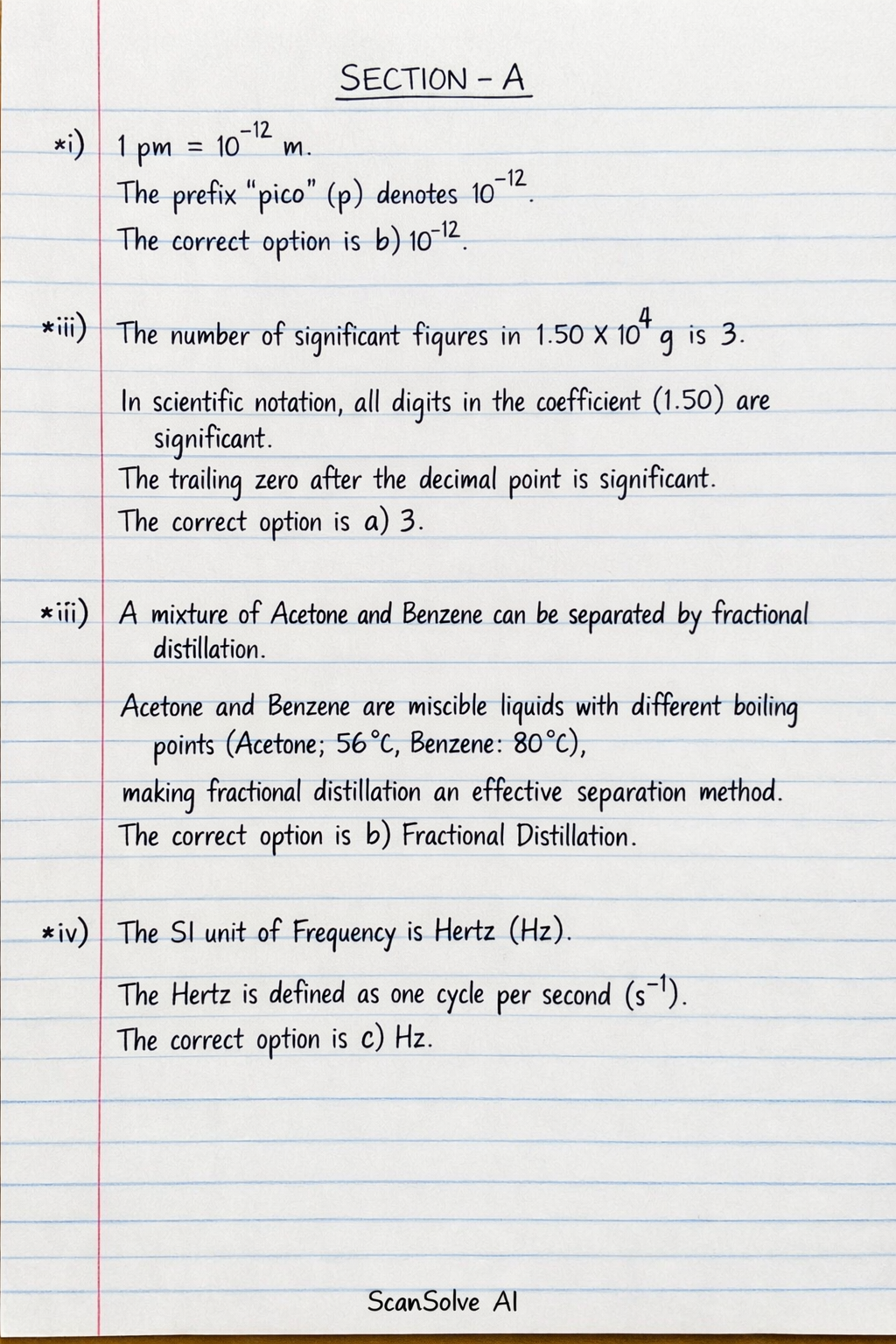
SECTION - A
i) 1 pm = m.
The prefix "pico" (p) denotes .
The correct option is b) .
ii) The number of significant figures in g is 3.
In scientific notation, all digits in the coefficient (1.50) are significant. The trailing zero after the decimal point is significant.
The correct option is a) 3.
iii) A mixture of Acetone and Benzene can be separated by fractional distillation.
Acetone and Benzene are miscible liquids with different boiling points (Acetone: 56 °C, Benzene: 80 °C), making fractional distillation an effective separation method.
The correct option is b) Fractional Distillation.
iv) The SI unit of Frequency is Hertz (Hz).
The Hertz is defined as one cycle per second ().
The correct option is c) Hz.
v) The type of hybridization in is .
Boron in forms three single bonds with fluorine atoms and has no lone pairs. This results in a trigonal planar geometry and hybridization.
Based on the provided options, assuming 'a)' is intended to be despite the blurriness, the correct option is a) . (Note: If option 'a)' is strictly , then is not listed, and the question options are flawed.)
vi) The oxidation number of S in is +6.
Let the oxidation number of S be . The oxidation number of oxygen is typically -2. The overall charge of the ion is -2.
The correct option is c) +6.
vii) Which of the following pairs is not isoelectronic?
Isoelectronic species have the same number of electrons.
- a) (10 electrons) & (11 electrons) - Not isoelectronic.
- b) (10 electrons) & (10 electrons) - Isoelectronic.
- c) (10 electrons) & (2 electrons) - Not isoelectronic.
- d) (18 electrons) & (10 electrons) - Not isoelectronic. Since the question asks for a pair that is not isoelectronic, and options a, c, and d all fit this description, the question is ambiguous. However, if only one answer must be chosen, we select the first instance. The correct option is a) & .
viii) The composition of syngas is primarily carbon monoxide (CO) and hydrogen ().
Syngas, or synthesis gas, is a fuel gas mixture consisting primarily of hydrogen, carbon monoxide, and often some carbon dioxide.
The correct option is a) .
ix) Borax has formula .
Borax is commonly known as sodium tetraborate decahydrate (), but its anhydrous form is . Options b) and d) are identical.
The correct option is **b) $Na_2B_4O_
Try one yourself
A new problem that tests the same skill.
Still stuck on this one?
Ask a follow-up, and the answer starts from this question.
More Chemistry Questions
Handwritten Step-by-Step Solution
Get this as a handwritten image on WhatsApp — like a tutor wrote it for you.
Try on WhatsApp