
We read your photo as:
The following are solutions to chemistry questions. Identify the questions themselves.
Chemistry
ScanSolve AI Answer
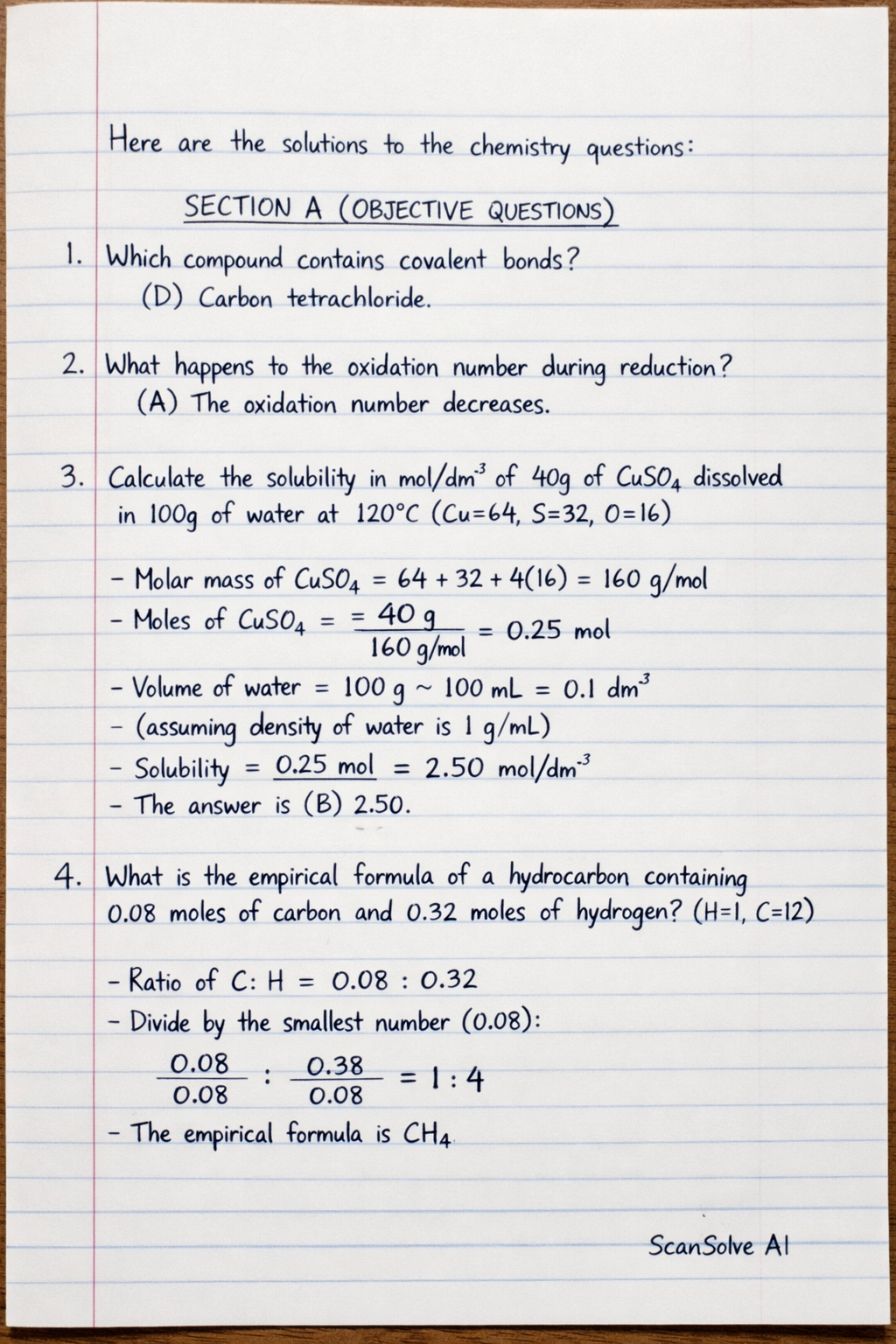
Here are the solutions to the chemistry questions:
SECTION A (OBJECTIVE QUESTIONS)
- Which compound contains covalent bonds? (D) Carbon tetrachloride
- What happens to the oxidation number during reduction? (A) The oxidation number decreases.
- Calculate the solubility in mol dm⁻³ of 40g of CuSO₄ dissolved in 100g of water at 120°C (Cu=64, S=32, O=16).
- Molar mass of CuSO₄ =
- Moles of CuSO₄ =
- Volume of water = (assuming density of water is )
- Solubility =
- The answer is (B) 2.50.
- What is the empirical formula of a hydrocarbon containing 0.08 moles of carbon and 0.32 moles of hydrogen? (H=1, C=12, O=16)
- Ratio of C:H =
- Divide by the smallest number (0.08):
- The empirical formula is CH₄.
- The answer is (D) CH₄.
- The IUPAC system uses (D) Rule approach in naming compounds.
- What is the oxidation number of Manganese in KMnO₄?
- K is +1, O is -2. Let Mn be .
- The answer is (D) +7.
- Boyle's law describes the relationship between (A) Pressure and volume of a gas.
- Charles' law describes the relationship between (C) Temperature and volume of a gas.
- The general gas equation combines which of the following laws? (B) Boyles, Charles and Avogadro's law.
- The ideal gas equation is given by: (B) PV=nRT.
- Graham's law of diffusion of a gas is inversely proportional to it's: (A) Square root of its molar mass.
- Gay-Lussac's law relate the pressure and temperature of a gas at constant (C) Volume.
- Avogadro's number represents the number of: (C) Atoms in one mole of a substance.
- When solving a mass to mass stoichiometry problem, the molar mass of the: (D) Resistance and product are used to convert between grams and moles. (Assuming "Resistance" is a typo for "Reactant").
- The equation tell us that: (D) Two molecules of hydrogen react with one molecule of oxygen to form two molecules of water.
SECTION B (THEORY)
1a. Define the following terms: * (i) Empirical formula: The simplest whole-number ratio of atoms of each element in a compound. * (ii) Molecular formula: The actual number of atoms of each element present in a molecule of a compound.
**1b. A compound contains 31.91% potassium, 28.93
Was this helpful?
Still stuck on this one?
Ask a follow-up, and the answer starts from this question.
Got a different question?Ask your own question
More Chemistry Questions
QWhat are the answers to these chemistry questions?QWhat are the answers to the following multiple choice and fill-in-the-blank chemistry questions?QCombine the following into a single homework question, asking for identification of correct answers…QSolve this chemistry questionsQHere are the solutions to the biology questions:
Handwritten Step-by-Step Solution
Get this as a handwritten image on WhatsApp — like a tutor wrote it for you.
Try on WhatsApp