
We read your photo as:
Identify the properties, uses, and methods of separation and identification of common gases based on their reactions and physical properties.
Chemistry
ScanSolve AI Answer
Step-by-step solution
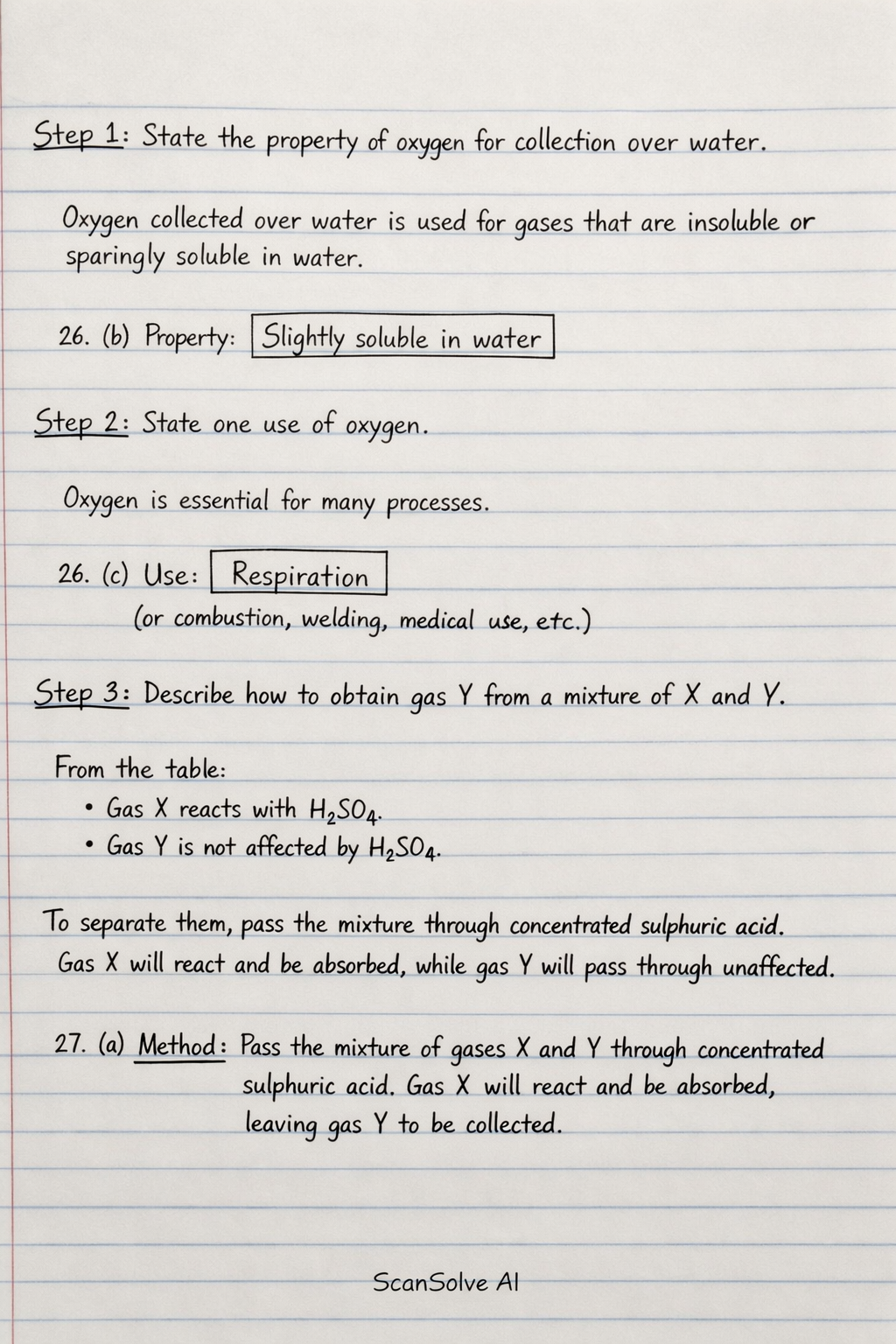
4 stepsState the property of oxygen for collection over water.
The previous setup (Question 26) showed oxygen collected over water. This method is used for gases that are insoluble or sparingly soluble in water.
26. (b) Property:State one use of oxygen.
Oxygen is essential for many processes.
26. (c) Use: (or combustion, welding, medical use, etc.)Describe how to obtain gas Y from a mixture of X and Y.
From the table:
- Gas X reacts with .
- Gas Y is not affected by . To separate them, pass the mixture through concentrated sulphuric acid. Gas X will react and be absorbed, while gas Y will pass through unaffected. 27. (a) Method: Pass the mixture of gases X and Y through concentrated sulphuric acid. Gas X will react and be absorbed, leaving gas Y to be collected.
Suggest an identity for gas X and provide a reason.
From the table:
- Gas X is lighter than air.
- Gas X reacts with to form a salt (meaning it's a basic gas).
- Gas X dissolves without reacting in . Ammonia () fits these properties. It is lighter than air (molar mass 17 g/mol), is a basic gas that reacts with acids to form salts, and dissolves in aqueous solutions like NaOH without reacting with the base itself. 27. (b) Identity and Reason: . It is lighter than air and reacts with acids to form salts.
Just one more to go today!
Was this helpful?
Still stuck on this one?
Ask a follow-up, and the answer starts from this question.
Got a different question?Ask your own question
More Chemistry Questions
QIdentify which items on a list are gases and which are liquids, based on their properties.QComplete the table for different gases, their reagents, drying agents, and methods of gas…QIdentify the gas prepared and explain its preparation with a balanced chemical equation…QAnalyze the provided experimental setups and flowcharts to identify substances, describe collection…QIdentify the gaseous species in the reaction.
Handwritten Step-by-Step Solution
Get this as a handwritten image on WhatsApp — like a tutor wrote it for you.
Try on WhatsApp