
We read your photo as:
Identify the gaseous species in the reaction.
ScanSolve AI Answer
Step-by-step solution
5 stepsIdentify the gaseous species in the reaction.
The given reaction is:
When considering the effect of pressure on equilibrium, we only look at the gaseous reactants and products. Solids () and aqueous solutions () are not significantly affected by changes in pressure.
Count the total moles of gas on each side of the reaction.
- Reactant side: We have , which means there are 2 moles of gas.
- Product side: We have , which means there is 1 mole of gas.
Apply Le Chatelier's Principle.
Le Chatelier's Principle states that if a change of condition is applied to a system in equilibrium, the system will shift in a direction that relieves the stress.
- A decrease in pressure favors the side of the reaction with a greater number of moles of gas.
- An increase in pressure favors the side of the reaction with a fewer number of moles of gas.
Determine the direction of the shift.
On the reactant side, there are 2 moles of gas.
On the product side, there is 1 mole of gas.
Since the reactant side has more moles of gas (2 moles > 1 mole), a decrease in pressure will cause the equilibrium to shift towards the reactant side. This means the backward reaction will be favored.Evaluate the given options.
- A. rate of forward reaction will increase: Incorrect. The equilibrium shifts to the left, favoring the backward reaction.
- B. rates of forward and backward reaction are not affected: Incorrect. Pressure changes affect equilibria involving gases.
- C. rate of backward reaction will increase: Correct. When the equilibrium shifts to the left, the rate of the backward reaction increases relative to the forward reaction to re-establish equilibrium.
- D. the equilibrium will shift: While true, option C provides a more specific and accurate description of how the equilibrium shifts in terms of reaction rates.
The final answer is
Still stuck on this one?
Ask a follow-up, and the answer starts from this question.
More Chemistry Questions
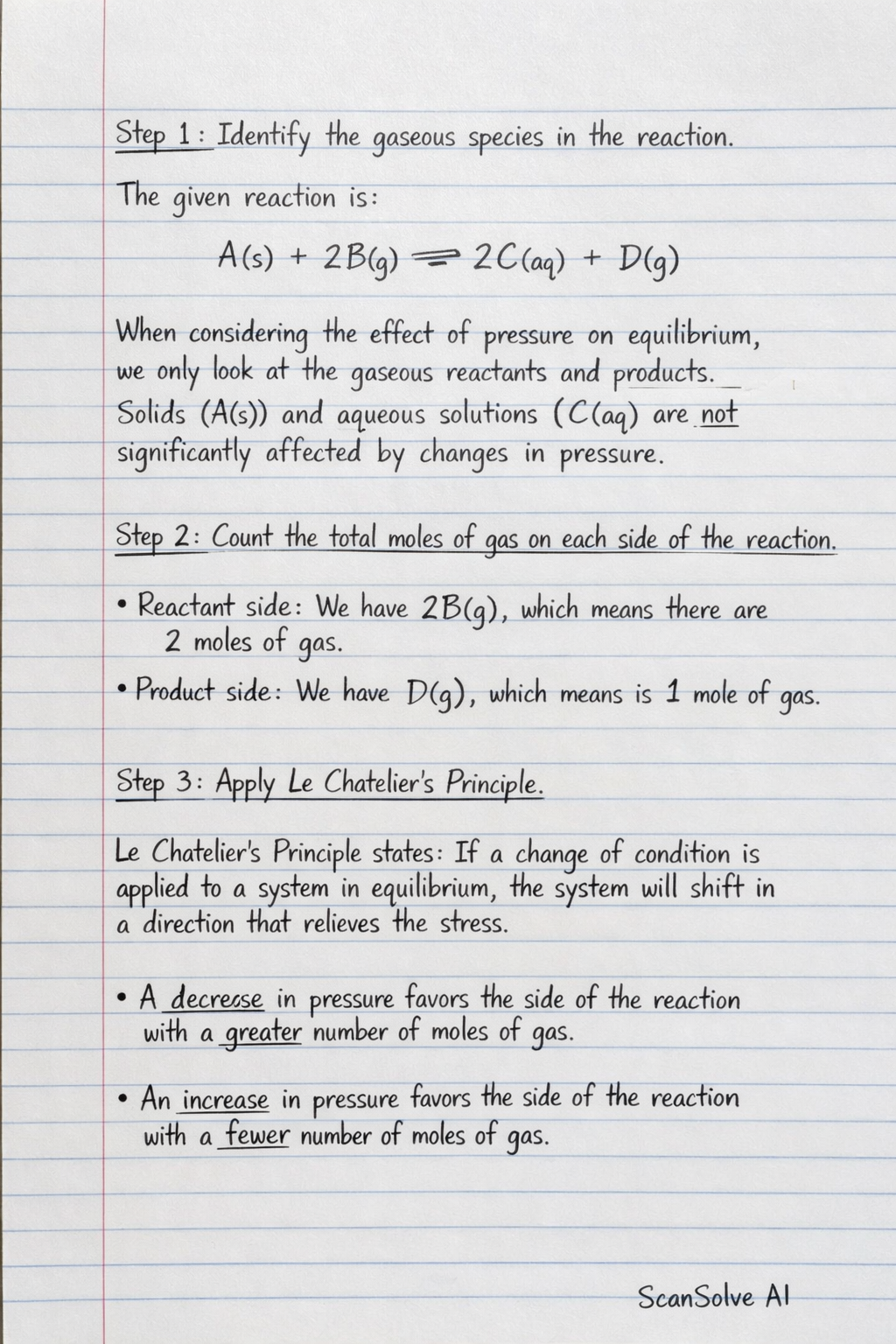
Handwritten Step-by-Step Solution
Get this as a handwritten image on WhatsApp — like a tutor wrote it for you.
Try on WhatsApp