
We read your photo as:
Identify the forces involved and the conditions for equilibrium.
ScanSolve AI Answer
Answer
Step-by-step solution
5 stepsIdentify the forces involved and the conditions for equilibrium.
To keep the box from falling, the upward static friction force () must balance the downward gravitational force ().
The horizontal force () applied to the box creates a normal force () from the wall. Since the box is not moving horizontally, these forces are equal in magnitude.
The maximum static friction force is given by the formula:
For the box to not fall, the static friction force must be at least equal to the gravitational force. The minimum applied force corresponds to the situation where the static friction is at its maximum value.
Substitute the relationships into the static friction formula.
We know and . Substitute these into the maximum static friction formula:
Solve for the minimum force .
Rearrange the equation to solve for :
Plug in the given values.
Given and :
Select the correct option.
The calculated minimum force is , which corresponds to option (c).
The final answer is .
Try one yourself
A new problem that tests the same skill.
Still stuck on this one?
Ask a follow-up, and the answer starts from this question.
More Chemistry Questions
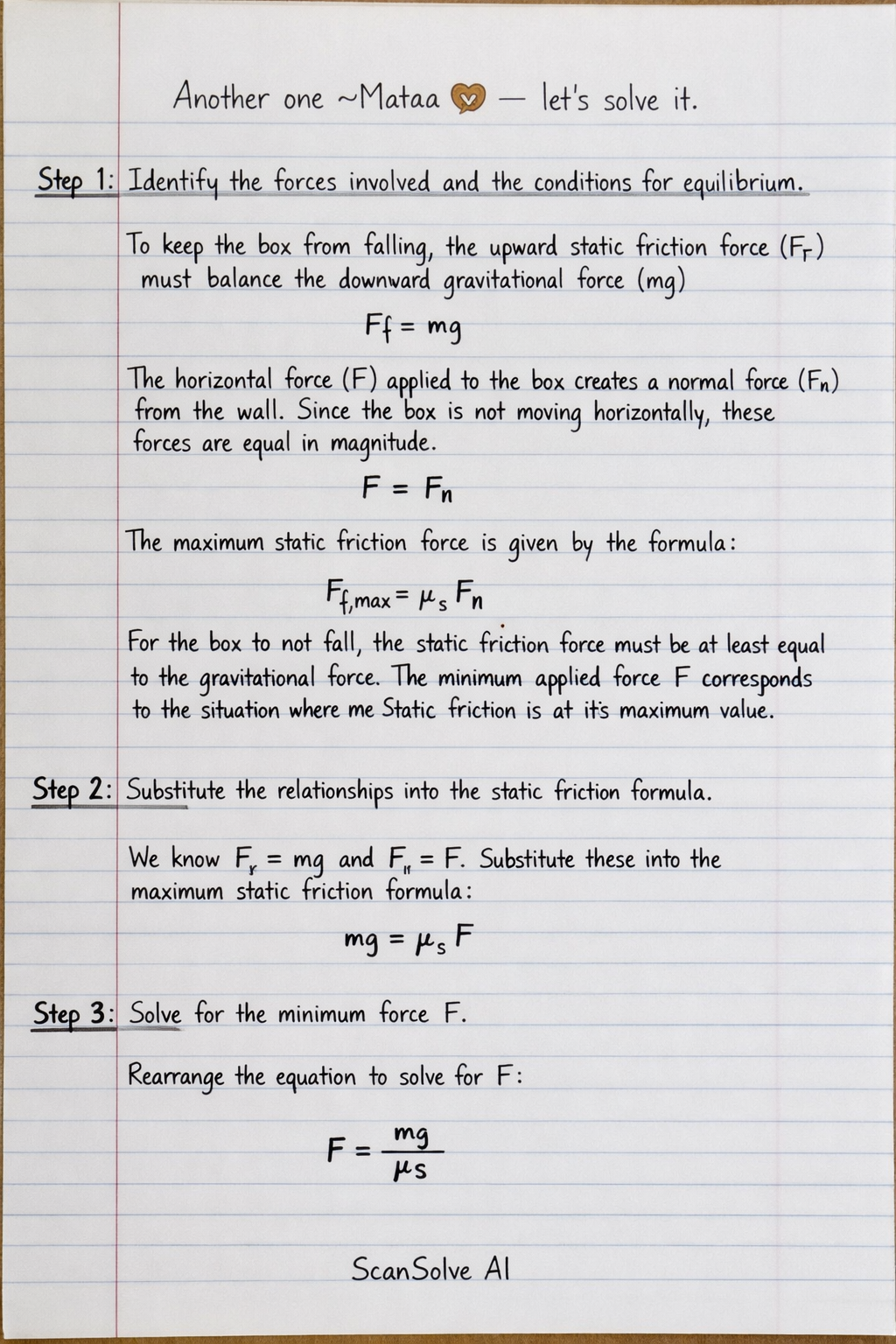
Handwritten Step-by-Step Solution
Get this as a handwritten image on WhatsApp — like a tutor wrote it for you.
Try on WhatsApp