
We read your photo as:
Suggest the reagent for the following conversion of cyclohexanol to cyclohexanecarboxylic acid.
ScanSolve AI Answer
Step-by-step solution
3 stepsThe conversion shown is the oxidation of a primary alcohol (cyclohexylmethanol) to a carboxylic acid (cyclohexanecarboxylic acid). This requires a strong oxidizing agent.
Identify the functional groups.
The reactant is a primary alcohol: .
The product is a carboxylic acid: .Determine the type of reaction.
The transformation from a primary alcohol to a carboxylic acid involves the oxidation of the carbon atom bonded to the hydroxyl group.
Select an appropriate strong oxidizing agent.
Strong oxidizing agents are required to convert primary alcohols directly to carboxylic acids. Common reagents include:
- Potassium permanganate () in acidic or basic conditions, followed by acidification.
- Chromium trioxide () in sulfuric acid (Jones reagent).
- Sodium dichromate () or potassium dichromate () in sulfuric acid.
One suitable reagent is potassium permanganate.
The reagent for the following conversion is .
Still stuck on this one?
Ask a follow-up, and the answer starts from this question.
More Chemistry Questions
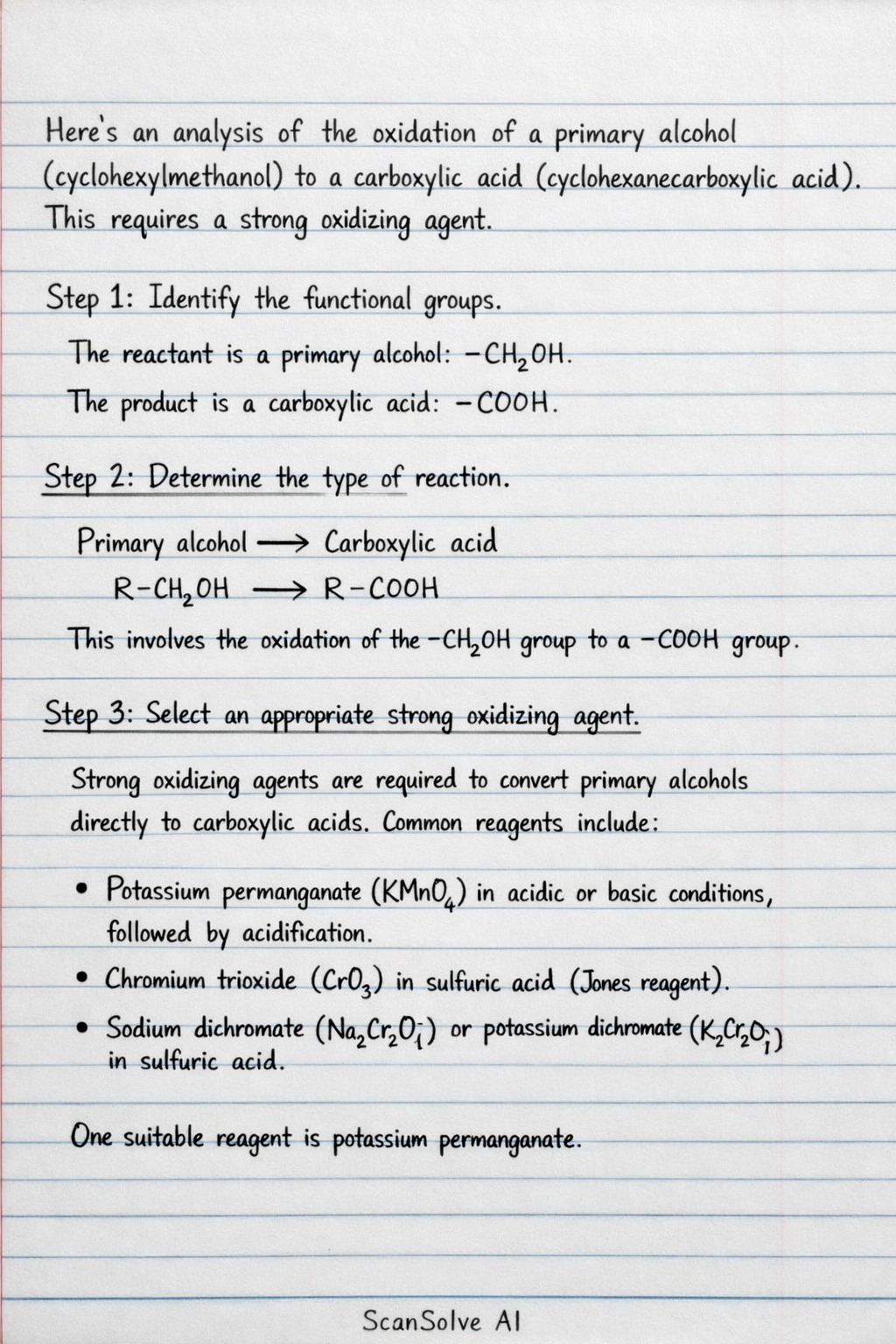
Handwritten Step-by-Step Solution
Get this as a handwritten image on WhatsApp — like a tutor wrote it for you.
Try on WhatsApp