
We read your photo as:
This reaction involves the conversion of bicyclo[3.2.1]octan-2-one (an 8-carbon ketone) to bicyclo[3.1.1]heptan-2-one (a 7-carbon ketone). This transformation is a ring contraction accompanied by th
Chemistry
ScanSolve AI Answer
This reaction involves the conversion of bicyclo[3.2.1]octan-2-one (an 8-carbon ketone) to bicyclo[3.1.1]heptan-2-one (a 7-carbon ketone). This transformation is a ring contraction accompanied by the loss of one carbon atom. This type of reaction sequence is characteristic of a Favorskii rearrangement followed by decarboxylation.
The general steps are:
- -Halogenation: Introduce a halogen (e.g., bromine) at an -carbon of the ketone.
- Favorskii Rearrangement: React the -halo ketone with a base (e.g., or $\text{
Was this helpful?
Still stuck on this one?
Ask a follow-up, and the answer starts from this question.
Got a different question?Ask your own question
More Chemistry Questions
QDescribe the mechanism of ring contraction of bicyclo[3.2.1]octan-2-one to…Q1.1. Compound B is 1-bromobutane. Reaction 1 converts Compound A to 1-bromobutane using Br2. Given…QSketch the percentage tautomeric form of Ketoacetic ester and how would you use it to synthesize…QExplain the reactions shown in the image, which illustrates transformations of organic compounds…QName the following molecule using IUPAC nomenclature: A cyclopentane ring with a bromine atom and an…
Browse by topic:Organic Chemistry
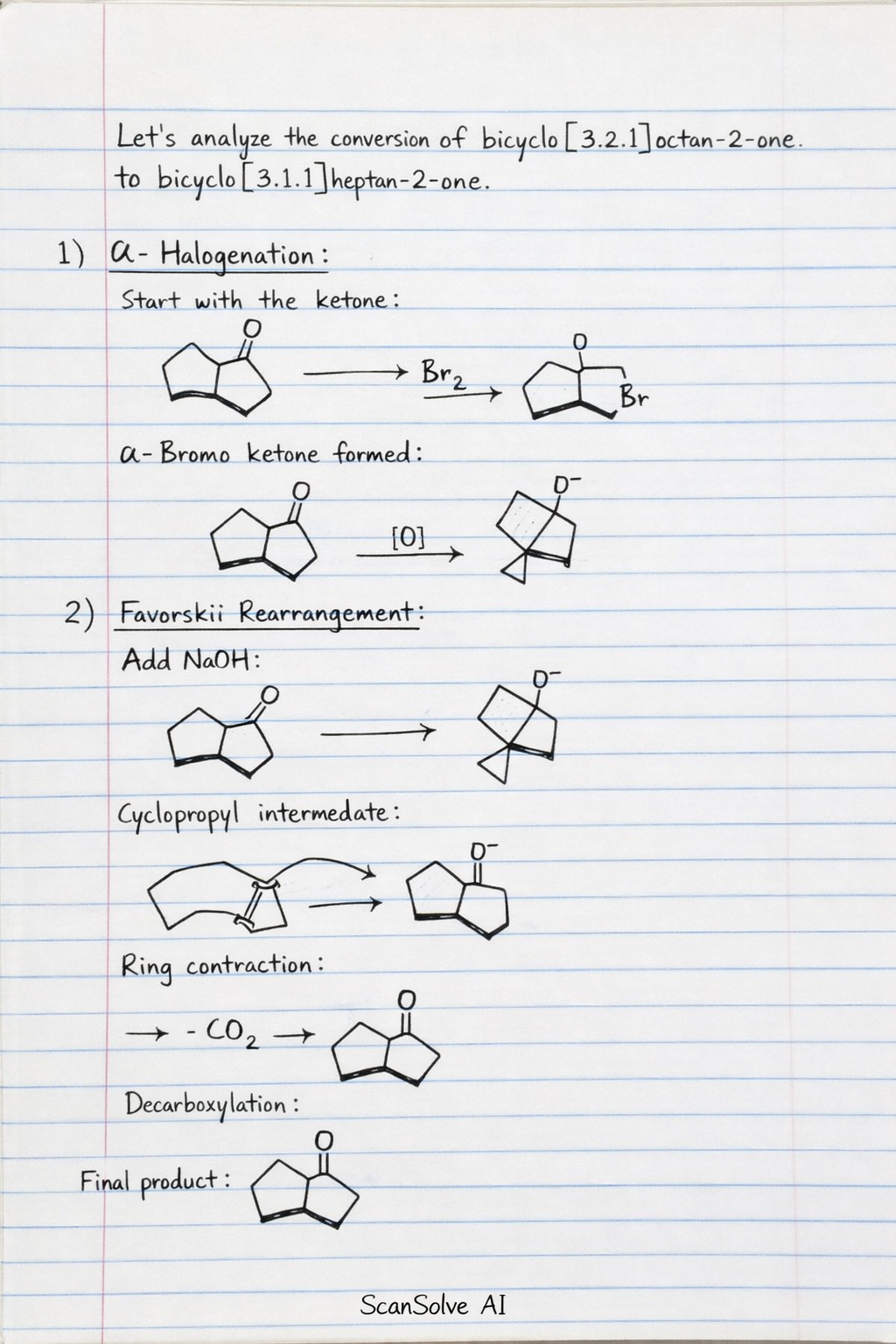
Handwritten Step-by-Step Solution
Get this as a handwritten image on WhatsApp — like a tutor wrote it for you.
Try on WhatsApp