
We read your photo as:
Sketch the percentage tautomeric form of Ketoacetic ester and how would you use it to synthesize 2-butanone.
ScanSolve AI Answer
here are the solutions for questions 3, 4, and 5:
Question 3:
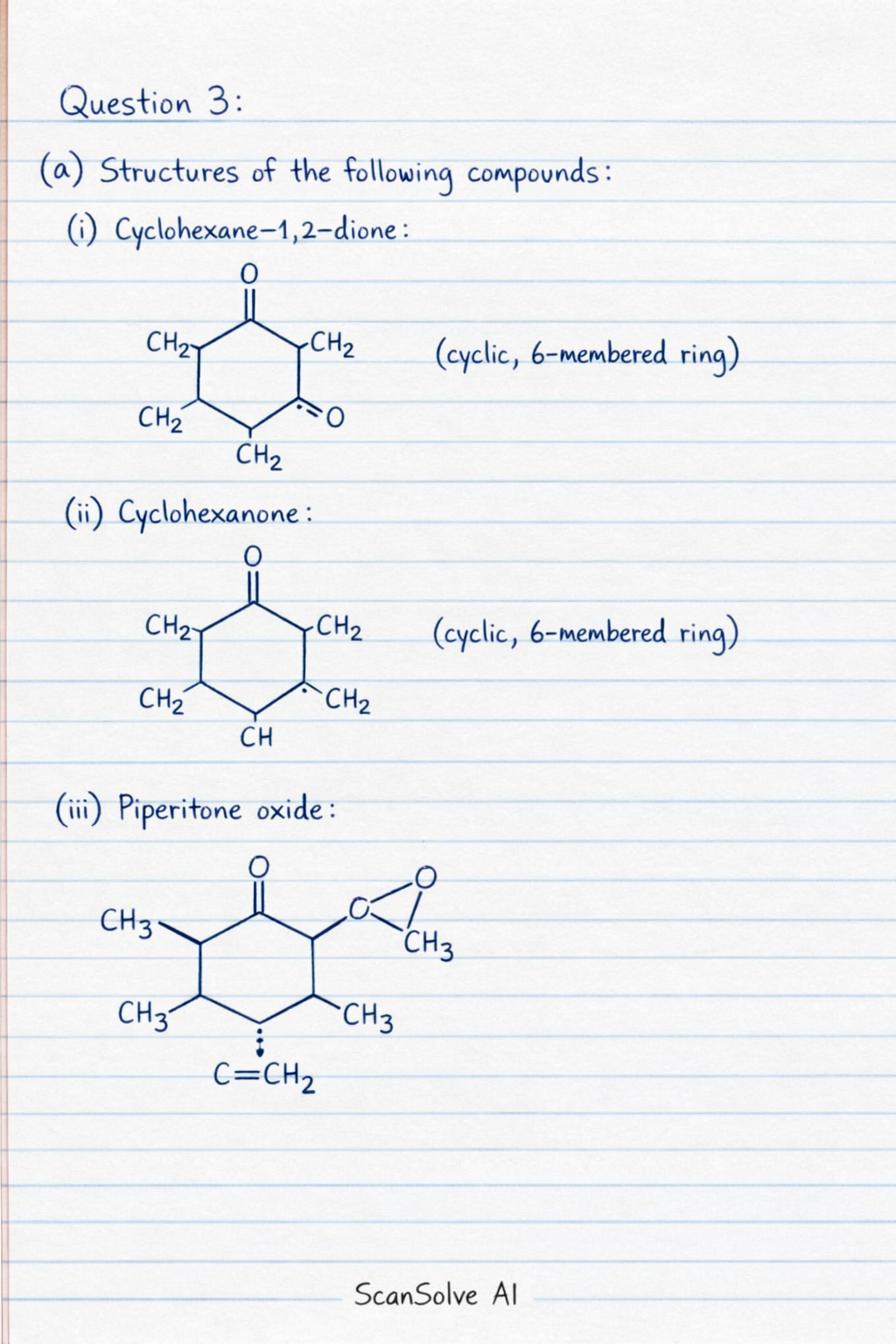
a) Structures of the following compounds:
(i) Cyclohexane-1,2-dione:
(ii) Cyclohexanone:
(iii) Piperitone oxide:
(iv) Diphenol (assuming 1,2-benzenediol, catechol):
(v) 3,3-dimethylcyclohexane-1,2-dione:
b) Two methods of preparing diols:
- Hydroxylation of alkenes: Alkenes can be converted to vicinal diols (1,2-diols) using reagents like cold, dilute, alkaline potassium permanganate () or osmium tetroxide () followed by reduction. Equation (using ):
- Hydrolysis of epoxides: Epoxides (oxiranes) can be hydrolyzed under acidic or basic conditions to yield vicinal diols. Equation (acid-catalyzed hydrolysis):
c) Structures of the following compounds:
(i) Propane-1,3-dial (malonaldehyde):
(ii) 1,3-Diphenyl-1,3-dione (assuming 1,3-diphenylpropane-1,3-dione, dibenzoylmethane):
(iii) Pentane-2,4-dione (acetylacetone):
(iv) Heptane-2,5-dione:
(v) 2,5-Hexanedione (assuming "2,5-phenyl dione" is a typo for 2,5-hexanedione, a common -diketone):
Question 4:
a) Structures of glycol dinitrate and glyceryl trinitrate:
- Glycol dinitrate (ethylene glycol dinitrate):
- Glyceryl trinitrate (nitroglycerin):
Three properties of these compounds:
- They are explosive due to the presence of multiple nitrate groups.
- They are highly unstable and sensitive to shock and heat.
- They are powerful vasodilators and are used in medicine (e.g., nitroglycerin for angina).
b) Three properties of polyols:
- They have high boiling points due to extensive intermolecular hydrogen bonding.
- They are typically viscous liquids at room temperature.
- They are highly soluble in water due to the presence of multiple hydroxyl groups.
c) Structure of the simplest triol and reason for elevated boiling point:
The simplest triol is glycerol (propane-1,2,3-triol).
Glycerol has an elevated boiling point (290 °C) because it contains three hydroxyl (-OH) groups. These hydroxyl groups allow for extensive intermolecular hydrogen bonding between glycerol molecules. Hydrogen bonds are strong intermolecular forces that require a significant amount of energy to overcome, leading to a higher boiling point compared to compounds of similar molecular weight but fewer hydroxyl groups.
Question 5:
a) Definition of protein:
A protein is a large, complex biomolecule composed of one or more long chains of amino acid residues. These chains are linked together by peptide bonds and fold into specific three-dimensional structures essential for their biological function.
b) Six examples of body materials where proteins are important constituents:
- Enzymes (e.g., amylase, pepsin)
- Hormones (e.g., insulin, growth hormone)
- Antibodies (immunoglobulins)
- Structural components (e.g., collagen in connective tissue, keratin in hair/nails)
- Transport proteins (e.g., hemoglobin for oxygen transport)
- Muscle fibers (e.g., actin and myosin for muscle contraction)
c) Six biological importance of protein to the human system:
- Catalysis: Enzymes, which are proteins, catalyze nearly all biochemical reactions in the body.
- Structural Support: Proteins like collagen and keratin provide structural integrity to tissues, organs, hair, and skin.
- Transport: Proteins such as hemoglobin transport oxygen, while others transport nutrients, ions, and waste products.
- Immunity: Antibodies (immunoglobulins) are proteins that identify and neutralize foreign invaders like bacteria and viruses.
- Movement: Actin and myosin are proteins responsible for muscle contraction and cellular movement.
- Regulation: Many hormones (e.g., insulin) are proteins that regulate various physiological processes, and receptor proteins mediate cell signaling.
Still stuck on this one?
Ask a follow-up, and the answer starts from this question.
More Chemistry Questions
Handwritten Step-by-Step Solution
Get this as a handwritten image on WhatsApp — like a tutor wrote it for you.
Try on WhatsApp