
We read your photo as:
Describe the mechanism of ring contraction of bicyclo[3.2.1]octan-2-one to bicyclo[3.1.1]heptan-2-one.
ScanSolve AI Answer
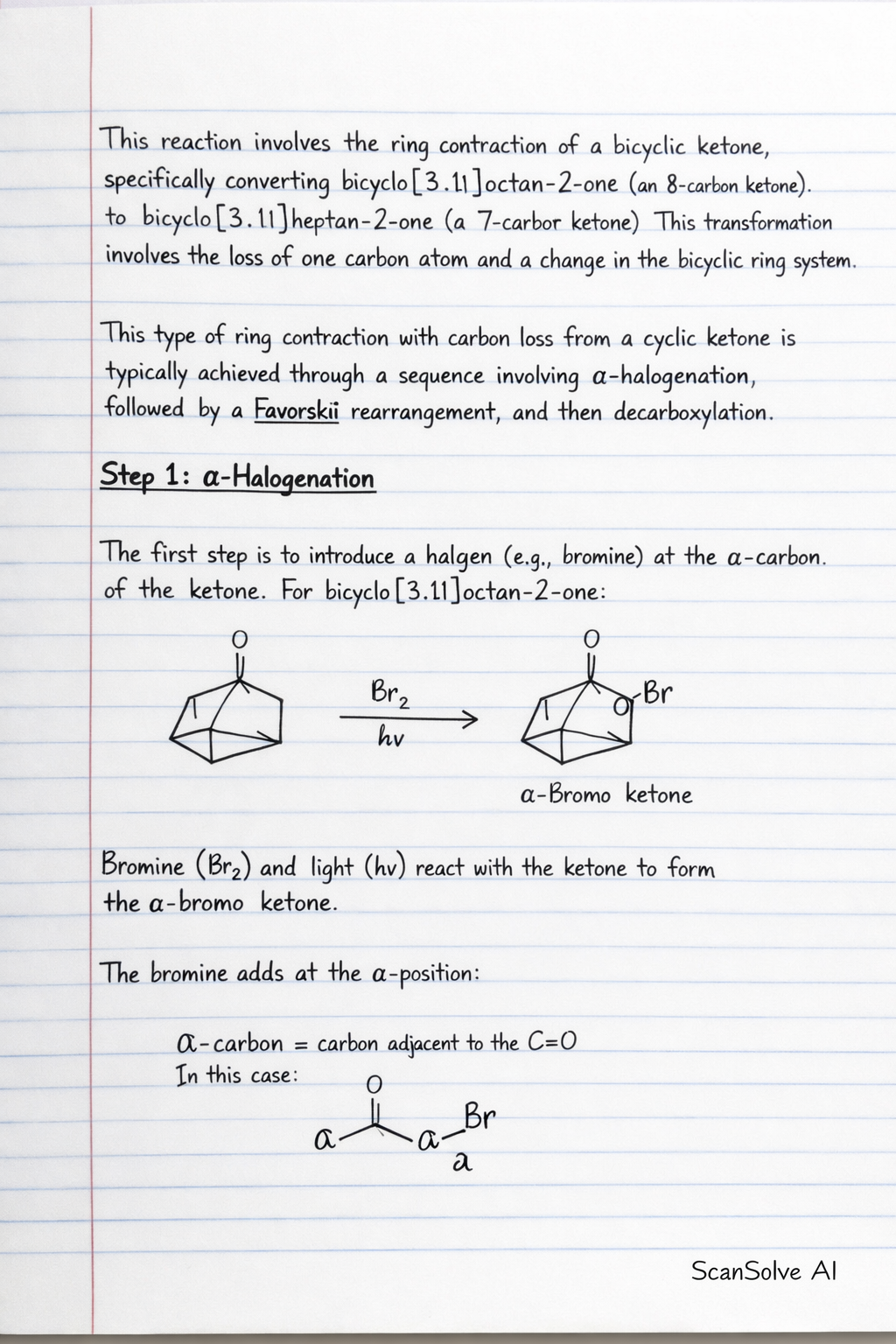
This reaction involves the ring contraction of a bicyclic ketone, specifically converting bicyclo[3.2.1]octan-2-one (an 8-carbon ketone) to bicyclo[3.1.1]heptan-2-one (a 7-carbon ketone). This transformation involves the loss of one carbon atom and a change in the bicyclic ring system.
This type of ring contraction with carbon loss from a cyclic ketone is typically achieved through a sequence involving -halogenation, followed by a Favorskii rearrangement, and then decarboxylation.
Step 1: -Halogenation
The first step is to introduce a halogen (e.g., bromine) at an -carbon of the ketone. For bicyclo[3.2
Still stuck on this one?
Ask a follow-up, and the answer starts from this question.
More Chemistry Questions
Handwritten Step-by-Step Solution
Get this as a handwritten image on WhatsApp — like a tutor wrote it for you.
Try on WhatsApp